
Five policy planks to prepare U.S. workers for dislocation caused by artificial intelligence
Reports NOV 23, 2026
By: Jacob Leibenluft, Gene Sperling
NOV 1, 2016
Read the full PDF in your browser (opens in a new tab)
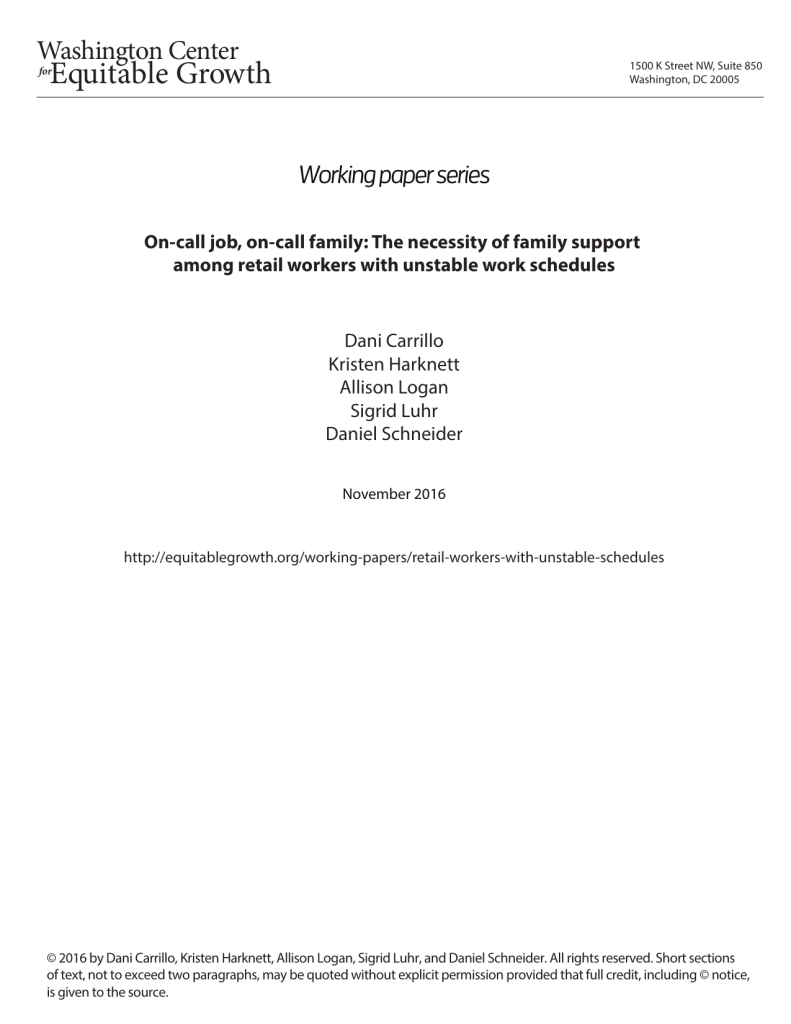
Drawing on 25 in-depth interviews with parents employed in the service sector in the San Francisco Bay area, we describe an array of challenges: insufficient work hours, volatile incomes, unpredictable schedules, and the lack of flexibility for time off. Meeting the demands of work and parenting almost invariably involved reliance on informal child care support. Working parents with stable schedules were often able to manage parenting responsibilities using a “tag-team” parenting approach. Those with unstable schedules often engaged in a “child-care scramble” in which the care arrangements were pieced together on an ad hoc basis. Some parents with unstable work schedules were able to avoid this instability by relying heavily on one “family anchor,” usually a grandparent, who could consistently provide child care. In sum, on-call family support is required to meet the demands of unstable work schedules, and instability in work schedules often reproduces a similar instability at home.
Reports NOV 23, 2026
By: Jacob Leibenluft, Gene Sperling
Essays NOV 20, 2026
By: Chris Clayton, Korin Davis
Essays OCT 30, 2026
By: Christopher Bangert-Drowns
Get updates on our latest research, event announcements, and policy insights delivered straight to your inbox. Stay connected with the leading voices on equitable growth.

