


Policy Resources
From in-depth analysis to evidence-backed policy insights, find resources that help explain how economic policy shapes outcomes for workers, families, and long-term growth.
Our Policy Areas of Focus
The Washington Center for Equitable Growth connects economic evidence and policy to promote shared prosperity and growth by translating evidence for policymakers, elevating scholars and their work, and funding policy-relevant research.

How Ideas Move Into Policy Decisions
AI, Tech & Energy
Equitable Growth advances research and policy analysis on how artificial intelligence, emerging technologies, and the energy transition affect workers, inequality, and broad-based economic growth.

We focus on:
- The effect of AI and the energy transition on employment levels, job quality, and regional labor markets
- The effect of AI and the energy transition on investment, productivity, inequality, and growth
- How supply chains and market structure affect the direction of the tech and energy industries
- The effect of technology on worker power, job quality, and the returns to work
Macroeconomics & Economic Measurement
Equitable Growth advances research and policy analysis on macroeconomic policies and better economic measurement that promote stable and broad-based economic growth.
We focus on:
- Measuring and reducing wealth inequality using novel data and analysis
- Tools to respond to recessions that limit scarring and quickly stabilize households and the macroeconomy
- Which trade-related policies, including tariffs or industrial policy, are most effective at supporting a stable and dynamic economy
Political Economy & Democracy
Equitable Growth supports research and policy analysis on how economic inequality shapes political power and democratic institutions, and how that in turn affects broad-based economic growth.

We focus on:
- Economic and cultural factors that contribute to rising support for authoritarian populism and policy solutions for a pro-growth, pro-democracy economy
- The role of social scientists in supporting the use of evidence in policymaking
Taxation
Equitable Growth advances research and policy analysis on how tax policies can generate revenue and promote policies for a fairer, more efficient tax code.

We focus on:
- Distributional analysis, including distributional weighting of benefit-cost analysis
- Pass-through and other business taxation
- Tax enforcement, especially related to trusts and large, complex partnerships
- Taxing wealth, including from new sources of wealth, such as artificial intelligence and cryptocurrency
Competition & Economic Dynamism
Equitable Growth advances research and policy analysis on how strong competition among U.S. businesses reduces inequality and creates broad-based economic growth.

We focus on:
- Monopsony and corporate consolidation
- The effectiveness of antitrust enforcement and regulatory policies
- The effect of market concentration on employment, wages, prices, and availability of services
- New approaches to antitrust that do not necessarily rely on prices
Household Economic Security
Equitable Growth advances research and policy analysis on how access to care, policies that balance work, life, and education create stable, broad-based economic growth.

We focus on:
- Care policy, including childcare, and paid leave
- Job quality, scheduling, and earnings stability
- Social insurance and public benefits, including unemployment insurance
- Income volatility, household economic security, and economic mobility
Economic Equity & Opportunity
Equitable Growth advances research and policy analysis on how trends in economic inequality and mobility and changes in the economy have affected the concentration of wealth, income, and earnings, and how these distributional shifts have affected the promise of economic security and opportunity.

We focus on:
- Gender and racial earnings gaps
- The distribution of income, wealth, and growth
- Intergenerational economic mobility
- Wealth-building and access to assets, including child savings accounts
Labor, Wages & Worker Power
Equitable Growth advances research and policy analysis on how inequalities in wages, bargaining power, and the evolving labor market affect workers’ economic security and opportunity as well as broad-based economic growth.

We focus on:
- Policies beyond the minimum wage to boost wages and non-wage amenities
- Policies that increase workers' bargaining power or inform labor strategies
- Policies to address occupational segregation and gender and racial income inequality
- Firm responses to policies intended to improve worker wages and well-being
- Policies that are most effective at supporting workers and/or regional labor markets to respond to transitions
How Ideas Move Into Policy Decisions

Translate evidence and engage decision makers
Diagnose policy challenges where evidence can make a difference
Train and equip academics to translate their research findings to inform policy solutions
Identify rigorous research evidence that provides actionable insights for policymakers

Equitable Growth
connects policy and research at every step

Progress depends on a continuous exchange between ideas and action.
Policy challenges shape the direction of research, and research shapes how policymakers understand those challenges and their solutions. When the two stay connected, evidence becomes more than insight. It becomes a tool for better decisions.

That connection is powered by people.
At the center of this work is a network of more than 400 researchers focusing on real policy questions—helping explain economic trends, evaluate solutions, and inform decision-making.
65 Results


Five policy planks to prepare U.S. workers for dislocation caused by artificial intelligence (opens in a new tab)
Reports NOV 23, 2026
The rise of artificial intelligence and the potential for new technology to spark widespread job dislocation reflects a unique challenge for policymakers because of how wide the range of scenarios…
By: Jacob Leibenluft (opens in a new tab), Gene Sperling (opens in a new tab)

An economic statistical agenda for the next presidential administration and U.S. Congress (opens in a new tab)
Reports NOV 17, 2026
This report argues that policymakers in the next presidential administration should adopt an economic statistical agenda to save an essential statistical system that is imperiled by decades of neglect and…
By: Austin Clemens (opens in a new tab)
The deeper argument at the heart of the federal budget debate (opens in a new tab)
Reports OCT 5, 2026
Interest rates on the national debt have recently crept up to levels that the U.S. government and the American people haven’t experienced in several decades. This is a potentially concerning…
By: Michael Linden (opens in a new tab)
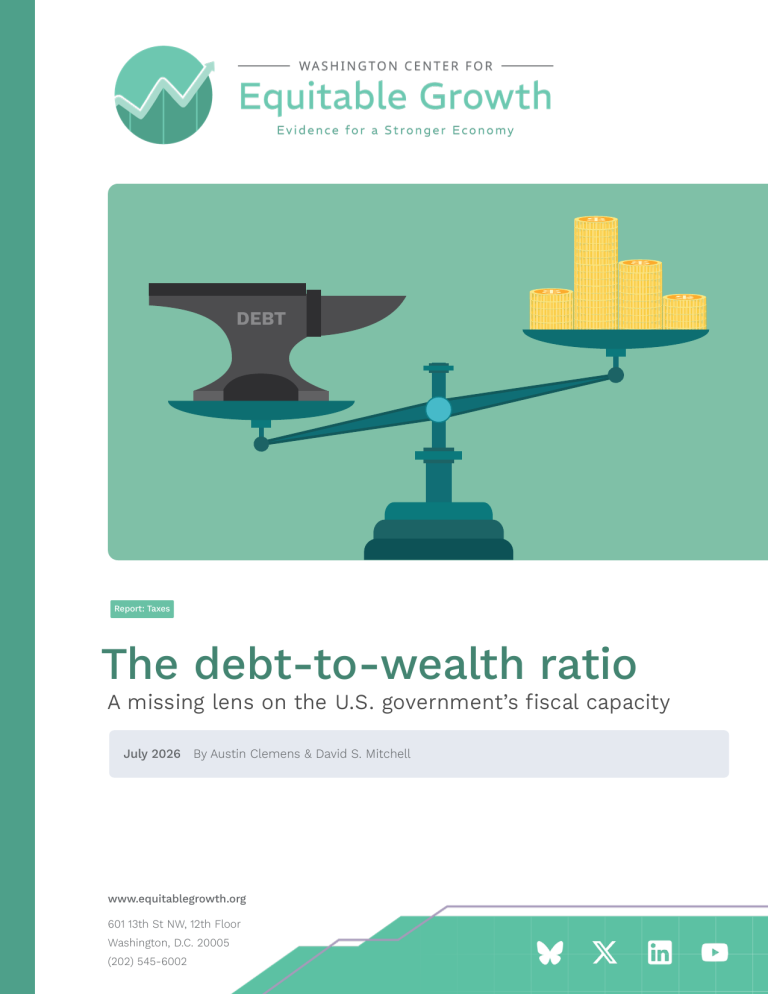
The debt-to-wealth ratio: A missing lens on the U.S. government’s fiscal capacity (opens in a new tab)
Reports JUL 30, 2026
Few statistics shape the fiscal debate in the United States as powerfully as the ratio of federal debt-to-Gross Domestic Product. Debt held by the public recently surpassed 100 percent of…
By: Austin Clemens (opens in a new tab), David S. Mitchell (opens in a new tab)
Defining top wealth and income thresholds for U.S. tax policy design and analysis (opens in a new tab)
Reports MAY 27, 2026
Wealth and income inequality are an ongoing area of interest for policymakers. In particular, the rise of the richest of the rich—not just the top 1 percent, but also the…
By: Austin Clemens (opens in a new tab)
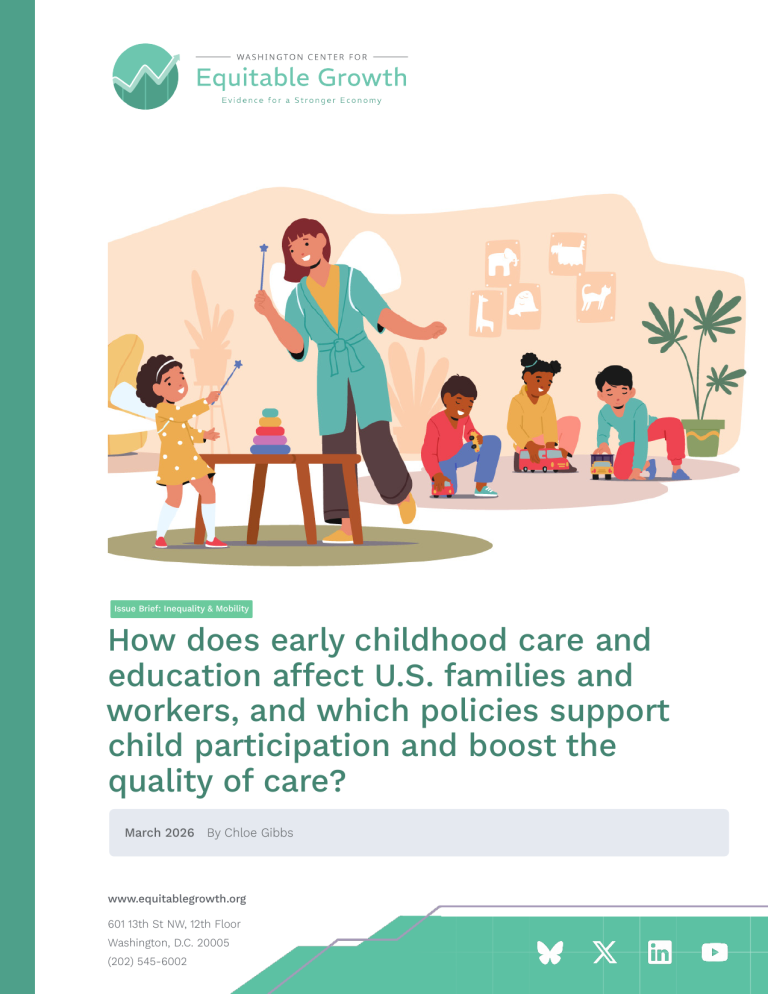
How does early childhood care and education affect U.S. families and workers, and which policies support child participation and boost the quality of care? (opens in a new tab)
Reports APR 16, 2026
As states consider policy action in early childhood care and education, there is an existing—and growing—evidence base from which to draw lessons. This report summarizes the rigorous evidence on program…
By: Chloe Gibbs (opens in a new tab)
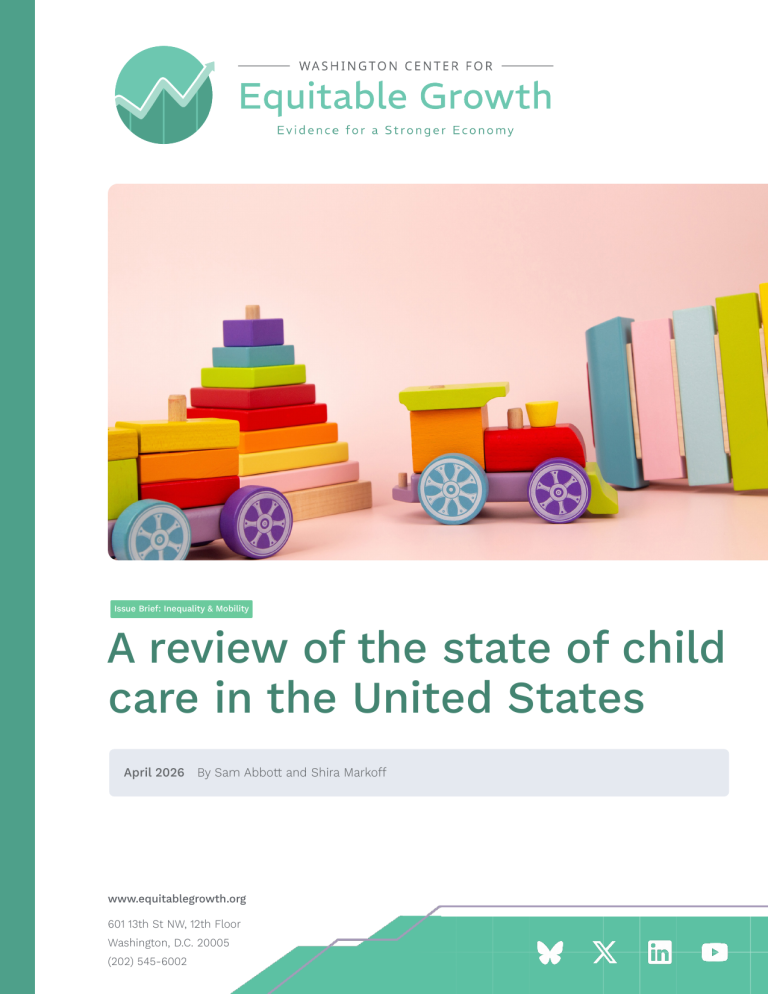
A review of the state of child care in the United States (opens in a new tab)
Reports APR 9, 2026
Affordable, available, high-quality child care is essential for sustained, broadly shared economic growth and equitable access to workforce opportunities. In most of the United States, however, child care fails this…
By: Sam Abbott (opens in a new tab), Shira Markoff (opens in a new tab)
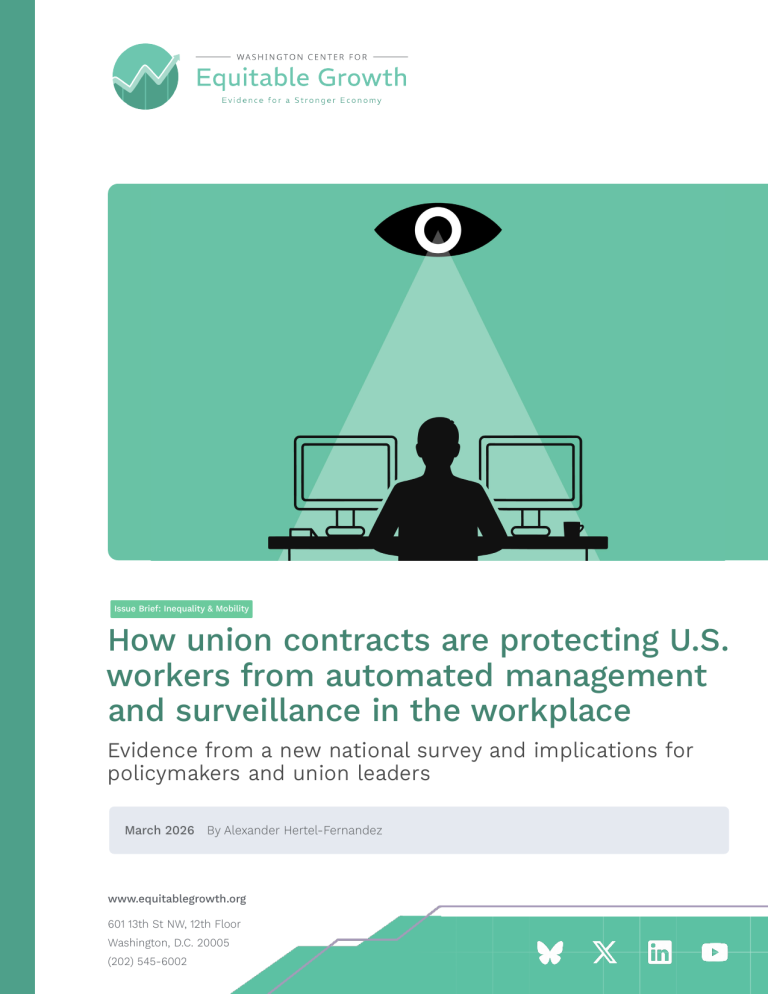
How union contracts are protecting U.S. workers from automated management and surveillance in the workplace (opens in a new tab)
Reports MAR 12, 2026
Employers are increasingly using electronic and automated tools to collect data on their workers on and off the job and then using that data to inform decisions about workers’ pay,…
By: Alexander Hertel-Fernandez (opens in a new tab)
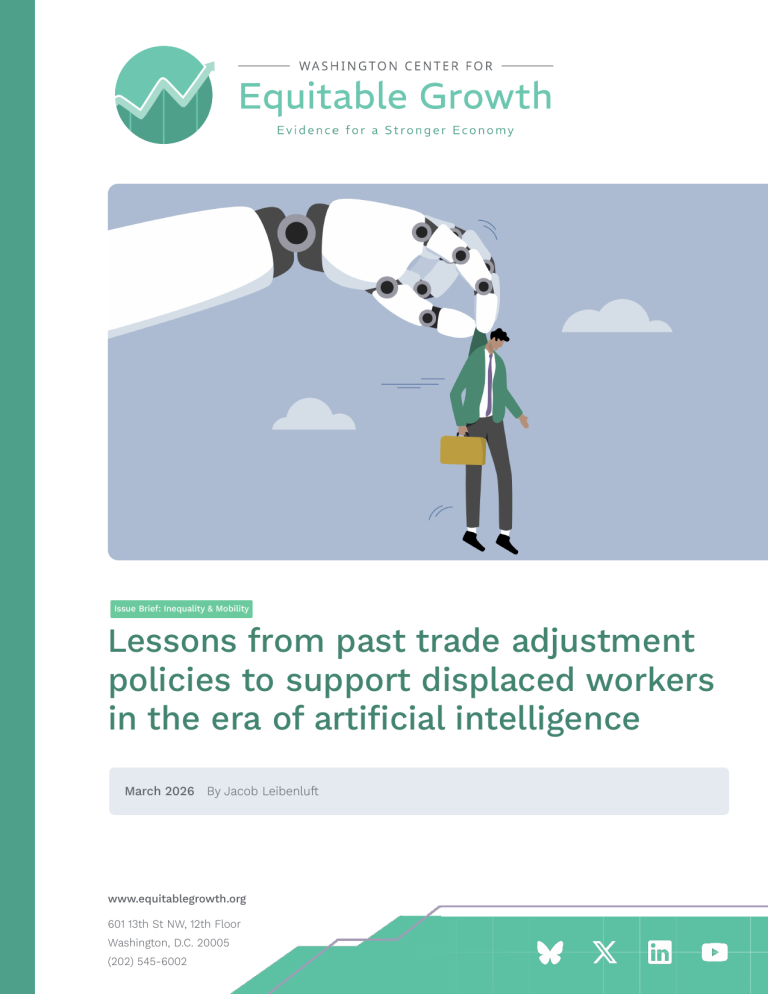
Lessons from past trade adjustment policies to support displaced workers in the era of artificial intelligence (opens in a new tab)
Reports MAR 11, 2026
More than 60 years ago, U.S. policymakers, economists, and labor leaders alike agreed that the potential for new economic forces to strengthen U.S. prosperity and security was just over the…
By: Jacob Leibenluft (opens in a new tab)
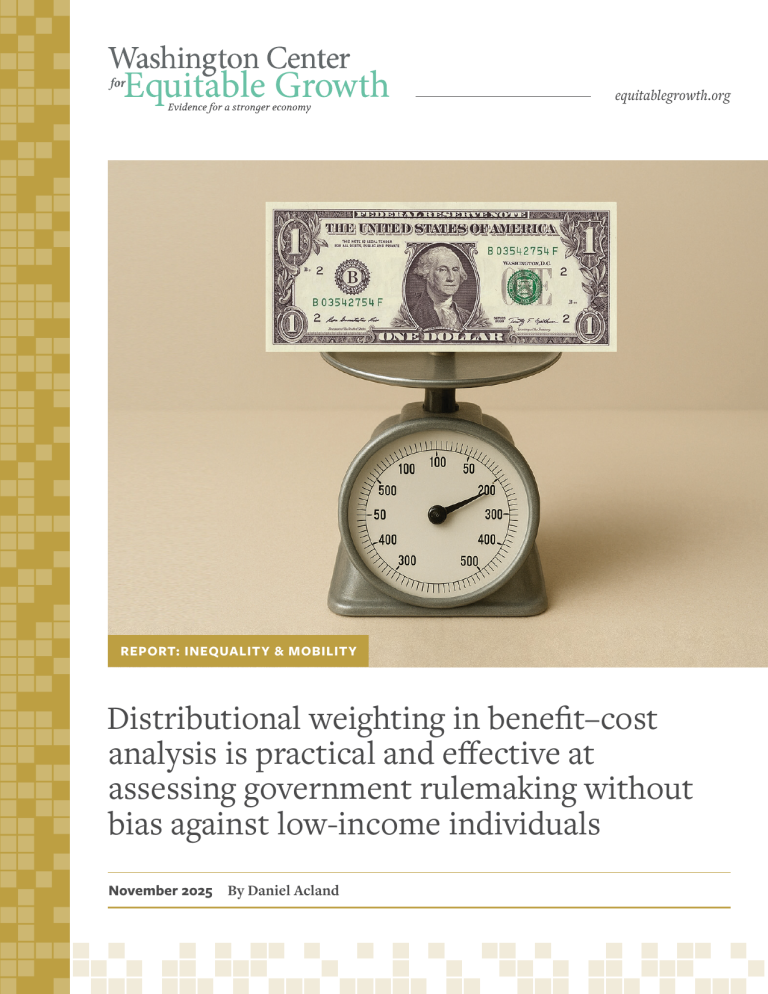
Distributional weighting in benefit-cost analysis is practical and effective at assessing government rulemaking without bias against low-income individuals (opens in a new tab)
Reports NOV 13, 2025
Distributional weighting in benefit-cost analysis is a tool for overcoming bias against lower-income individuals in economists’ measurements of the net benefit of government policies that affect populations at different levels…
By: Daniel Acland (opens in a new tab)
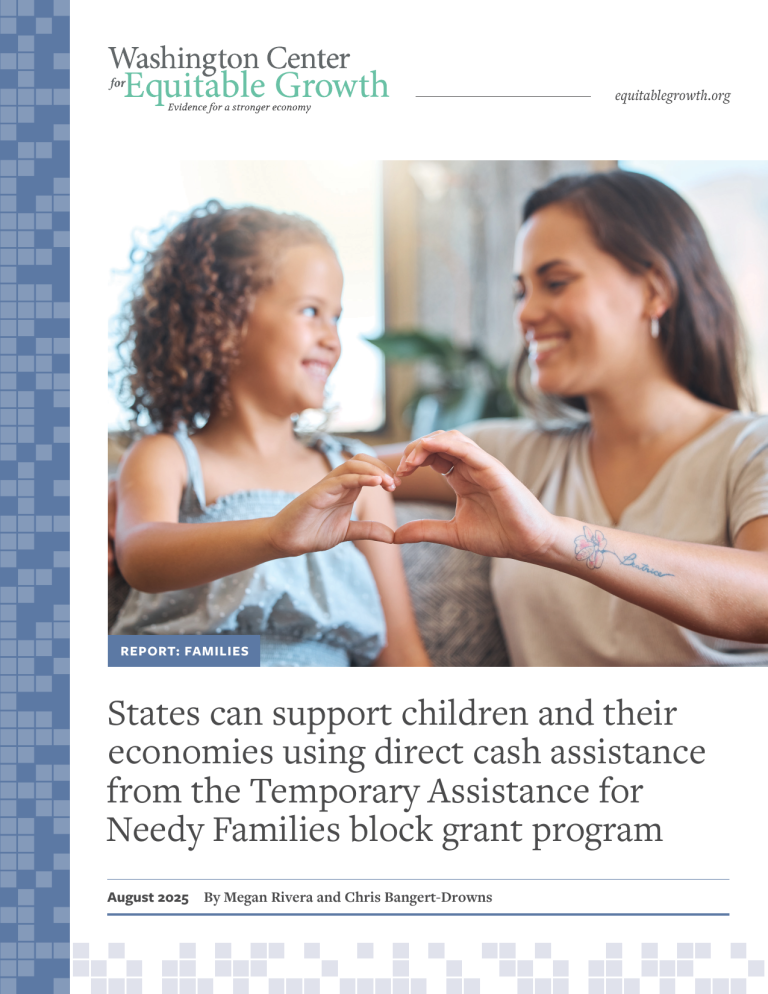
States can support children and their economies using direct cash assistance from the Temporary Assistance for Needy Families block grant program (opens in a new tab)
Reports AUG 28, 2025
Efficient, effective, and responsive income support programs can reduce economic inequality and support economic mobility. If targeted effectively, these programs can help children, families, and workers meet their needs and…
By: Megan Rivera (opens in a new tab), Christopher Bangert-Drowns (opens in a new tab)

What is austerity, and how does it affect the broader U.S. economy? (opens in a new tab)
Reports AUG 12, 2025
With the passage into law of the Republican budget reconciliation bill last month and the recent work of the Department of Government Efficiency under Elon Musk, austerity is once again…
By: Ernie Tedeschi (opens in a new tab), Kevin Rinz (opens in a new tab)