


Policy Resources
From in-depth analysis to evidence-backed policy insights, find resources that help explain how economic policy shapes outcomes for workers, families, and long-term growth.
Our Policy Areas of Focus
The Washington Center for Equitable Growth connects economic evidence and policy to promote shared prosperity and growth by translating evidence for policymakers, elevating scholars and their work, and funding policy-relevant research.

How Ideas Move Into Policy Decisions
AI, Tech & Energy
Equitable Growth advances research and policy analysis on how artificial intelligence, emerging technologies, and the energy transition affect workers, inequality, and broad-based economic growth.

We focus on:
- The effect of AI and the energy transition on employment levels, job quality, and regional labor markets
- The effect of AI and the energy transition on investment, productivity, inequality, and growth
- How supply chains and market structure affect the direction of the tech and energy industries
- The effect of technology on worker power, job quality, and the returns to work
Macroeconomics & Economic Measurement
Equitable Growth advances research and policy analysis on macroeconomic policies and better economic measurement that promote stable and broad-based economic growth.
We focus on:
- Measuring and reducing wealth inequality using novel data and analysis
- Tools to respond to recessions that limit scarring and quickly stabilize households and the macroeconomy
- Which trade-related policies, including tariffs or industrial policy, are most effective at supporting a stable and dynamic economy
Political Economy & Democracy
Equitable Growth supports research and policy analysis on how economic inequality shapes political power and democratic institutions, and how that in turn affects broad-based economic growth.

We focus on:
- Economic and cultural factors that contribute to rising support for authoritarian populism and policy solutions for a pro-growth, pro-democracy economy
- The role of social scientists in supporting the use of evidence in policymaking
Taxation
Equitable Growth advances research and policy analysis on how tax policies can generate revenue and promote policies for a fairer, more efficient tax code.

We focus on:
- Distributional analysis, including distributional weighting of benefit-cost analysis
- Pass-through and other business taxation
- Tax enforcement, especially related to trusts and large, complex partnerships
- Taxing wealth, including from new sources of wealth, such as artificial intelligence and cryptocurrency
Competition & Economic Dynamism
Equitable Growth advances research and policy analysis on how strong competition among U.S. businesses reduces inequality and creates broad-based economic growth.

We focus on:
- Monopsony and corporate consolidation
- The effectiveness of antitrust enforcement and regulatory policies
- The effect of market concentration on employment, wages, prices, and availability of services
- New approaches to antitrust that do not necessarily rely on prices
Household Economic Security
Equitable Growth advances research and policy analysis on how access to care, policies that balance work, life, and education create stable, broad-based economic growth.

We focus on:
- Care policy, including childcare, and paid leave
- Job quality, scheduling, and earnings stability
- Social insurance and public benefits, including unemployment insurance
- Income volatility, household economic security, and economic mobility
Economic Equity & Opportunity
Equitable Growth advances research and policy analysis on how trends in economic inequality and mobility and changes in the economy have affected the concentration of wealth, income, and earnings, and how these distributional shifts have affected the promise of economic security and opportunity.

We focus on:
- Gender and racial earnings gaps
- The distribution of income, wealth, and growth
- Intergenerational economic mobility
- Wealth-building and access to assets, including child savings accounts
Labor, Wages & Worker Power
Equitable Growth advances research and policy analysis on how inequalities in wages, bargaining power, and the evolving labor market affect workers’ economic security and opportunity as well as broad-based economic growth.

We focus on:
- Policies beyond the minimum wage to boost wages and non-wage amenities
- Policies that increase workers' bargaining power or inform labor strategies
- Policies to address occupational segregation and gender and racial income inequality
- Firm responses to policies intended to improve worker wages and well-being
- Policies that are most effective at supporting workers and/or regional labor markets to respond to transitions
How Ideas Move Into Policy Decisions

Translate evidence and engage decision makers
Diagnose policy challenges where evidence can make a difference
Train and equip academics to translate their research findings to inform policy solutions
Identify rigorous research evidence that provides actionable insights for policymakers

Equitable Growth
connects policy and research at every step

Progress depends on a continuous exchange between ideas and action.
Policy challenges shape the direction of research, and research shapes how policymakers understand those challenges and their solutions. When the two stay connected, evidence becomes more than insight. It becomes a tool for better decisions.

That connection is powered by people.
At the center of this work is a network of more than 400 researchers focusing on real policy questions—helping explain economic trends, evaluate solutions, and inform decision-making.
151 Results

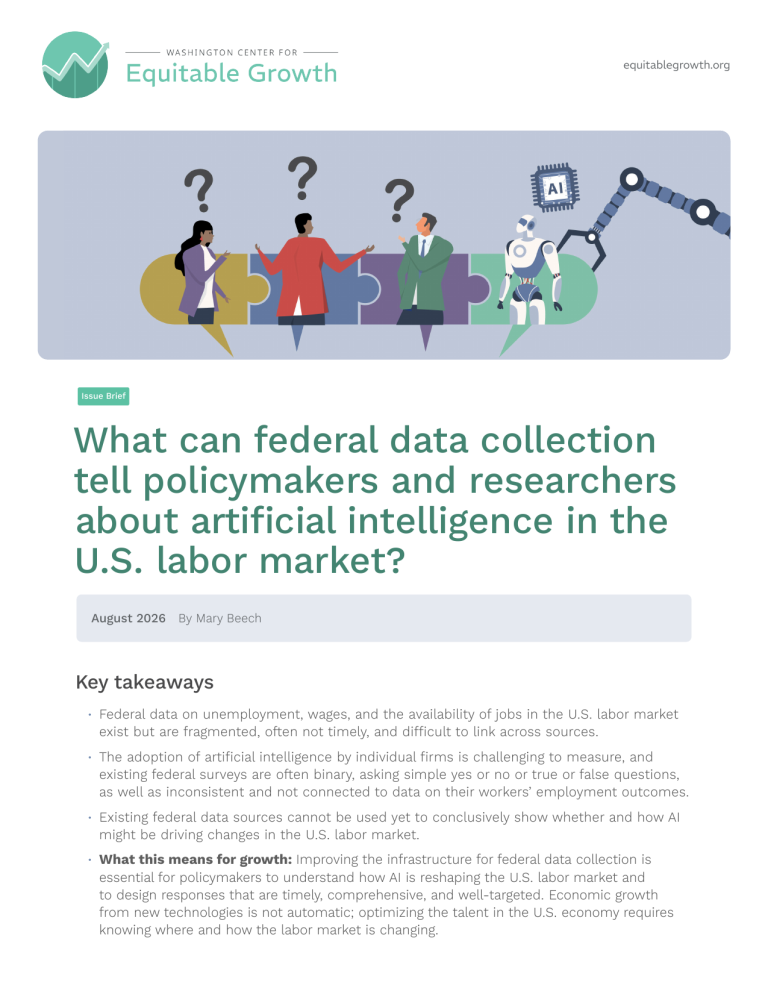
What can federal data collection tell policymakers and researchers about artificial intelligence in the U.S. labor market? (opens in a new tab)
Issue Briefs AUG 24, 2026
It is impossible to perfectly predict how artificial intelligence will affect the U.S. labor market. Policymakers and researchers are grappling with important questions around this topic, including what new opportunities…
By: Mary Beech (opens in a new tab)

What is the relationship between inflation, interest rates, and economic growth, and what does it mean for the new Federal Reserve chair? (opens in a new tab)
Issue Briefs MAY 18, 2026
Since regaining the Oval Office in early 2025, President Donald Trump has repeatedly called for lower interest rates and severely criticized former Federal Reserve Board Chair Jerome Powell’s cautious approach…
By: Jacob Robbins (opens in a new tab)

Federal policymakers can ensure Trump accounts do not exacerbate inequality in the United States (opens in a new tab)
Issue Briefs APR 14, 2026
In July 2025, Congress passed a federal budget bill (Public Law 119-21, also commonly known as the One Big Beautiful Bill Act) that, among other things, established a new type…
By: Megan Rivera (opens in a new tab)

Why federal food assistance became politically polarizing—and what to do about it (opens in a new tab)
Issue Briefs FEB 2, 2026
On January 31, 1964, President Lyndon B. Johnson requested that Congress pass federal legislation to make the Food Stamp Program permanent. Up to that point, the program had operated as…
By: Carlos Fernando Avenancio-Leon (opens in a new tab)

How artificial intelligence uncouples hard work from fair wages through ‘surveillance pay’ practices—and how to fix it (opens in a new tab)
Issue Briefs AUG 21, 2025
Correction: Freddie Mac and Udemy contacted the Washington Center for Equitable Growth on March 18, 2026 and April 2, 2026, respectively, to say they no longer had business relationships with…
By: Veena Dubal (opens in a new tab), Wilneida Negrón (opens in a new tab)
Tariffs impact U.S. industries differently, with manufacturing the most exposed (opens in a new tab)
Issue Briefs JUL 29, 2025
Estimates in this brief were generated July 21, before the announcement of trade deals with Japan and the European Union. All data and code used in the Equitable Growth tariff…
By: Christopher Bangert-Drowns (opens in a new tab)

Slow wage growth is the key to understanding U.S. inequality in the 21st century (opens in a new tab)
Issue Briefs JUL 8, 2025
The Washington Center for Equitable Growth today launched the U.S. Inequality Tracker, which tracks income and wealth inequality in the United States and highlights how particular components of income and…
By: Austin Clemens (opens in a new tab)

Why do some jobs pay better than others? Think about what workers do. (opens in a new tab)
Issue Briefs MAY 6, 2025
Most U.S. labor market data characterize jobs by describing the categories of industry and occupation to which the jobs belong. But to understand why some types of jobs tend to…
By: Kevin Rinz (opens in a new tab), Chiara Chanoi (opens in a new tab), Christopher Bangert-Drowns (opens in a new tab)

Advancing economic research on the Inflation Reduction Act: Q&A with Heather Boushey (opens in a new tab)
Issue Briefs APR 23, 2025
The Inflation Reduction Act of 2022 is the most significant economic and clean energy jobs program the United States has ever initiated. To improve overall understanding of whether the new…
By: Equitable Growth (opens in a new tab)
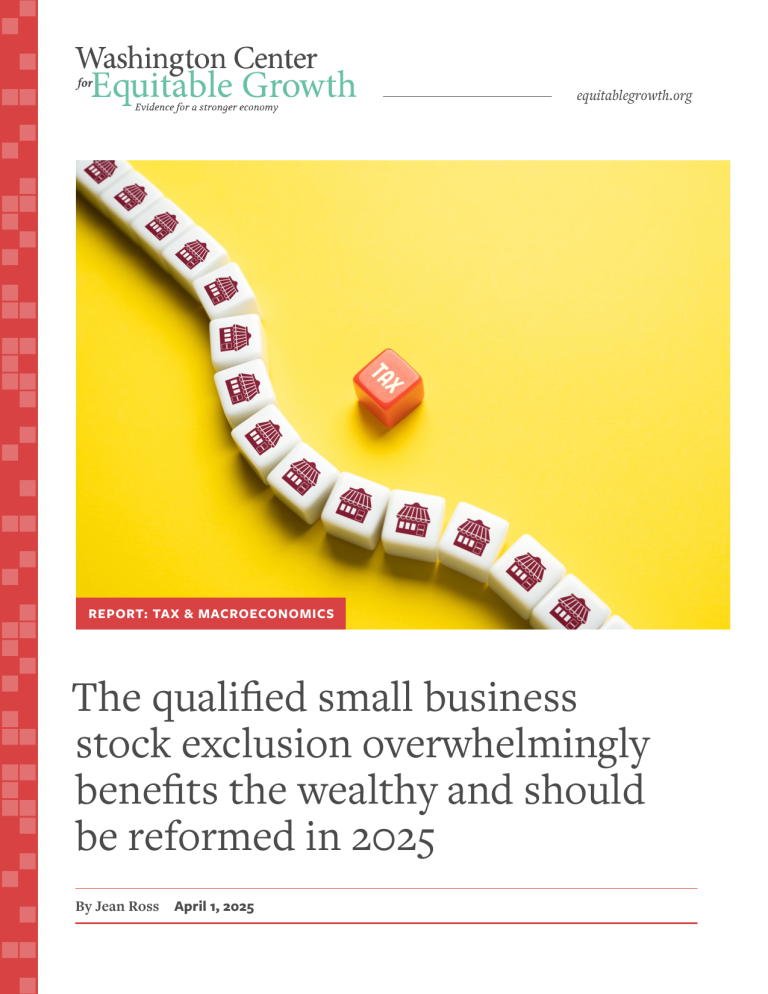
The qualified small business stock exclusion overwhelmingly benefits the wealthy and should be reformed in 2025 (opens in a new tab)
Issue Briefs APR 1, 2025
This year’s debate over the expiring personal income and estate tax provisions of the 2017 Tax Cuts and Jobs Act provides an opportunity for reforming the qualified small business stock…
By: Jean Ross (opens in a new tab)

Benchmarking the U.S. economy that President Donald Trump is set to inherit (opens in a new tab)
Issue Briefs JAN 16, 2025
When President Donald Trump takes the presidential oath of office again on January 20, he will be inheriting a very different economy, with a very different outlook, than the one…
By: Ernie Tedeschi (opens in a new tab)
Accelerating research can help fill the AI knowledge gaps for U.S. policymakers (opens in a new tab)
Issue Briefs DEC 17, 2024
It is hard for policymakers to ignore today’s “AI arms race” and the public debate on the economic and social significance of generative artificial intelligence. The discourse is fueled in…
By: Rohini Kosoglu (opens in a new tab), Christian Edlagan (opens in a new tab)