


Skip to content
Browse All Resources
Blog

DEC 2, 2015

A snapshot of the long-term impacts of universal pre-k in Minnesota

Abstract

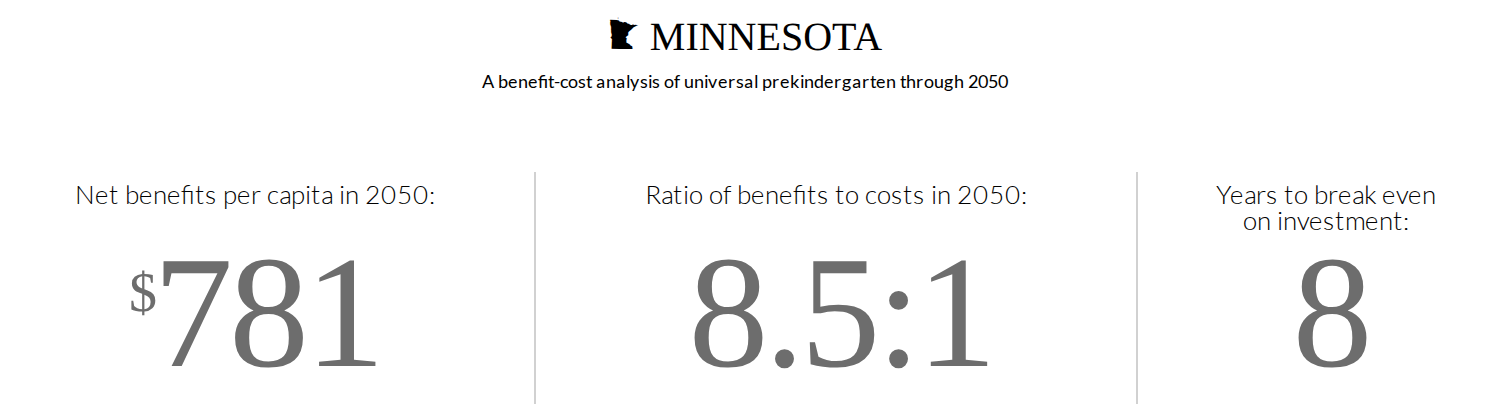
Minnesota: net benefits per capita in 2050, $781; ratio of benefits to costs in 2050, 8.5 to 1; years to break even on investment, 8.

If the United States were to invest in a public, voluntary, high-quality universal prekindergarten program starting in 2016 and fully phased in by 2017, what would the long-term impacts be for Minnesota? Our study looks to quantify the long-term benefits and costs of investing in a high-quality universal prekindergarten program available to all 3- and 4-year-olds across the United States. Use the data and interactives below to explore how a universal prekindergarten program would affect Minnesota.

Who would participate?

Currently, in Minnesota, 1.1 percent of 3- and 4-year-olds (1,601 children) participate in state-sponsored prekindergarten. Unfortunately, the quality of these programs varies significantly, which means that preschoolers do not always experience the same benefits or long-term effects. If a universal prekindergarten program were enacted in 2016 and fully phased in by 2017, 85.8 percent of 3- and 4-year-olds (120,416 children) would be enrolled in public prekindergarten, benefiting from a high-quality early childhood education.

How does pre-k enrollment now compare to what it could be in Minnesota? Current 1%, added 85%, total 86%.

What are the benefits of a universal prekindergarten program?

High-quality prekindergarten education can generate significant long-run benefits for participating children, their families, and even other non-participants. Longitudinal studies have shown, for example, that aside from improved educational achievement, children who have attended a prekindergarten program have spent less time in special education and had lower grade retention rates. These children also experience less child maltreatment and reduced crime, smoking, and depression rates over the course of their lives. In addition, both participating children and their parents have higher projected earnings, which subsequently increases government tax revenue.

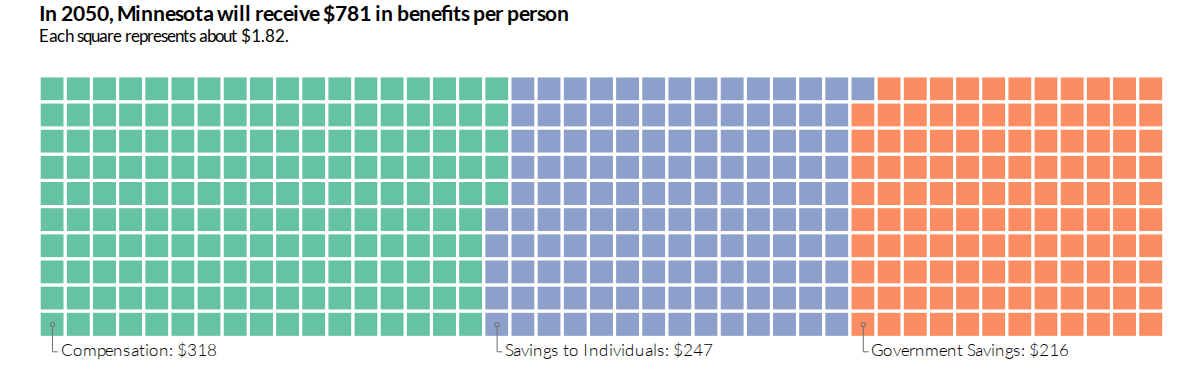
If a universal prekindergarten program were to start in the United States in 2016, Minnesota would see more than $5,267 million in total benefits in 2050, amounting to savings of $781 per capita that year. Here’s how these total benefits break down:

  • $216.26 per person is attributed to savings to government.
  • $317.62 per person comes from increased compensation.
  • The remaining $247.13 per person is accounted for by savings to each individual from better health and less crime.

In 2050, Minnesota will receive $781 in benefits per person. Compensation: $318; Savings to Individuals: $247; Government Savings: $216.

What are the costs?

Currently, Minnesota spends $40 per capita per year on preschool programs, special education services, and Head Start. In 2017, when a universal prekindergarten program is fully phased in, it would take an investment of $91 more per capita per year to maintain a high-quality prekindergarten program.

How does pre-k investment in Minnesota now compare to what is required for a high-quality universal program? Current $40, added $91, total $131.

There are three main costs associated with a high-quality universal prekindergarten program: the cost of the program, increased high school attendance, and increased college attendance. The program itself is based on Chicago’s comprehensive high-quality Child-Parent Center half-day program, so the costs take into account the multitude of services that are provided at the Child-Parent Center offset by the current spending on similar early childhood education programs as to not double-count expenditures. Because studies have shown that students who attend prekindergarten have higher high school completion rates and are more likely to attend college, these usage costs are also factored into the total cost of a universal prekindergarten program.

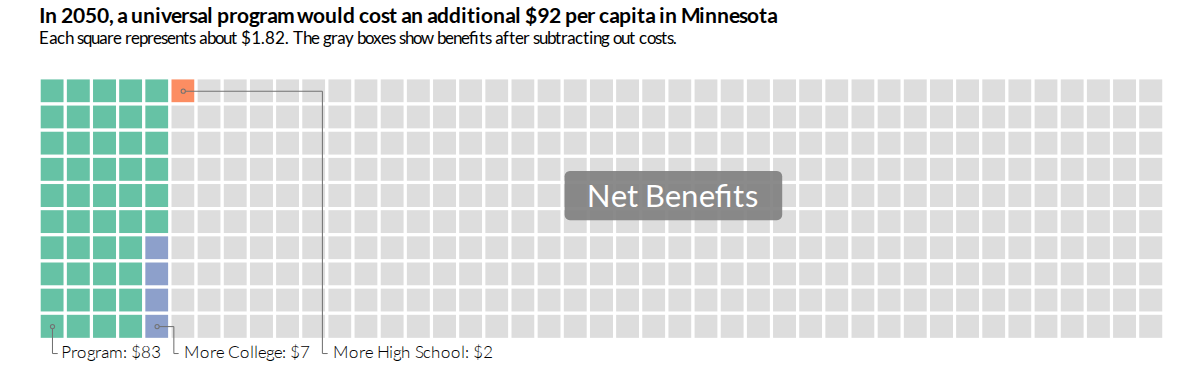
In 2050, these costs add up to an additional $622 million, or $92.27 per capita in Minnesota. $83.17 per capita is attributed to program costs, $2.38 comes from increased high school usage per person, and the remaining $6.72 per person is accounted for by increased college attendance.

In 2050, a universal program would cost an additional $92 per capita in Minnesota. Program: $83; More College: $7; More High School: $2; the rest of the grid shows net benefits.

How do the benefits compare to the costs?

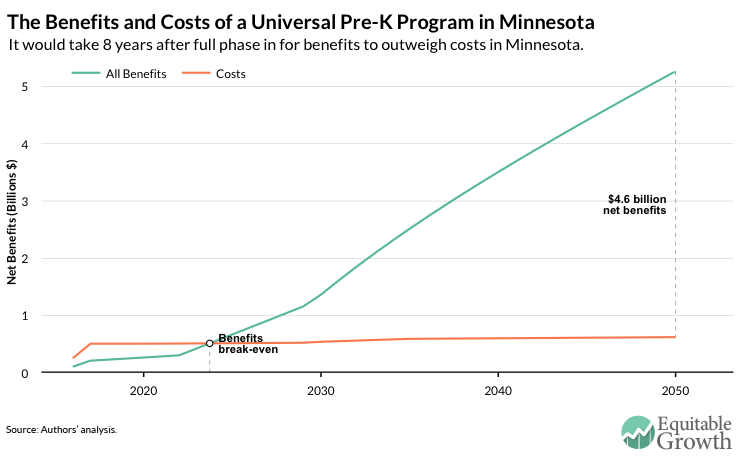
If a high-quality universal prekindergarten program were to start in the United States in 2016 and be fully phased in by the end of 2017, the program would require a total of $508 million in Minnesota taxpayer dollars. Over time, the cost would eventually grow to include the cost of additional high school and college attendance. But in just 8 years after full phase-in, by the end of 2024, the benefits of the program would outstrip the costs. And by 2050, there would be more than $5,267 million in total benefits compared to merely $622 million in total costs, yielding net benefits of $4,645 million. By 2050, for every dollar invested in a universal program, there would be $8.46 in returns.

To see the national numbers, return to the full report.

Related

Your Direct Line to Cutting-Edge Research

Get updates on our latest research, event announcements, and policy insights delivered straight to your inbox. Stay connected with the leading voices on equitable growth.