


Resources
From peer-reviewed research to accessible policy briefs, explore the scholarship that’s shaping debates and driving change.

523 Results


Equitable Growth’s “Econ 101” convening on Capitol Hill busts debt myths and charts a path ahead for the incoming 120th U.S. Congress (opens in a new tab)
Blog NOV 24, 2026
The Washington Center for Equitable Growth recently convened an educational event for congressional staff—part of our ongoing “Econ 101” series on Capitol Hill—highlighting new ways to think about the revenue…
By: Christopher Bangert-Drowns (opens in a new tab)

Reimagining and rebuilding the federal government: the role of social scientists in evidence-backed U.S. policymaking (opens in a new tab)
Essays NOV 20, 2026
The Washington Center for Equitable Growth earlier this month convened a panel of scholars and former senior officials at the Association for Public Policy Analysis and Management’s Fall Research Conference…
By: Chris Clayton (opens in a new tab), Korin Davis (opens in a new tab)
AI-related inputs drove U.S. businesses’ import growth in 2025 (opens in a new tab)
Essays NOV 18, 2026
The enduring question of last year’s tariff rollercoaster is whether the economic pain was worth reshoring U.S. supply chains. A preliminary answer came in a September data release from the…
By: Christopher Bangert-Drowns (opens in a new tab)

An economic statistical agenda for the next presidential administration and U.S. Congress (opens in a new tab)
Reports NOV 17, 2026
This report argues that policymakers in the next presidential administration should adopt an economic statistical agenda to save an essential statistical system that is imperiled by decades of neglect and…
By: Austin Clemens (opens in a new tab)

An end to summer tariff peace threatens U.S. economic growth (opens in a new tab)
Essays OCT 30, 2026
The summer months of relative tranquility in U.S. trade policy could be shattered as announced tariff escalations with Canada take effect, translating into higher costs for U.S. businesses and consumers,…
By: Christopher Bangert-Drowns (opens in a new tab)

A snapshot of the argument at the heart of the federal budget debate (opens in a new tab)
Essays OCT 20, 2026
Over the past few weeks, the federal budget, and especially the persistent and large budget deficit, has been thrust back into the news. With it, the argument about who is…
By: Equitable Growth (opens in a new tab)
The deeper argument at the heart of the federal budget debate (opens in a new tab)
Reports OCT 5, 2026
Interest rates on the national debt have recently crept up to levels that the U.S. government and the American people haven’t experienced in several decades. This is a potentially concerning…
By: Michael Linden (opens in a new tab)

Applying a debt-to-wealth lens internationally reveals subtle differences between countries’ fiscal capacities (opens in a new tab)
Essays SEP 24, 2026
In late August, investor demand for government bonds weakened, sending yields (the interest rate governments must offer to attract investors) soaring. Yields on 10-year U.S. bonds, which were just 4…
By: Austin Clemens (opens in a new tab), David S. Mitchell (opens in a new tab)

Trump’s trade war with Canada grows increasingly costly as Section 338 tariffs harm both economies (opens in a new tab)
Essays SEP 22, 2026
President Donald Trump continues to escalate his administration’s perplexing trade spat with Canada through the expanded use of novel tariff powers in Section 338 of the Tariff Act of 1930.…
By: Christopher Bangert-Drowns (opens in a new tab)

What happens to U.S. workers without access to Unemployment Insurance amid economic downturns or disruptions related to AI? (opens in a new tab)
Essays SEP 2, 2026
The adoption of artificial intelligence in the workplace has led to predictions of U.S. labor market disruptions. In response, policymakers have increased attention on the fitness of the nation’s social…
By: Megan Rivera (opens in a new tab)
Defining extreme wealth is more complicated than it looks (opens in a new tab)
Videos AUG 13, 2026
Facing high levels of income and wealth inequality and shrinking tax revenues, U.S. policymakers are showing increased interest in proposals to tax the richest households. Yet determining which households fall into that category is complex and changes based…
By: Equitable Growth (opens in a new tab)

Estimating AI exposure is useful for research but cannot yet tell policymakers the whole story of AI’s impact on the labor market (opens in a new tab)
Essays AUG 7, 2026
Artificial intelligence has the potential to substantially change the nature and availability of work. To effectively manage the transitions this technology might bring to the U.S. economy, policymakers need information…
By: Chiara Chanoi (opens in a new tab)
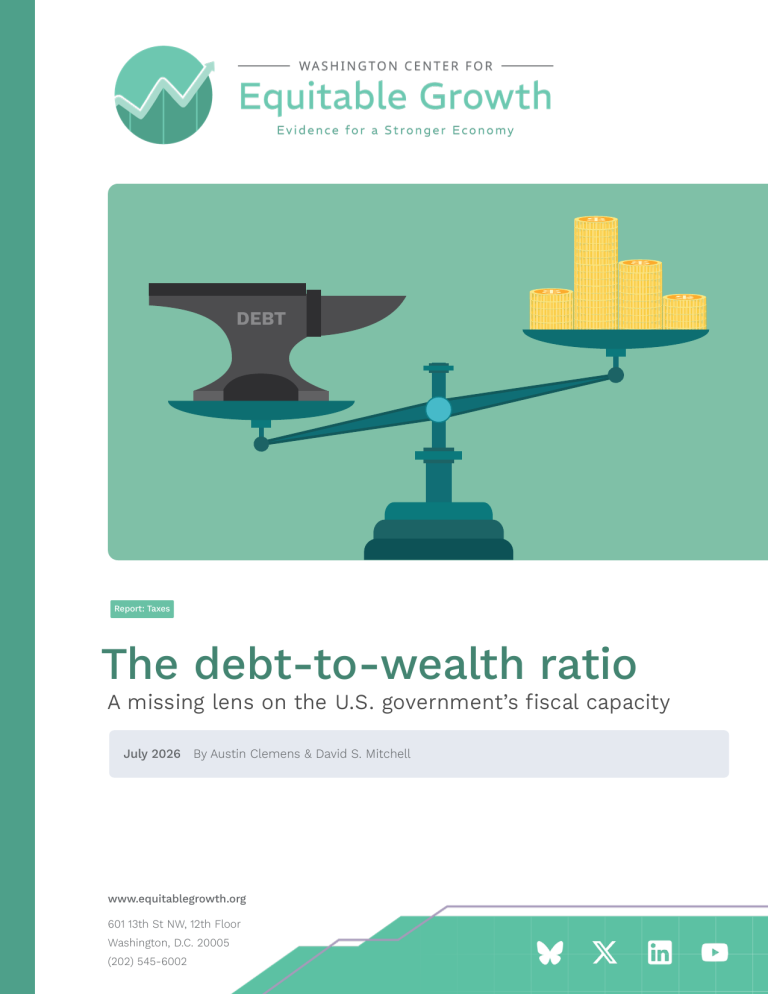
The debt-to-wealth ratio: A missing lens on the U.S. government’s fiscal capacity (opens in a new tab)
Reports JUL 30, 2026
Few statistics shape the fiscal debate in the United States as powerfully as the ratio of federal debt-to-Gross Domestic Product. Debt held by the public recently surpassed 100 percent of…
By: Austin Clemens (opens in a new tab), David S. Mitchell (opens in a new tab)

The costs of the Trump administration’s tariffs diverge for countries and industries so far in 2026 (opens in a new tab)
Essays JUL 14, 2026
The first 4 months of 2026 saw continued seismic changes in U.S. trade policy. In late February, the U.S. Supreme Court struck down the Trump administration’s use of the International…
By: Christopher Bangert-Drowns (opens in a new tab)

Personal Income in the United States nudges up in May but is down 0.76 percent in the past 6 months (opens in a new tab)
Essays JUN 25, 2026
According to today’s release of Personal Income estimates from the U.S. Bureau of Economic Analysis, U.S. household incomes have fallen 0.76 percent in the past 6 months, with month-to-month declines…
By: Austin Clemens (opens in a new tab)

U.S. income data for 2024 shows the top 10 percent accrued the highest share of income since 2000 (opens in a new tab)
Essays JUN 25, 2026
Today, Equitable Growth updated the U.S. Inequality Tracker through 2024 following the release of new data last week by the U.S. Bureau of Economic Analysis. The data show that the…
By: Austin Clemens (opens in a new tab)

Factsheet: Defining top U.S. income and wealth thresholds for tax policy (opens in a new tab)
Factsheets MAY 27, 2026
Federal and state policymakers in the United States, responding to high levels of income and wealth inequality and shrinking tax revenues, are increasingly interested in proposals to tax households with…
By: Austin Clemens (opens in a new tab)
Defining top wealth and income thresholds for U.S. tax policy design and analysis (opens in a new tab)
Reports MAY 27, 2026
Wealth and income inequality are an ongoing area of interest for policymakers. In particular, the rise of the richest of the rich—not just the top 1 percent, but also the…
By: Austin Clemens (opens in a new tab)

What is the relationship between inflation, interest rates, and economic growth, and what does it mean for the new Federal Reserve chair? (opens in a new tab)
Issue Briefs MAY 18, 2026
Since regaining the Oval Office in early 2025, President Donald Trump has repeatedly called for lower interest rates and severely criticized former Federal Reserve Board Chair Jerome Powell’s cautious approach…
By: Jacob Robbins (opens in a new tab)
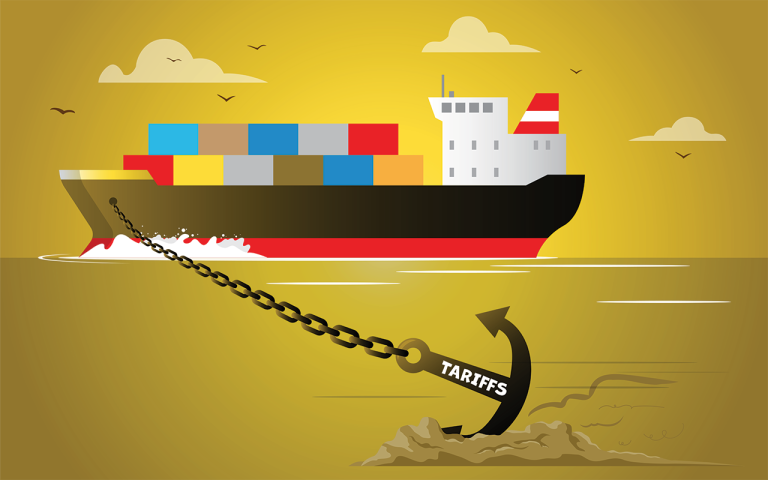
Tariff policies in 2025 increased input costs for key U.S. industries, threatening growth and investment (opens in a new tab)
Essays MAR 24, 2026
All tariffs are not created equal. Throughout U.S. history, policymakers have imposed import taxes for a variety of economic and ideological reasons, with varying impacts. Targeted tariffs have been effective…
By: Christopher Bangert-Drowns (opens in a new tab)
New research examines the historical macroeconomic effects of tariffs and sheds light on current U.S. trade policies (opens in a new tab)
Essays MAR 4, 2026
U.S. policymakers have enacted tariffs for a variety of reasons over the course of the country’s history. Motivated by economic pressures to raise federal revenues or address balance-of-payment issues, or…
By: Christopher Bangert-Drowns (opens in a new tab)

The state of the U.S. economy one year into the second Trump administration (opens in a new tab)
Essays FEB 23, 2026
President Donald Trump will soon give his annual State of the Union speech before Congress, one year into his second term in the White House. Ahead of his remarks, now…
By: Michael Linden (opens in a new tab)

Analyzing recent U.S. economic policies using Equitable Growth’s Inequality Tracker (opens in a new tab)
Essays JAN 22, 2026
The Washington Center for Equitable Growth’s Inequality Tracker is a data visualization tool designed to help policymakers and economic analysts examine and analyze U.S. income and wealth inequality in the…
By: Austin Clemens (opens in a new tab)
ASSA 2026 Round-up: Day 3 (opens in a new tab)
Blog JAN 6, 2026
Yesterday was the third and final day of the 2026 annual meeting of the Allied Social Science Associations, which is organized by the American Economic Association. The 3-day conference, held…
By: Equitable Growth (opens in a new tab)


Your Direct Line to Cutting Edge Research
Be the first to know about our latest events, research releases, and expert insights. Get exclusive updates delivered right to your inbox and never miss an opportunity to engage with our community.