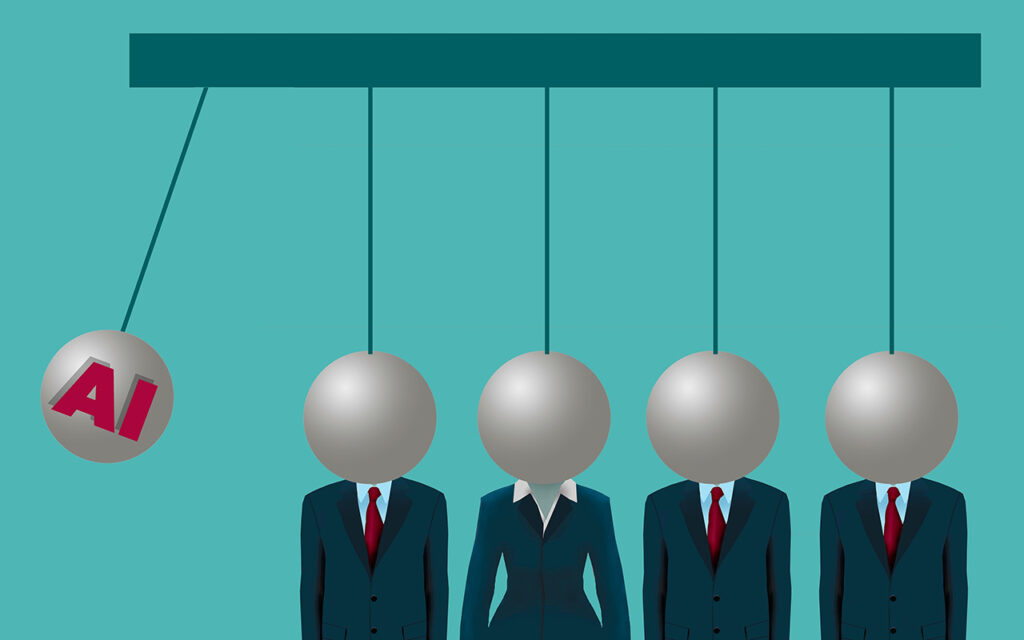

Five policy planks to prepare U.S. workers for dislocation caused by artificial intelligence
Reports NOV 23, 2026
By: Jacob Leibenluft, Gene Sperling
OCT 23, 2026
The adoption of advanced artificial intelligence tools in the workplace has led to widespread concerns about the degradation of work and potential job displacements. While research is mixed on AI’s current labor market impacts, U.S. policymakers should prepare for a range of scenarios that account for the ways in which AI could evolve. Part of that preparation should include implementing sorely needed reforms to the Unemployment Insurance system, the federal-state program that provides partial wage replacement for involuntarily unemployed workers.
In addition to supporting (opens in a new tab) the economic well-being of unemployed workers and their families, Unemployment Insurance serves as one of the most cost-effective automatic economic stabilizers when unemployment rises during an economic downturn by replacing lost wages and helping to sustain demand across the U.S. economy.
The newly proposed Stability and Opportunity for Workers Act (opens in a new tab) put forth by Sen. Ron Wyden (D-OR), the ranking member of the Senate Finance Committee, aims to strengthen the UI system to more effectively support workers and the economy, including in the case of future economic disruptions caused by advancements in AI. The proposed legislation would establish new national standards for UI benefits across states and expand access to UI benefits for more types of workers currently excluded from the system, such as self-employed and gig workers.
The proposed legislation also would establish a transition wage program to support workers’ economic stability while they train for new career paths and introduce a job seekers allowance, a modest weekly benefit for unemployed workers who are seeking work but do not qualify for traditional UI benefits given their limited prior work experience. The proposed legislation also would expand existing Short-Time Compensation benefits, a social insurance program sometimes referred to as work-sharing that provides an alternative to layoffs during economic downturns, helping businesses retain employees by providing UI benefits to workers whose hours are reduced to help make up part of the difference in lost wages.
This column will review some of the evidence behind the concerns targeted by the proposed Stability and Opportunity for Workers Act to inform policymakers’ perspectives as they look to strengthen, modernize, and expand the nation’s Unemployment Insurance system and prepare it to navigate the increasing adoption of advanced technologies across the U.S. economy. As we argue, available evidence suggests that provisions in the Stability and Opportunity for Workers Act would make needed progress in supporting workers during spells of unemployment and are an integral step to ensuring that our social insurance system is ready for any future disruptions that AI might introduce to the labor market.
In its current state, the UI system offers vital support for both workers and the U.S. economy, but its effectiveness has substantially eroded over time. The proposed Stability and Opportunity for Workers Act addresses several of the program’s potential shortfalls.
The UI system operates as a federal-state partnership and gives states tremendous discretion to set benefit eligibility, duration, and levels of income support. In recent decades, many states have cut (opens in a new tab) their programs’ income support, meaning that workers can count on less support during spells of unemployment. A recent survey of unemployed workers found (opens in a new tab) that one in five says that current benefit levels are inadequate to meet their basic needs.
Equally concerning is the eroding reach of the UI program. The percentage of unemployed workers receiving (opens in a new tab) benefits has fallen from more than 50 percent in the 1950s to less than 30 percent in recent years. Analysis of 2026 data (opens in a new tab)reveals a disconnect between the UI program’s responsiveness and real job losses; unemployment benefit claims are not increasing with known increases in the unemployment rate. Researchers (opens in a new tab) point to the disparate rules and regulations that govern each state’s UI program as driving factors in this gap.
For these reasons, the federal government needs to ensure that all eligible workers can expect a minimum standard of benefits during spells of unemployment, regardless of geography. The Stability and Opportunity for Workers Act would do just that.
Currently, there is no federal minimum for UI benefit amounts that states must provide eligible workers, nor for how long. Similarly situated workers at a firm with multiple branches could receive a maximum of $325 per week (opens in a new tab) for up to 12 weeks in Tennessee or $628 for up to 26 weeks in Illinois (opens in a new tab) just hours away. The proposed Stability and Opportunity for Workers Act would establish a national standard for UI benefits requiring all states to offer at least 26 weeks of benefits that replace at least 75 percent of workers’ wages, and the maximum amount of income support must equal at least two-thirds of each state’s average weekly wage.
The proposed legislation also aims to modernize the Extended Benefits program, proposing that 52 additional weeks of benefits automatically become available to workers when unemployment rises nationally. Let’s examine each of these components briefly in turn.
Unemployment Insurance provides critical support that allows laid-off workers time to find jobs that best match their skills rather than taking the first available jobs. This added time is particularly needed when job searches take longer than they have in recent years (opens in a new tab). Exhaustion rates, when workers use their benefits before finding new employment, tend to be higher in states with shorter benefit periods, and the month in which benefits run out is associated with drops in spending (opens in a new tab), both of which undermine the macroeconomic stabilizing effects of Unemployment Insurance (opens in a new tab).
Workers could benefit from better skill matches through higher wages and job satisfaction, and the wider economy benefits from a more efficient allocation of labor. Indeed, research finds that UI benefits can help low-income workers secure jobs that are more stable and higher paying than the ones they previously were in. The proposed Stability and Opportunity for Workers Act would require all states to offer at least 26 weeks of benefits, an evidence-based step and a necessary reversal of the trend among states that have cut (opens in a new tab) benefit durations in recent years.
For Unemployment Insurance to serve its dual purpose of partially replacing lost wages and boosting the U.S. economy during downturns, the wage-replacement rate must be large enough to support households’ needs during spells of unemployment. Currently, replacement rates vary widely by state. Some, including Florida and Arizona, replace less than 15 percent of average weekly wages. In the strongest states, as many as one quarter of unemployed workers say that benefits are inadequate to meet their basic financial needs (opens in a new tab).
The proposed Stability and Opportunity for Workers Act would require all states to set benefit amounts to replace 75 percent of a worker’s average weekly wages, and state maximum benefit amounts must be equal to at least two-thirds of the state’s average weekly wages.
During recessions, workers tend to stay unemployed for longer spells of time. The UI system should accommodate that reality by offering benefits for longer periods of time when it is harder for workers to find new jobs. Currently, the Extended Benefits program offers an additional 13 weeks to 20 weeks of Unemployment Insurance benefits to workers in states with rising unemployment rates or UI claims.
First enacted in 1970, the Extended Benefits system has played an exceedingly limited role in supporting workers during recessions due to flawed trigger requirements to enable expanded benefits. Just 2 percent of those receiving UI benefits did so through the Extended Benefits system from 1986 through 2023. Perversely, as states have made it harder for unemployed workers to access UI benefits, it has become harder for states to trigger, or turn on, their Extended Benefits, even during a recession (since the trigger is based on the proportion of workers claiming benefits).
In addition, the Extended Benefits can trigger off when there has been no increase in unemployment even if unemployment remains high. That means that the program can turn off during periods of persistently high unemployment. Given the failure of the Extended Benefits system, Congress has acted nine times (opens in a new tab) to temporarily expand UI benefits in response to recessions, most recently during the COVID-19 pandemic. The proposed Stability and Opportunity for Workers Act would make 52 additional weeks of benefits automatically available in the case of high unemployment, removing the uncertainty behind ad-hoc congressional action.
The UI system currently excludes millions of workers in non-traditional labor arrangements, among them recent labor market entrants or reentrants, entry-level, self-employed, part-time, and gig workers. These workers typically are excluded from the nation’s social insurance infrastructure for a variety of reasons but are no less at risk of job losses or income disruptions.
The proposed Stability and Opportunity for Workers Act aims to include these workers in the UI program by reducing earnings thresholds, including more workers in UI eligibility, and establishing a new job-seekers allowance for workers who do not qualify for traditional UI benefits. These reforms would go far in expanding evidence-based protections for more workers and bolstering the UI system’s role as an automatic stabilizer.
The self-employed, including independent contractors, made up an estimated 16.5 million workers (opens in a new tab) in 2025. But researchers have argued that government data, including surveys and tax records on independent contractors, provide an incomplete picture of this population (opens in a new tab), potentially undercounting their prevalence in the U.S. economy. In addition, in July 2025, the U.S Bureau of Labor Statistics reported (opens in a new tab) an estimated 4.8 million part-time workers would have preferred full-time employment but were working part-time because their hours had been reduced or they were unable to find full-time jobs.
The proposed Stability and Opportunity for Workers Act would lower the earnings threshold for part-time workers and introduce a new test (opens in a new tab) for determining eligibility for UI benefits that would expand eligibility to workers whose employers improperly classify them as independent contractors.
Every year, millions of recent graduates (opens in a new tab) join the U.S. labor market. In 2024 (opens in a new tab), for example, roughly 1.2 million high school graduates joined the labor market (2 million additional graduates enrolled in college), 352,000 completed an associate’s degree, and 1.2 million earned a bachelor’s degree. These new labor market entrants are typically excluded from receiving UI benefits because they lack sufficient wage history.
In addition to new entrants, reentrants are another important category of workers typically excluded from traditional UI benefits. These new entrants can include workers who take time off to care for a family member, deal with an illness, or spend time in the criminal justice system. The Stability and Opportunity for Workers Act would establish a federally financed job seeker’s allowance, a modest weekly benefit for unemployed workers who are seeking work but would not be eligible for traditional UI benefits.
While there is no causal evidence yet on how AI may be affecting entry-level employment, the exclusion of these workers from most UI benefits is well documented. Investing in social insurance programs that buttress household income security during downturns and support economic activity during disruptions are both shown to improve economic resiliency.
Evidence supports the importance of keeping workers attached to the U.S. labor market. In the event of AI-related disruptions in workplaces, research suggests interventions should include income assistance and wrap-around programs to support workers looking for new jobs. The proposed Stability and Opportunity for Workers Act aims to prepare the federal social insurance system to support workers for a potential labor market transformation by investing in programs that evidence has found help workers stay attached to the labor market. These include:
It is difficult to anticipate exactly how AI will ultimately impact workers or the U.S. labor market. Nonetheless, there are steps U.S. policymakers can take now to improve our nation’s social insurance programs, such as the Unemployment Insurance system, which evidence shows improve individual worker outcomes and temper economic downturns.
Despite its critical role in our safety net, the UI system’s ability to support unemployed workers and act as an automatic stabilizer during economic downturns has substantially eroded in recent decades. The proposed Stability and Opportunity for Workers Act includes an evidence-based set of reforms to improve the UI system for American workers both now and in the future facing potential AI-related dislocations.
The proposed legislation is an important starting point for future UI reform conversations, which should include reforms to UI financing to ensure that the program is on a sustainable foundation, as well as opportunities for policymakers to think even more ambitiously about how the UI system could offer a foundation for building (opens in a new tab) greater worker organization and power.
For nearly a century, our social insurance system has helped buffer the economic risks Americans have faced from unemployment to poverty in old age. As we look to the future, we should be building a social insurance system that can last for another century and protect Americans from potential AI-driven dislocations as well as all the risks we cannot foresee.
Reports NOV 23, 2026
By: Jacob Leibenluft, Gene Sperling
Essays NOV 20, 2026
By: Chris Clayton, Korin Davis
Essays NOV 18, 2026
By: Christopher Bangert-Drowns
Get updates on our latest research, event announcements, and policy insights delivered straight to your inbox. Stay connected with the leading voices on equitable growth.