
Five policy planks to prepare U.S. workers for dislocation caused by artificial intelligence
Reports NOV 23, 2026
By: Jacob Leibenluft, Gene Sperling
OCT 29, 2019
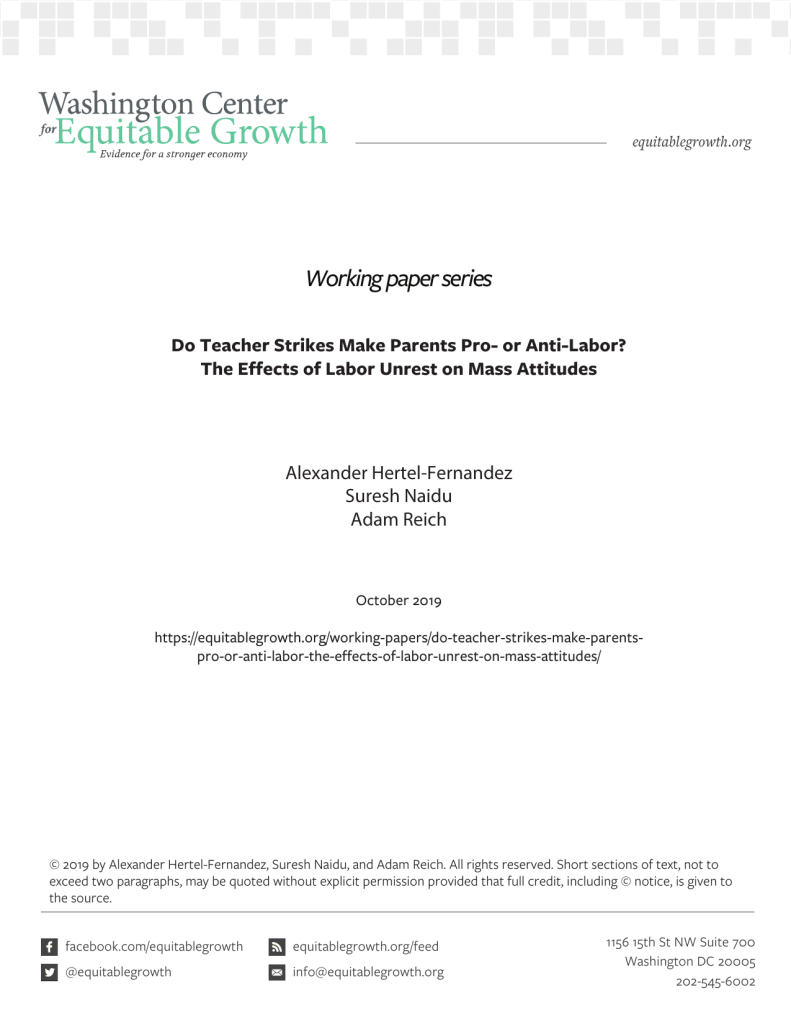
Strikes are a central tool of organized labor, yet existing research has focused on the economic consequences of strikes, rather than their political effects. We examine how labor actions by teachers, a well-organized group of public-sector workers, changes mass attitudes about the strikes and the labor movement more generally. Our context involves large-scale teacher strikes and walkouts in six states in 2018. Using an original survey in the affected states, we study the causal effect of strike exposure among parents whose children’s ages place them in or out of school. Firsthand strike exposure increased parents’ support for the teachers and for the labor movement, as well as parents’ interest in labor action (though not necessarily through traditional unions). We next examine the mechanisms for these strike effects, identifying the role of political education of parents by teachers. Our results underscore the importance of strikes as a political strategy for unions.
Reports NOV 23, 2026
By: Jacob Leibenluft, Gene Sperling
Essays NOV 20, 2026
By: Chris Clayton, Korin Davis
Essays OCT 30, 2026
By: Christopher Bangert-Drowns
Get updates on our latest research, event announcements, and policy insights delivered straight to your inbox. Stay connected with the leading voices on equitable growth.