
Skip to content
Browse All Resources
Factsheets

JUL 8, 2019

Factsheet: Minimum wage increases are good for U.S. workers and the U.S. economy

Overview

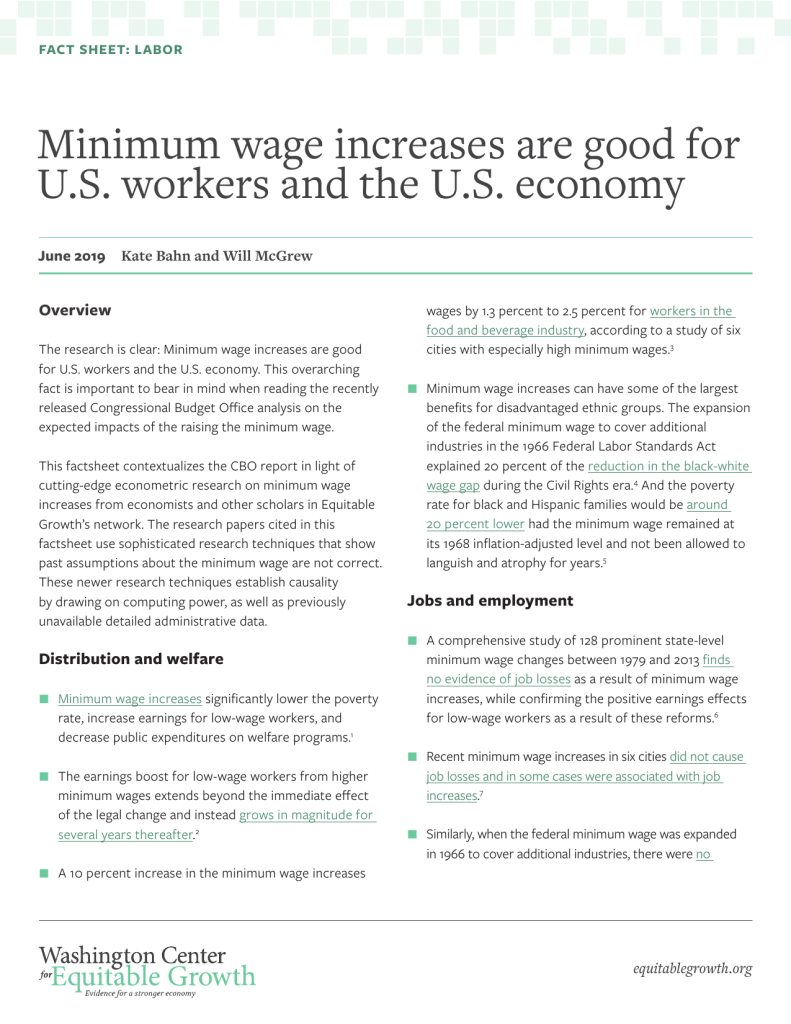
The research is clear: Minimum wage increases are good for U.S. workers and the U.S. economy. This overarching fact is important to bear in mind when reading the recently released Congressional Budget Office analysis on the expected impacts of raising the minimum wage.

This factsheet contextualizes the CBO report (opens in a new tab) in light of cutting-edge econometric research on minimum wage increases from economists and other scholars in Equitable Growth’s network. The research papers cited in this factsheet use sophisticated research techniques that show past assumptions about the minimum wage are not correct. These newer research techniques hone in on causality by drawing on improved empirical methodologies, computing power, and previously unavailable detailed administrative data.

Distribution and welfare

Jobs and employment

The importance of the latest research methodology

The empirical revolution evident in the research papers cited in this factsheet allow policymakers and economists alike to move past guesses about how individuals or businesses might react to policy changes involving the minimum wage to observe how they actually behave. Three key studies by leading scholars on the minimum wage that exemplify this new data-driven analysis are:

  • An analysis that leverages data from 1979 to 2014 with several empirical strategies to confirm that minimum wage increases have minimal employment effects, while illustrating the key methodological flaws in economics papers alleging large employment losses11
  • A study showing that recent research on the supposed ill-effects of a recent minimum wage increase in Seattle is largely uninformative for policymaking, as it relies on many of the same methodological flaws as previous studies12
  • An expansive study that uses several cutting-edge econometric methods on the most comprehensive dataset in the minimum wage research literature to substantiate large income increases and negligible employment costs in more than 100 state-level minimum wage increases in recent decades13

Conclusion

While some states and cities have increased their minimum wages in recent years, the current federal minimum wage has been stuck at $7.25 since 2009. Recent breakthroughs in economic methodology and analysis prove that raising the federal minimum wage would decrease poverty and increase earnings for workers, especially for low-wage workers and people of color. Yet the recent analysis from the Congressional Budget Office unjustifiably discounts the new, more empirically rigorous research, leading it to underestimate the benefits and overestimate the harms of raising the minimum wage. As federal legislators consider the Raise the Wage Act, a bill that would gradually increase the federal minimum wage to $15 an hour over the next five years, it is critical that they have access to the most cutting-edge economic evidence on which to base their decision.

About the Authors

Kate Bahn is the director of Labor Market Policy and an economist at the Washington Center for Equitable Growth. Will McGrew is a research assistant at the Washington Center for Equitable Growth.

End Notes

1. Arindrajit Dube, “Minimum wages and the distribution of family incomes.” Working Paper (Washington Center for Equitable Growth, 2017), available at https://www.equitablegrowth.org/our-work/resources/minimum-wages-and-the-distribution-of-family-incomes/.

2. Kevin Rinz and John Voorheis, “The distributional effects of minimum wages: Evidence from linked survey and administrative data.” Working Paper (Washington Center for Equitable Growth, 2018), available at https://www.equitablegrowth.org/our-work/resources/the-distributional-effects-of-minimum-wages-evidence-from-linked-survey-and-administrative-data/.

3. Sylvia A. Allegretto and others, “The New Wave of Local Minimum Wage Policies: Evidence from Six Cities” (Berkeley, CA: Institute for Research on Labor and Employment, 2018), available at https://irle.berkeley.edu/the-new-wave-of-local-minimum-wage-policies-evidence-from-six-cities/ (opens in a new tab).

4. Ellora Derenoncourt and Claire Montialoux, “Minimum Wages and Racial Inequality” (2018), available at https://scholar.harvard.edu/files/elloraderenoncourt/files/montialoux_jmp_2018.pdf (opens in a new tab).

5. Ben Zipperer, “The erosion of the federal minimum wage has increased poverty, especially for black and Hispanic families” (Washington: Economic Policy Institute, 2018), available at https://www.epi.org/publication/the-erosion-of-the-federal-minimum-wage-has-increased-poverty-especially-for-black-and-hispanic-families/ (opens in a new tab).

6. Doruk Cengiz and others, “The Effect of Minimum Wages on Low-Wage Jobs,” The Quarterly Journal of Economics (2019), available at https://academic.oup.com/qje/advance-article-abstract/doi/10.1093/qje/qjz014/5484905?redirectedFrom=fulltext (opens in a new tab).

7. Allegretto and others, “The New Wave of Local Minimum Wage Policies: Evidence from Six Cities.”

8. Derenoncourt and Montialoux, “Minimum Wages and Racial Inequality.”

9. David Howell, “The employment effects of a much higher U.S. federal minimum wage: Lessons from other rich countries” (Washington: Washington Center for Equitable Growth, 2016), available at https://www.equitablegrowth.org/our-work/resources/the-employment-effects-of-a-much-higher-u-s-federal-minimum-wage-lessons-from-other-rich-countries/.

10. David Howell, Kea Fiedler, and Stephanie Luce, “What’s the right minimum wage? Reframing the debate from ‘no job loss’ to a ‘minimum living wage.’” Working Paper (Washington Center for Equitable Growth, 2016), available at https://www.equitablegrowth.org/our-work/resources/whats-the-right-minimum-wage-reframing-the-debate-from-no-job-loss-to-a-minimum-living-wage/.

11. Sylvia A. Allegretto and others, “Credible Research Designs for Minimum Wage Studies: A Response to Neumark, Salas, and Wascher,” ILR Review 70 (3) (2017): 559–592, available at https://journals.sagepub.com/doi/abs/10.1177/0019793917692788 (opens in a new tab).

12. Ben Zipperer, “Six reasons not to put too much weight on the new study of Seattle’s minimum wage,” Working Economics Blog, October 22, 2018, available at https://www.epi.org/blog/six-reasons-not-to-put-too-much-weight-on-the-new-study-of-seattles-minimum-wage/ (opens in a new tab) (last accessed June 24, 2019).

13. Cengiz and others, 2019.

Related

Your Direct Line to Cutting-Edge Research

Get updates on our latest research, event announcements, and policy insights delivered straight to your inbox. Stay connected with the leading voices on equitable growth.