
Equitable Growth’s “Econ 101” convening on Capitol Hill busts debt myths and charts a path ahead for the incoming 120th U.S. Congress
Blog NOV 24, 2026
By: Christopher Bangert-Drowns
NOV 29, 2022
Factsheet: What the research says about the economics of the 2021 enhanced Child Tax Credit
Download
The Child Tax Credit has historically provided income support to middle- and high-income taxpayers with children. In 2021, however, the U.S. Congress enacted a temporary enhanced Child Tax Credit with three key changes:
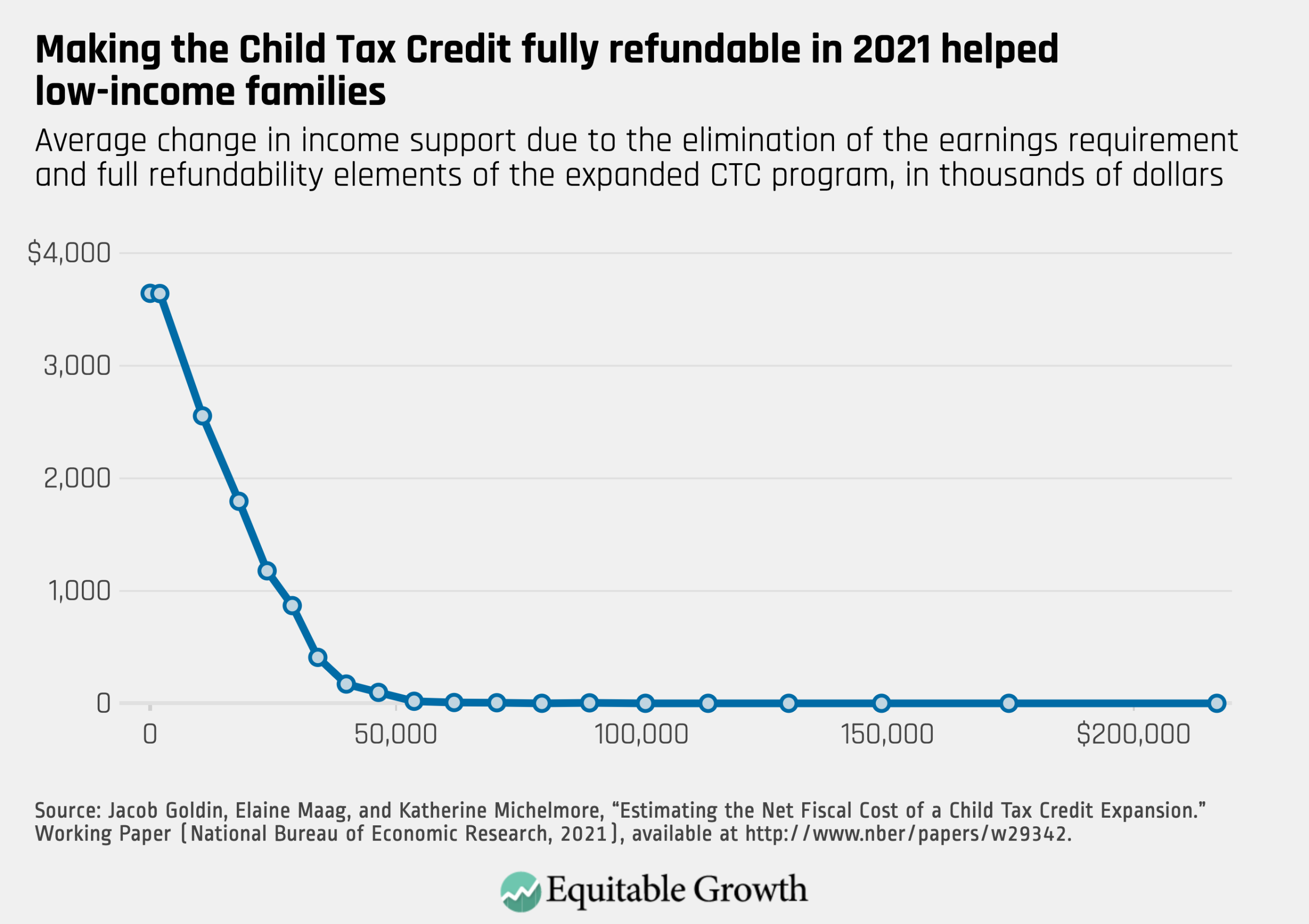
The temporary expansion of the Child Tax Credit increased benefit levels the most for low-income households, as shown below. (See Figure 1.) All of these changes have since expired.

Making the Child Tax Credit fully refundable in 2021 helped low-income families
This factsheet summarizes the current research on the effects of the enhanced Child Tax Credit. Early evaluations of its temporary expansion generally find that it increased economic well-being with limited or no detriment to the U.S. labor supply. A well-established body of research suggests that the improved well-being of these children will boost U.S. productivity and growth when they reach adulthood.

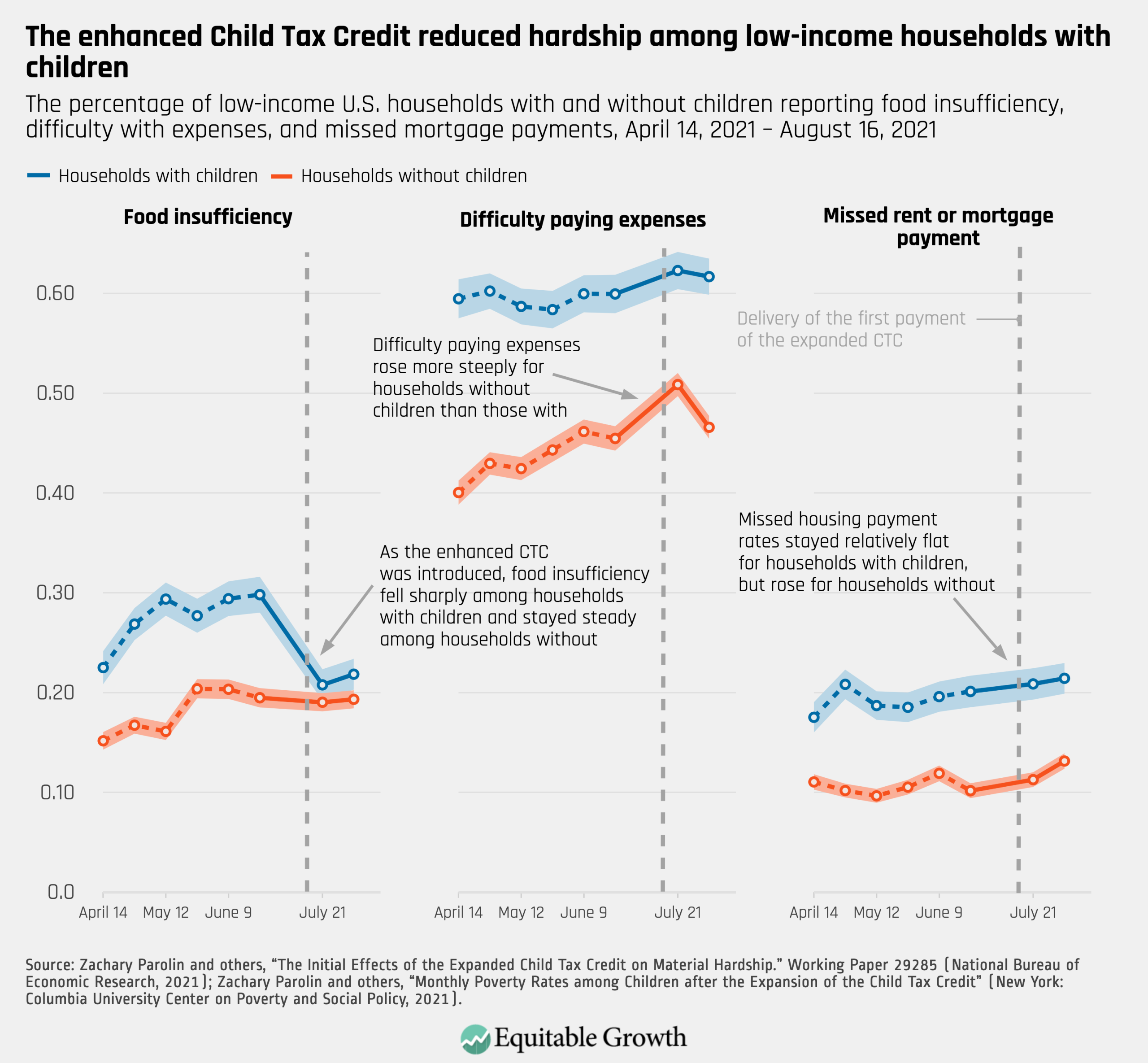
The enhanced Child Tax Credit reduced hardship among low-income households with children

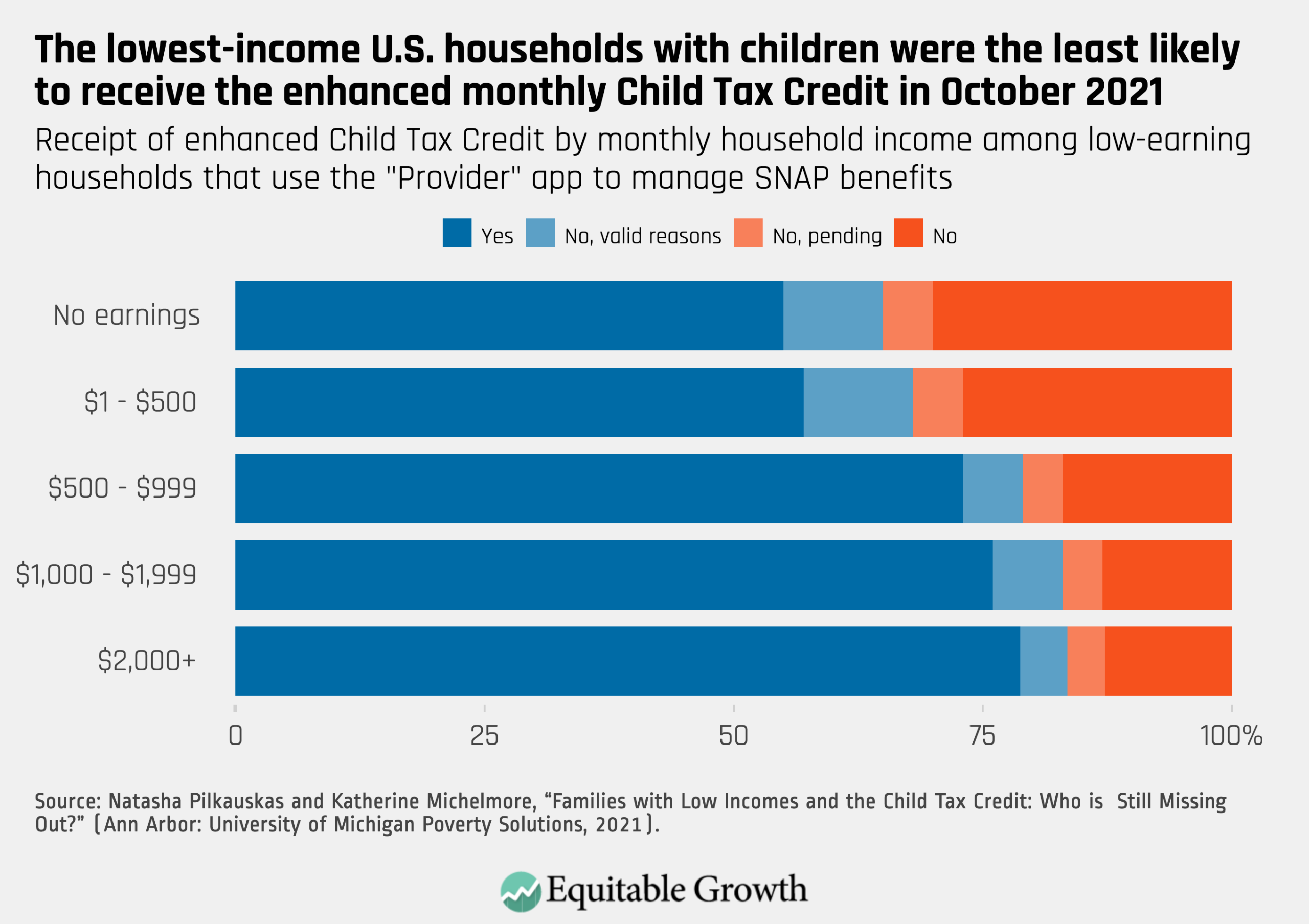
The lowest-income U.S. households with children were the least likely to receive the enhanced monthly Child Tax Credit in October 2021
Research broadly supports a permanent expansion of the Child Tax Credit. There seems to be a consensus that such a policy would improve well-being. The trial expansion of the enhanced Child Tax Credit in 2021 did not seem to cause parents to work less. Most simulations of a permanent expansion of this income support suggest that labor disincentives would be small.
Indeed, the primary argument for not expanding the Child Tax Credit is that it would allow low-income parents to work less, which would work against the program’s goal of reducing child poverty. Yet a large body of evidence on income support for children makes a strong case that these policies tend to improve children’s well-being, as well as their socioeconomic outcomes in adulthood, thus boosting U.S. economic productivity and growth over the long term.
1. Zachary Parolin and others, “The Initial Effects of the Expanded Child Tax Credit on Material Hardship.” Working Paper 29285 (National Bureau of Economic Research, 2021), available at https://www.nber.org/papers/w29285 (opens in a new tab); Zachary Parolin and others, “Monthly Poverty Rates among Children after the Expansion of the Child Tax Credit” (New York: Columbia University Center on Poverty and Social Policy, 2021), available at https://www.povertycenter.columbia.edu/publication/monthly-poverty-july-2021 (opens in a new tab)
2. Natasha Pilkauskas and others, “The Effects of Income on the Economic Wellbeing of Families with Low Incomes: Evidence from the 2021 Expanded Child Tax Credit.” Working Paper No. w30533 (National Bureau of Economic Research, 2022), available at https://www.nber.org/papers/w30533 (opens in a new tab).
3. Ibid.
4. National Academies of Sciences, Engineering, and Medicine, “A Roadmap to Reducing Child Poverty” (2019), available at https://nap.nationalacademies.org/child-poverty (opens in a new tab); Anna Aizer, Hilary Hoynes, and Adriana Lleras-Muney, “Children and the US Social Safety Net: Balancing Disincentives for Adults and Benefits for Children,” Journal of Economic Perspectives 36 (2) (2022): 149–74, available at https://www.aeaweb.org/articles?id=10.1257/jep.36.2.149 (opens in a new tab).
5. Elizabeth Ananat and others, “Effects of the Expanded Child Tax Credit on Employment Outcomes: Evidence from Real-World Data from April to December 2021.” Working Paper 29823 (National Bureau of Economic Research, 2022), available at https://papers.ssrn.com/sol3/papers.cfm?abstract_id=4051257 (opens in a new tab).
6. Pilkauskas and others, “The Effects of Income on the Economic Wellbeing of Families with Low Incomes: Evidence from the 2021 Expanded Child Tax Credit.”
7. Jacob Goldin, Elaine Maag, and Katherine Michelmore, “Estimating the Net Fiscal Cost of a Child Tax Credit Expansion.” Working Paper 29342 (National Bureau of Economic Research, 2021), available at https://papers.ssrn.com/sol3/papers.cfm?abstract_id=3940028 (opens in a new tab); Irwin Garfinkel and others, “The Benefits and Costs of a U.S. Child Allowance.” Working Paper 29854 (National Bureau of Economic Research, 2022), available at https://www.nber.org/papers/w29854 (opens in a new tab).
8. Kevin Corinth and others, “The Anti-Poverty, Targeting, and Labor Supply Effects of Replacing a Child Tax Credit with a Child Allowance.” Working Paper 29366 (National Bureau of Economic Research, 2021), available at https://www.nber.org/papers/w29366 (opens in a new tab).
9. Sophie Collyer, David Harris, and Christopher Wimer, “Left behind: The one-third of children in families who earn too little to get the full child tax credit,” Poverty & Social Policy Brief 3 (6) (2019).
10. Natasha Pilkauskas and Katherine Michelmore, “Families with Low Incomes and the Child Tax Credit: Who is Still Missing Out?” (Ann Arbor: University of Michigan Poverty Solutions, 2021).
11. Ibid.
12. Ibid.
13. Ibid.
14. Ibid.
Blog NOV 24, 2026
By: Christopher Bangert-Drowns
Essays NOV 20, 2026
By: Chris Clayton, Korin Davis
Essays NOV 18, 2026
By: Christopher Bangert-Drowns
Get updates on our latest research, event announcements, and policy insights delivered straight to your inbox. Stay connected with the leading voices on equitable growth.