
Five policy planks to prepare U.S. workers for dislocation caused by artificial intelligence
Reports NOV 23, 2026
By: Jacob Leibenluft, Gene Sperling
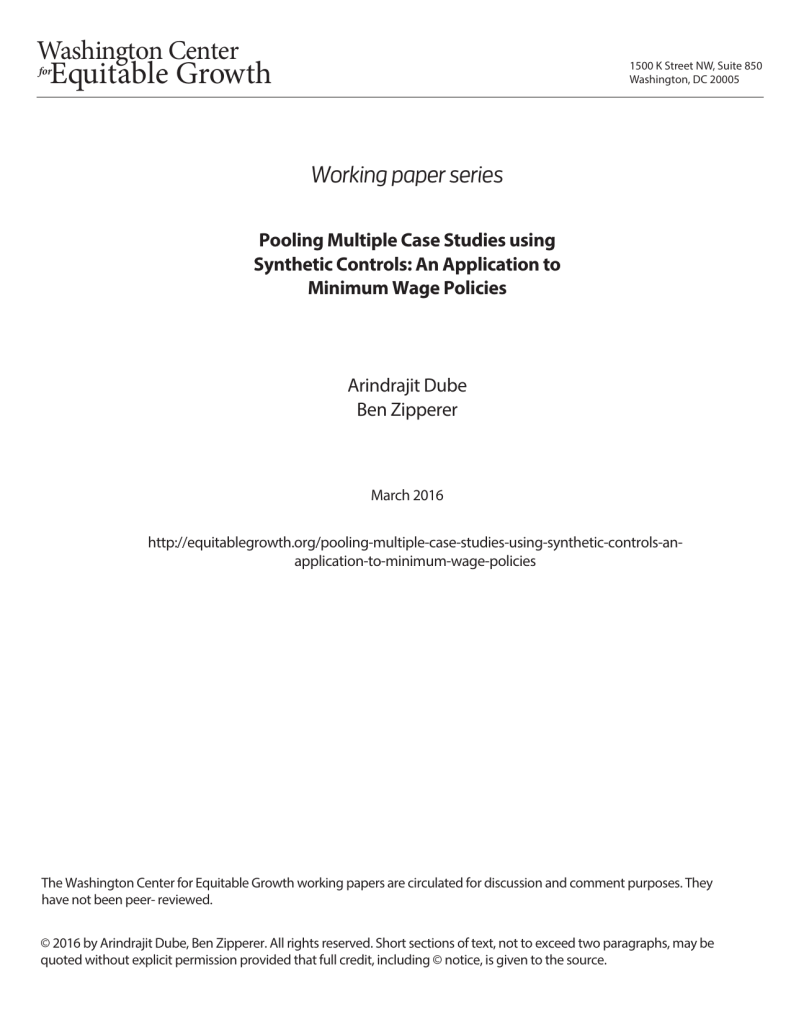
MAR 1, 2016
By: Arindrajit Dube and Ben Zipperer
Read the full PDF in your browser (opens in a new tab)
We assess the employment and wage effects minimum wage increases between 1979 and 2013 by pooling 29 synthetic control case studies. Using the mean percentile rank, a simple, distribution-free method, we find a sizable, positive and statistically significant effect on the average teen wage. We also test for heterogeneous treatment effects using the distribution of estimated ranks, which has a known form, and detect heterogeneity in the wage elasticities, consistent with differential bites in the policy. In contrast, the employment estimates suggest a small constant effect not distinguishable from zero.
Reports NOV 23, 2026
By: Jacob Leibenluft, Gene Sperling
Essays NOV 20, 2026
By: Chris Clayton, Korin Davis
Essays OCT 30, 2026
By: Christopher Bangert-Drowns
Get updates on our latest research, event announcements, and policy insights delivered straight to your inbox. Stay connected with the leading voices on equitable growth.