




Academic
Request for Proposals: Research grants for early career scholars
Request for Proposals (RFPs) NOV 23, 2026
By: Equitable Growth
Economic Equity & Opportunity
 Browse All Resources
SEP 15, 2021

Despite the important role that child care plays in the lives of many U.S. families, the private child care market is not meeting their needs. This is not just an issue for families with young children in the United States—accessible, affordable, and high-quality care also has the potential to generate substantial economic activity and growth that benefits the entire economy.1
Public investments in child care can help eliminate the drag on growth that the lack of child care options creates. These investments, in turn, facilitate economic gains for families, businesses, and the U.S. economy as a whole.
Factsheet: What the research says about the economics of early care and education (PDF)
Download (opens in a new tab)This factsheet will review the research on the short- and long-term economic growth potential of a high-quality, accessible, and affordable early care and education system as well as the evidence supporting greater public investment in this market. For more information, see Equitable Growth’s companion report on the child care economy.
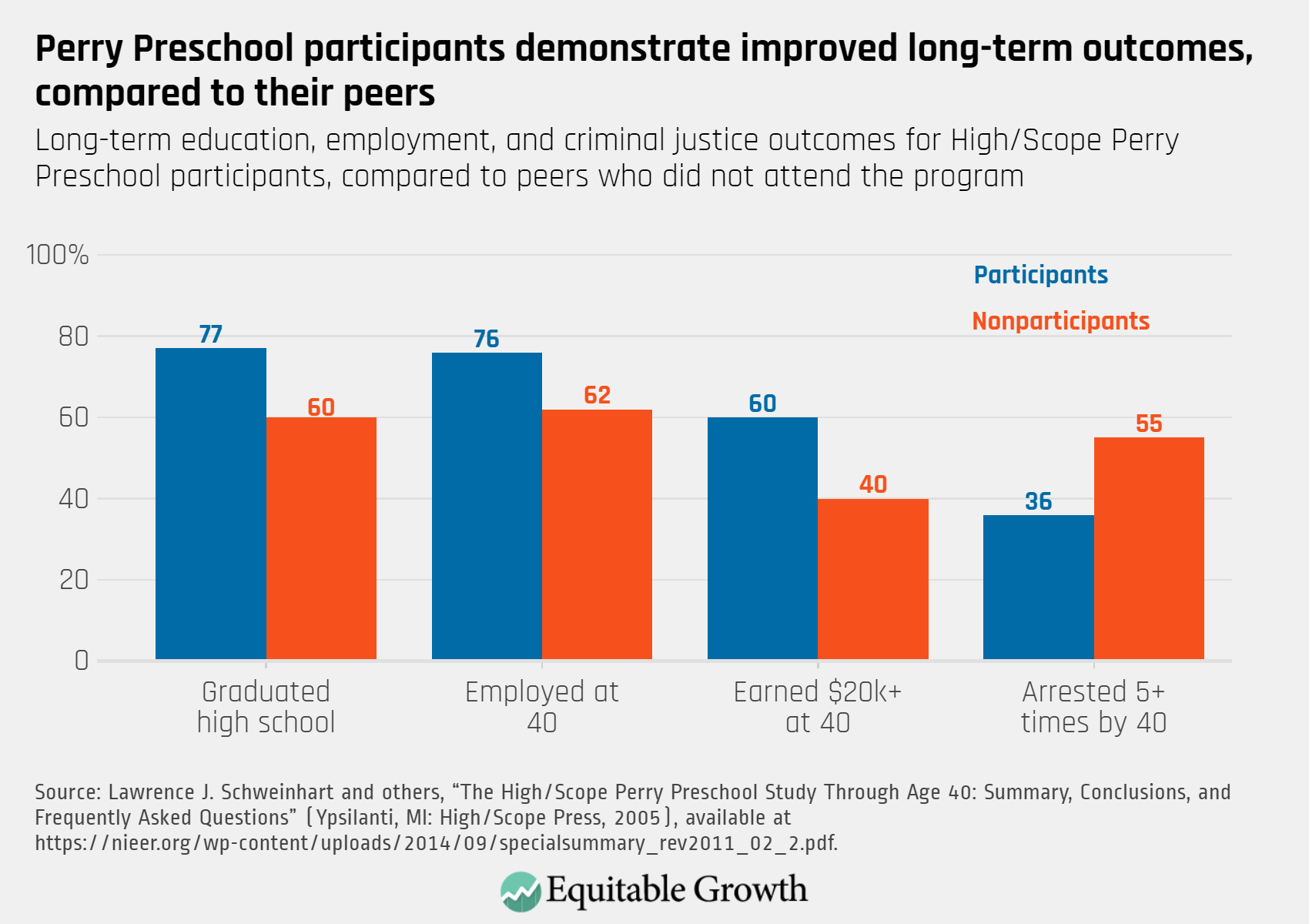
Perry Preschool participants demonstrate improved long-term outcomes, compared to their peers
By neglecting the child care market for decades, policymakers have shifted the burden of child care onto the shoulders of U.S. families already bearing the weight of childrearing, employment, and other responsibilities at home—despite research showing that the U.S. economy has much to gain from a functional and equitable child care system.
Addressing the child care crisis has the potential to improve families’ economic security and well-being in the United States, all while accelerating economic growth in the short- and long-term. To do so, policymakers must unburden families with meaningful, targeted, and evidence-based investments in the nation’s early care and education system.
For more information, see Equitable Growth’s report on the child care economy.
1. Ajay Chaundry and others, Cradle to Kindergarten: A New Plan to Combat Inequality, 2nd ed. (New York: The Russell Sage Foundation, 2021), pp. 41–69.
2. Rasheed Malik and others, “America’s Child Care Deserts in 2018” (Washington: Center for American Progress, 2018), available at https://www.americanprogress.org/issues/early-childhood/reports/2018/12/06/461643/americas-child-care-deserts-2018// (opens in a new tab).
3. Office of Child Care, “The Decreasing Number of Child Care Providers in the United States” (Washington: U.S. Department of Health and Human Services, 2019), available at https://www.acf.hhs.gov/occ/news/the-decreasing-number-of-family-child-care-providers-in-the-united-states (opens in a new tab).
4. Child Care Aware of America, “The US and the High Price of Child Care: An Examination of a Broken System” (2019), available at https://www.childcareaware.org/our-issues/research/the-us-and-the-high-price-of-child-care-2019/ (opens in a new tab).
5. Economic Policy Institute, “The Cost of Child Care in the United States” (2020), available at https://www.epi.org/child-care-costs-in-the-united-states/ (opens in a new tab).
6. Sara Raley, Suzanne M. Bianchi, and Wendy Wang, “When Do Fathers Care? Mothers’ Economic Contributions and Fathers’ Involvement in Child Care,” American Journal of Sociology 117 (5) (2012), available at https://www.journals.uchicago.edu/doi/10.1086/663354 (opens in a new tab).
7. Ozlem Tasseven, “The relationship between economic development and female labor force participation rate: A panel data analysis.” In Ü. Hacioğlu and H. Dinçer, eds., Global Financial Crisis and Its Ramifications on Capital Markets (Basel, Switzerland: Springer, Cham, 2017), available at https://doi.org/10.1007/978-3-319-47021-4_38 (opens in a new tab).
8. Chris M. Herbst and Burt S. Barnow, “Close to Home: A Simultaneous Equations Model of the Relationship Between Child Care Accessibility and Female Labor Force Participation,” Journal of Family and Economic Issues 29 (2008): 128–151, available at https://doi.org/10.1007/s10834-007-9092-5 (opens in a new tab).
9. Taryn Morrissey, “Child Care and Parent Labor Force Participation: A Review of the Research Literature,” Review of Economics of the Household 15 (1) (2017): 1–24, available at https://link.springer.com/article/10.1007%2Fs11150-016-9331-3 (opens in a new tab); Taryn Morrissey, “Addressing the need for affordable, high-quality early childhood care and education for all in the United States” (Washington: Washington Center for Equitable Growth, 2019), available at https://www.equitablegrowth.org/our-work/resources/addressing-the-need-for-affordable-high-quality-early-childhood-care-and-education-for-all-in-the-united-states/.
10. Rachel A. Gordon, Robert Kaestnery, and Sanders Korenman, “Child Care and Work Absences: Trade-Offs by Type of Care,” Journal of Family and Marriage 70 (1) (2008), available at https://www.jstor.org/stable/40056266?seq=1 (opens in a new tab).
11. Neal Halfon, Ericka Shulman, and Miles Hochstein, “Brain Development in Early Childhood. Building Community Systems for Young Children” (Los Angeles: University of California Center for Healthier Children, Families, and Community, 2001), available at https://files.eric.ed.gov/fulltext/ED467320.pdf (opens in a new tab).
12. William T. Gormley, Jr. and others, “The Effects of Universal Pre-K on Cognitive Development,” Developmental Psychology 41 (6) (2005), available at https://www.apa.org/pubs/journals/releases/dev-416872.pdf (opens in a new tab).
13. Taryn Morrissey, Lindsey Hutchinson, and Kimberly Burgess, “The Short- and Long-Term Impacts of Large Public Early Care and Education Programs” (Washington: U.S. Department of Health and Human Services, 2014), available at https://aspe.hhs.gov/system/files/pdf/180301/rb_longTermImpact.pdf (opens in a new tab).
14. Lawrence J. Schweinhart and others, “The High/Scope Perry Preschool Study Through Age 40: Summary, Conclusions, and Frequently Asked Questions” (Ypsilanti, MI: High/Scope Press, 2005), available at https://nieer.org/wp-content/uploads/2014/09/specialsummary_rev2011_02_2.pdf (opens in a new tab).
15. Guthrie Gray-Lobe, Parag A. Pathak, and Christopher R. Walters, “The Long-Term Effects of Universal Preschool in Boston.” Working Paper 28756 (National Bureau of Economic Research, 2021), available at http://www.nber.org/papers/w28756 (opens in a new tab).
16. Gabrielle Pepin, “The Effects of Child Care Subsidies on Paid Child Care Participation and Labor market Outcomes: Evidence from the Child and Development Care Credit.” Working Paper 20-331(W.E. Upjohn Institute for Employment Research, 2020), available at https://research.upjohn.org/cgi/viewcontent.cgi?article=1350&context=up_workingpapers (opens in a new tab); Chris M. Herbst, “The labor supply effects of child care costs and wages in the presence of subsidies and the earned income tax credit,” Review of Household Economics 8 (2) (2009), available at https://link.springer.com/article/10.1007%2Fs11150-009-9078-1 (opens in a new tab).
17. Marsha Weinraub and others, “Subsidizing child care: How child care subsidies affect the child care used by low-income African Americans families,” Early Childhood Research Quarterly 20 (2005), available at https://citeseerx.ist.psu.edu/viewdoc/download?doi=10.1.1.565.2163&rep=rep1&type=pdf (opens in a new tab); Suzanne W. Helburn, John R. Morris, and Kathy Modigliani, “Family child care finances and their effect on quality and incentives,” Early Childhood Research Quarterly 17 (4) (2002), available at https://www.sciencedirect.com/science/article/abs/pii/S0885200602001886?via%3Dihub (opens in a new tab).
18. U.S. Bureau of Labor Statistics, “Occupational Employment and Wages, May 2020, 39-9011 Childcare Workers” (Washington: U.S. Department of Labor, 2021), available at https://www.bls.gov/oes/current/oes399011.htm (opens in a new tab).
19. Eric C. Twombly, Maria D. Montilla, and Carol J. De Vita, “State Initiatives to Increase Compensation for Child Care Workers” (Washington: Urban Institute, 2001), available at https://files.eric.ed.gov/fulltext/ED452993.pdf (opens in a new tab).
20. Bassam A. Albassam and Mariam Camarero, “A model for assessing the efficacy of government expenditure,” Cogent Economics & Finance 8 (1) (2020), available at https://www.tandfonline.com/doi/full/10.1080/23322039.2020.1823065 (opens in a new tab); Paul M. Romer, “Human Capital and Growth: Theory and Evidence,” Carnegie-Rochester Conference Series on Public Policy 32 (1990), available at https://www.sciencedirect.com/science/article/abs/pii/016722319090028J?via%3Dihub (opens in a new tab).
Request for Proposals (RFPs) NOV 23, 2026
By: Equitable Growth

Reports NOV 23, 2026
By: Jacob Leibenluft, Gene Sperling

Essays NOV 20, 2026
By: Chris Clayton, Korin Davis
Get updates on our latest research, event announcements, and policy insights delivered straight to your inbox. Stay connected with the leading voices on equitable growth.


