




Academic
Request for Proposals: Research grants for early career scholars
Request for Proposals (RFPs) NOV 23, 2026
By: Equitable Growth
Economic Equity & Opportunity
 Browse All Resources
SEP 16, 2021
Sufficient income is one of the most important components of a stable and healthy household budget. Income support programs help ensure that U.S. households have the income they need to cover the basic expenses of daily life. Some income support is delivered through direct cash transfers, including in programs such as Temporary Assistance to Needy Families, Supplemental Security Income, Social Security Disability Income, and Unemployment Insurance, while others provide essential goods such as food or housing to families, thus freeing up existing household income to be used for other purposes.
Yet the COVID-19 crisis demonstrates that existing income support infrastructure in the United States is wholly insufficient in providing relief to those who needed it.1 Pandemic-specific income supports delivered through the Coronavirus Aid, Relief, and Economic Security, or CARES, Act and related programs successfully (opens in a new tab) blunted some of the worst pain of the coronavirus recession, but they failed to deliver for all who needed (opens in a new tab) income support due to sustained underinvestment in these vital programs over the past half-century.2
While both common sense and a robust body of literature (opens in a new tab) make clear that income support improves the economic well-being of the people who access it, it’s important not to overlook the effects these programs also have on the U.S. economy as a whole.3 This factsheet discusses the economic impacts of income support programs, who they reach, how racism prevents them from serving their economic function, and what policymakers can do about it, starting with the upcoming 2022 budget reconciliation negotiations.
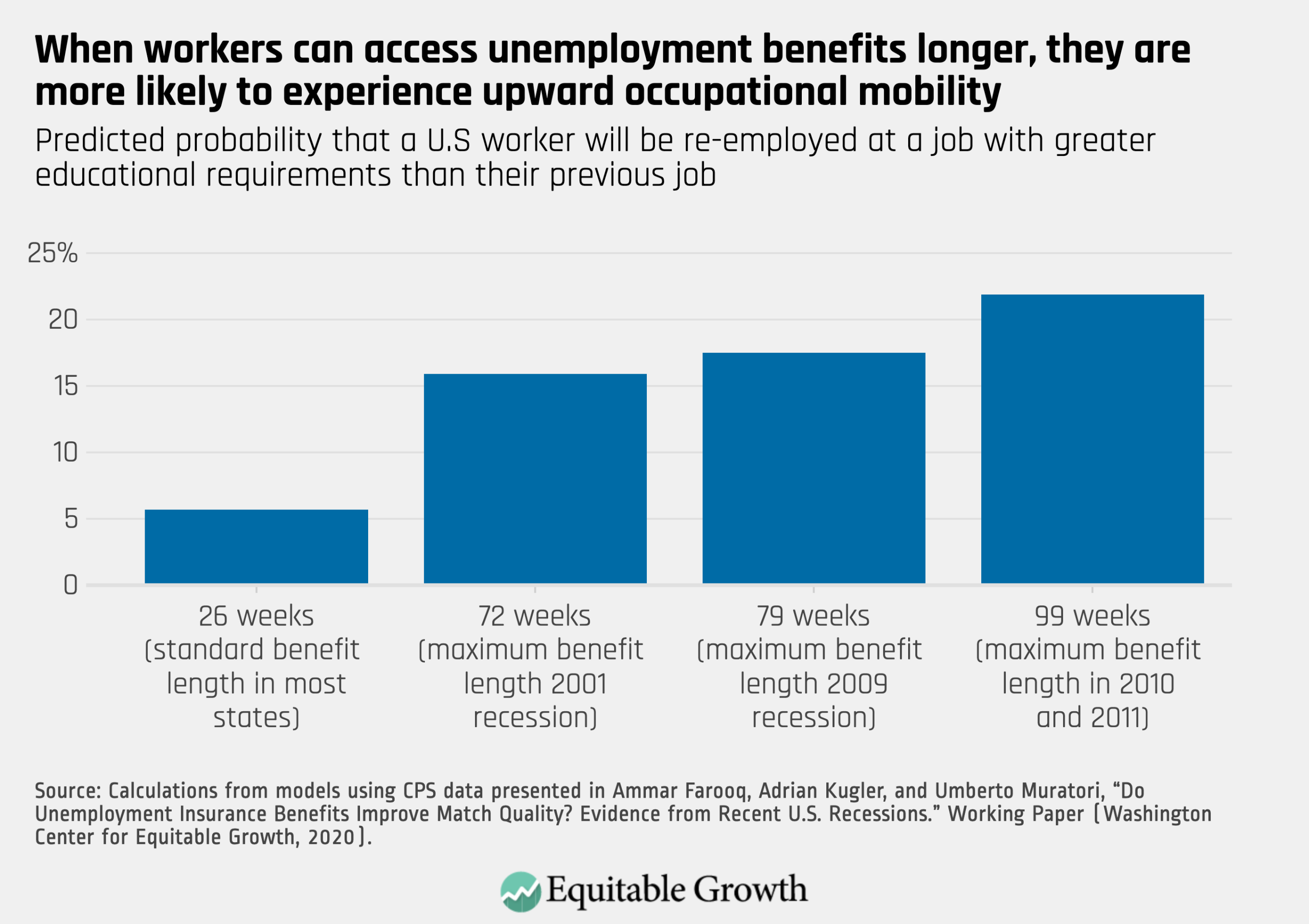
When workers can access unemployment benefits longer, they are more likely to experience upward occupational mobility
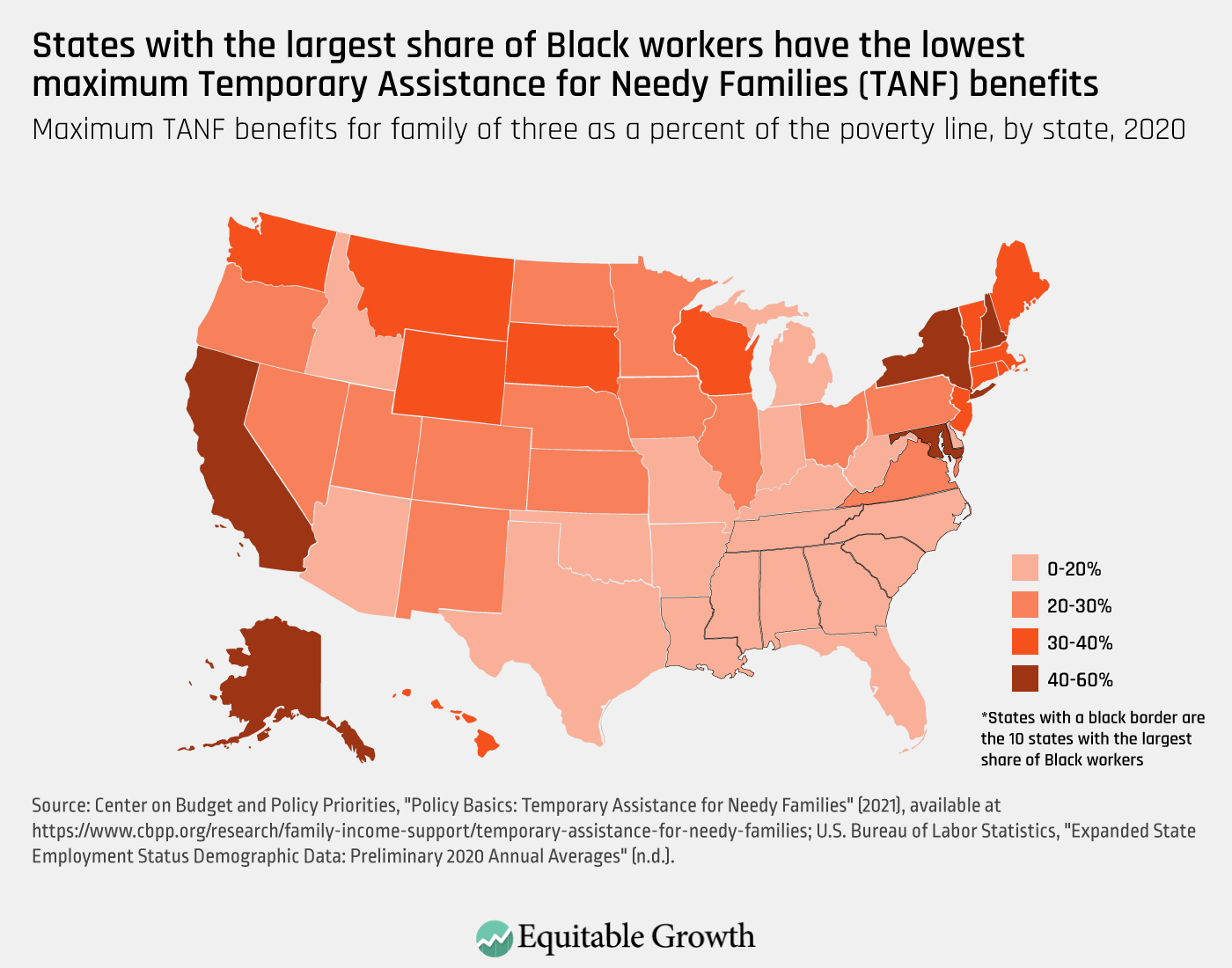
States with the largest share of Black workers have the lowest maximum Temporary Asssistance for Needy Families (TANF) benefits
Weaknesses in the U.S. system of income supports constrain and limit the overall strength of the U.S. economy, unnecessarily deepening recessions, depressing labor force participation, and harming future growth potential by underinvesting in the human capital of the next generation of workers. The inability to access income support programs to weather unexpected storms has serious consequences, especially for many workers of color, women, and their families. Indeed, the coronavirus recession exposed already-deep inequalities (opens in a new tab) in access to income supports along lines of race and gender.23
There are several options for policymakers who want to remedy these weaknesses and build a system of income supports that will fulfill its potential to help the economy grow, including:
The upcoming budget reconciliation negotiations offer a promising opportunity to enact these and other reforms to U.S. social infrastructure, including income support programs. These actions would not only benefit those U.S. workers and their families who need help the most, but also bolster the overall U.S. economy as it continues to recover from the coronavirus recession.
For more information, see Equitable Growth’s issue brief, “Weak income support infrastructure harms U.S. workers and their families and constrains economic growth.”
1. Alix Gould-Werth, “The only thing better than strengthening federal social supports now to prevent a coronavirus recession is strengthening them forever” (Washington: Washington Center for Equitable Growth, 2020), available at https://www.equitablegrowth.org/our-work/resources/the-only-thing-better-than-strengthening-federal-social-supports-now-to-prevent-a-coronavirus-recession-is-strengthening-them-forever/.
2. Zachary Parolin and others, “Monthly Poverty Rates in the United States during the COVID-19 Pandemic” (New York: Center on Poverty & Social Policy, 2020), available at https://www.povertycenter.columbia.edu/news-internal/2020/covid-projecting-monthly-poverty (opens in a new tab); Amanda Fischer and Alix Gould-Werth, “Broken plumbing: How systems for delivering economic relief in response to the coronavirus recession failed the U.S. economy” (Washington: Washington Center for Equitable Growth, 2020), available at https://www.equitablegrowth.org/our-work/resources/broken-plumbing-how-systems-for-delivering-economic-relief-in-response-to-the-coronavirus-recession-failed-the-u-s-economy/; Shawn Donnan and Reade Pickert, “U.S. Unemployment Rescue Left at Least 9 Million Without Help,” Bloomberg Businessweek, June 25, 2021, available at https://www.bloomberg.com/news/features/2021-06-25/u-s-unemployment-at-least-9-million-americans-didn-t-receive-any-benefits (opens in a new tab).
3. Arloc Sherman, Danilo Trisi, and Sharon Parrott. “Various Supports for Low-Income Families Reduce Poverty and Have Long-Term Positive Effects On Families and Children” (Washington: Center on Budget and Policy Priorities, 2021), available at https://www.cbpp.org/research/various-supports-for-low-income-families-reduce-poverty-and-have-long-term-positive (opens in a new tab).
4. Gabriel Chodorow-Reich and John Coglianese, “Unemployment insurance and macroeconomic stabilization” (Washington: The Brookings Institution, 2019), available at https://www.brookings.edu/research/unemployment-insurance-and-macroeconomic-stabilization/ (opens in a new tab).
5. Alan S. Blinder and Mark Zandi, “The Financial Crisis: Lessons for the Next One” (Washington: Center on Budget and Policy Priorities, 2015), available at https://www.cbpp.org/research/economy/the-financial-crisis-lessons-for-the-next-one (opens in a new tab); Hilary Hoynes and Diane Whitmore Schanzenbach, “Strengthening SNAP as an Automatic Stabilizer” (Washington: The Hamilton Project, 2019), available at https://www.hamiltonproject.org/assets/files/HoynesSchanzenbach_web_20190506.pdf (opens in a new tab).
6. Charles L. Baum II and Christopher J. Ruhm, “The Effects of Paid Family Leave in California on Labor Market Outcomes,” Journal of Policy Analysis and Management 35 (2) (2016), available at https://onlinelibrary.wiley.com/doi/abs/10.1002/pam.21894 (opens in a new tab).
7. Taryn W. Morrissey, “Child Care and Parent Labor Force Participation: A Review of the Research Literature,” Review of Economics of the Household 15 (1) (2017): 1–24, available at https://doi.org/10.1007/s11150-016-9331-3 (opens in a new tab).
8. Nada Eissa and Jeffrey B. Liebman, “Labor Supply Response to the Earned Income Tax Credit,” The Quarterly Journal of Economics 111 (2) (1996): 605–37, available at https://doi.org/10.2307/2946689 (opens in a new tab).
9. Alix Gould-Werth, “The long-run implications of extending unemployment benefits in the United States for workers, firms, and the economy” (Washington: Washington Center for Equitable Growth, 2020), available at https://www.equitablegrowth.org/our-work/resources/the-long-run-implications-of-extending-unemployment-benefits-in-the-united-states-for-workers-firms-and-the-economy/.
10. Joanna Venator, “Moving with Two Careers Is Hard, but Unemployment Insurance for Trailing Spouses Can Help” (Washington: Washington Center for Equitable Growth, 2021), available at https://www.equitablegrowth.org/our-work/resources/moving-with-two-careers-is-hard-but-unemployment-insurance-for-trailing-spouses-can-help/.
11. Jesse Rothstein, “The Earned Income Tax Credit” (Washington: Washington Center for Equitable Growth, 2015) available at https://www.equitablegrowth.org/our-work/resources/the-earned-income-tax-credit/; Hilary Hoynes, Doug Miller, and David Simon, “Income, the Earned Income Tax Credit, and Infant Health,” American Economic Journal: Economic Policy 7 (1) (2015): 172–211, available at https://doi.org/10.1257/pol.20120179 (opens in a new tab).
12. Shirlee Lichtman-Sadot and Neryvia Pillay Bell, “Child Health in Elementary School Following California’s Paid Family Leave Program,” Journal of Policy Analysis and Management 36 (4) (2017): 790–827, available at https://doi.org/10.1002/pam.22012 (opens in a new tab).
13. Martha Bailey and others, “New working paper shows long-term U.S. economic and health benefits of the Supplemental Nutrition Assistance Program” (Washington: Washington Center for Equitable Growth, 2020), available at https://www.equitablegrowth.org/our-work/resources/new-working-paper-shows-long-term-u-s-economic-and-health-benefits-of-the-supplemental-nutrition-assistance-program/.
14. Stacy West and others, “Preliminary Analysis: SEED’s First Year” (Stockton, CA: Stockton Economic Empowerment Demonstration, 2021), available at https://static1.squarespace.com/static/6039d612b17d055cac14070f/t/6050294a1212aa40fdaf773a/1615866187890/SEED_Preliminary+Analysis-SEEDs+First+Year_Final+Report_Individual+Pages+.pdf (opens in a new tab).
15. Hilary Hoynes and Nicole Maestas, “The Effect of Attorney and Non-Attorney Representation on the Initial Disability Determination Process.” Working Paper (National Bureau of Economic Research, 2016), available at https://www.nber.org/programs-projects/projects-and-centers/retirement-and-disability-research-center/center-papers/drc-nb16-15 (opens in a new tab); Michelle Derr and Elizabeth Brown, “Improving Program Engagement of TANF Families: Understanding Participation and Those with Reported Zero Hours of Participation in Work Activities” (Princeton, NJ: Mathematica, 2015), available at https://www.mathematica.org/publications/improving-program-engagement-of-tanf-families-understanding-participation-and-those-with-reported (opens in a new tab).
16. Center on Budget and Policy Priorities, “Policy Basics: Temporary Assistance for Needy Families” (2021), available at https://www.cbpp.org/research/family-income-support/temporary-assistance-for-needy-families (opens in a new tab).
17. Marianne Bitler and Hilary Hoynes, “The More Things Change, the More They Stay the Same? The Safety Net and Poverty in the Great Recession.” Working Paper 19449 (National Bureau of Economic Research, 2013), available at https://doi.org/10.3386/w19449 (opens in a new tab).
18. Mark R. Rank and Thomas A. Hirschl, “Poverty across the Life Cycle: Evidence from the PSID,” Journal of Policy Analysis and Management 20 (4) (2001): 737–755, available at https://onlinelibrary.wiley.com/doi/epdf/10.1002/pam.1026 (opens in a new tab); Jane E. Brody, “A Superfluous Organ Can Still Cause Trouble,” The New York Times, November 16, 2004, available at https://www.nytimes.com/2004/11/16/health/a-superfluous-organ-can-still-cause-trouble.html (opens in a new tab); Rose M. Kreider and Renee Ellis, “Number, Timing, and Duration of Marriages and Divorces: 2009” (Washington: U.S. Census Bureau, 2011), available at https://www.census.gov/prod/2011pubs/p70-125.pdf (opens in a new tab).
19. Sarah Minton and Linda Giannarelli, “Five Things You May Not Know about the US Social Safety Net” (Washington: Urban Institute, 2019), available at https://www.urban.org/sites/default/files/publication/99674/five_things_you_may_not_know_about_the_us_social_safety_net_1.pdf (opens in a new tab); Theodore Figinski, “Issue Brief Four: The Distribution and Evolution of the Social Safety Net and Social Insurance Benefits: 1990 to 2014” (Washington: U.S. Department of the Treasury, 2017), available at https://www.treasury.gov/resource-center/economic-policy/Documents/The%20Economic%20Security%20of%20American%20Households-%20the%20Safety%20Net.pdf (opens in a new tab).
20. Madison Allen, “Racism in Public Benefit Programs: Where Do We Go from Here?” (Washington: CLASP, 2020), available at https://www.clasp.org/blog/racism-public-benefit-programs-where-do-we-go-here (opens in a new tab).
21. Alberto F. Alesina, Edward L. Glaeser, and Bruce Sacerdote, “Why Doesn’t The US Have a European-Style Welfare State?” (Harvard Institute of Economic Research, 2001), available at https://doi.org/10.2139/ssrn.290047 (opens in a new tab).
22. Liz Hipple and Alix Gould-Werth, “Weak Income Support Infrastructure Harms U.S. Workers and Their Families and Constrains Economic Growth” (Washington: Washington Center for Equitable Growth, 2021). https://www.equitablegrowth.org/our-work/resources/weak-income-support-infrastructure-harms-u-s-workers-and-their-families-and-constrains-economic-growth/.
23. TIME’S UP Foundation, “Foundations for a Just and Inclusive Recovery” (2021), available at https://timesupfoundation.org/work/times-up-impact-lab/times-up-measure-up/foundations-for-a-just-and-inclusive-recovery/. (opens in a new tab)
24. Josh Bivens and others, “Reforming Unemployment Insurance: Stabilizing a System in Crisis and Laying the Foundation for Equity” (Washington: Economic Policy Institute, 2021), available at https://www.epi.org/publication/unemployment-insurance-reform/. (opens in a new tab)
Request for Proposals (RFPs) NOV 23, 2026
By: Equitable Growth

Reports NOV 23, 2026
By: Jacob Leibenluft, Gene Sperling

Essays NOV 20, 2026
By: Chris Clayton, Korin Davis
Get updates on our latest research, event announcements, and policy insights delivered straight to your inbox. Stay connected with the leading voices on equitable growth.


