
Five policy planks to prepare U.S. workers for dislocation caused by artificial intelligence
Reports NOV 23, 2026
By: Jacob Leibenluft, Gene Sperling
APR 22, 2021
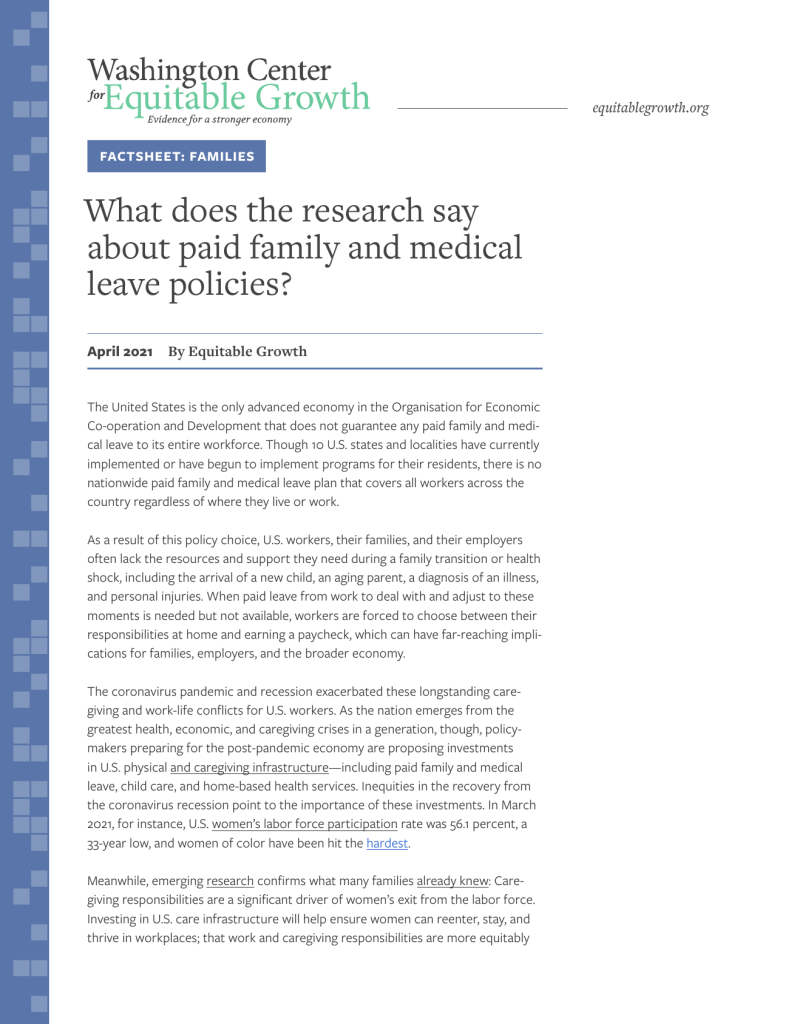
The United States is the only advanced economy in the Organisation for Economic Co-operation and Development that does not guarantee any paid family and medical leave to its entire workforce. Though 10 U.S. states and localities have currently implemented or have begun to implement programs for their residents, there is no nationwide paid family and medical leave plan that covers all workers across the country regardless of where they live or work.
As a result of this policy choice, U.S. workers, their families, and their employers often lack the resources and support they need during a family transition or health shock, including the arrival of a new child, an aging parent, a diagnosis of an illness, and personal injuries. When paid leave from work to deal with and adjust to these moments is needed but not available, workers are forced to choose between their responsibilities at home and earning a paycheck, which can have far-reaching implications for families, employers, and the broader economy.
The coronavirus pandemic and recession exacerbated these longstanding caregiving and work-life conflicts for U.S. workers. As the nation emerges from the greatest health, economic, and caregiving crises in a generation, though, policymakers preparing for the post-pandemic economy are proposing investments in U.S. physical and caregiving infrastructure—including paid family and medical leave, child care, and home-based health services. Inequities in the recovery from the coronavirus recession point to the importance of these investments. In March 2021, for instance, U.S. women’s labor force participation (opens in a new tab) rate was 56.1 percent, a 33-year low, and women of color have been hit the hardest.
Meanwhile, emerging research (opens in a new tab) confirms what many families already knew (opens in a new tab): Caregiving responsibilities are a significant driver of women’s exit from the labor force. Investing in U.S. care infrastructure will help ensure women can reenter, stay, and thrive in workplaces; that work and caregiving responsibilities are more equitably distributed; and that the country is equipped to handle both national crises, such as a new pandemic, and the personal crises that too often leave workers and their families in economic peril.
This factsheet looks at research on—and lessons learned from—state-provided paid family and medical leave programs in the United States. Building on this evidence and these lessons in establishing a national paid leave guarantee would address one of the most pressing deficiencies in the nation’s caregiving infrastructure.
This factsheet presents some of the research and evidence on paid family and medical leave as it relates to families’ economic security, human capital development, employer experiences, and U.S. economic growth. For more information on specific paid leave provisions or other aspects of the care economy, see Equitable Growth’s other factsheets on paid caregiving leave, paid medical leave, paid leave policy design, and our most recent factsheet on care infrastructure investments more broadly.
1. Charles L. Baum and Christopher J. Ruhm, “The Effects of Paid Family Leave in California on Labor Market Outcomes,” Journal of Policy Analysis and Management 35 (2) (2016): 333–56.
2. Kelly Jones and Britni Wilcher, “Reducing maternal labor market detachment: A role for paid family leave.” Working Paper (Washington Center for Equitable Growth, 2019).
3. Tanya S. Byker, “Paid Parental Leave Laws in the United States: Does Short-Duration Leave Affect Women’s Labor-Force Attachment,” The American Economic Review 106 (5) (2016): 242–246.
4. Claudia Goldin and Joshua Mitchell, “The New Life Cycle of Women’s Employment: Disappearing Humps, Sagging Middles, Expanding Tops,” Journal of Economic Perspectives 31 (1) (2017): 161–82.
5. Jack Smalligan and Chantel Boyens, “Paid Medical Leave Research” (Washington: Washington Center for Equitable Growth, 2020); Thomas Ahn and Aaron Yelowitz, “Paid Sick Leave and Absenteeism: The First Evidence from the U.S.” (SSRN, 2016).
6. Joelle Saad-Lessler, “How Does Paid Family Leave Affect Unpaid Care Providers,” The Journal of the Economics of Ageing 17 (2020).
7. Shirlee Lichtman-Sadot and Neryvia Pillay Bell, “Child Health in Elementary School Following California’s Paid Family Leave Program,” Journal of Policy Analysis and Management 36 (4) (2017): 790–827.
8. Joanne Klevens and others, “Paid Family Leave’s Effect on Hospital Admissions for Pediatric Abusive Head Trauma,” Injury Prevention: Journal of the International Society for Child and Adolescent Injury Prevention 22 (6) (2016): 442–45.
9. Rui Huang and Muzhe Yang, “Paid Maternity Leave and Breastfeeding Practice before and after California’s Implementation of the Nation’s First Paid Family Leave Program,” Economics and Human Biology 16 (2015): 45–59.
10. Samantha Trajkovski, “California Paid Family Leave and Parental Time Use” (Syracuse, NY: Syracuse University, 2019), available at https://docs.wixstatic.com/ugd/c6de6e_7fcc7bf2b2ff47eca9fe9c7a9659ff34.pdf (opens in a new tab).
11. Martha Bailey and others, “The Long-Term Effects of California’s 2004 Paid Family Leave Act on Women’s Careers: Evidence from U.S. Tax Data.” Working Paper (Washington Center for Equitable Growth, 2019).
12. Alexandra Boyle Stanczyk, “The Dynamics of U.S. Household Economic Circumstances Around a Birth,” Demography (opens in a new tab) 57 (2020): 1271–1296.
13. Alexandra Boyle Stanczyk, “Does Paid Family Leave Improve Household Economic Security Following a Birth? Evidence from California,” Social Service Review (opens in a new tab) 93 (2) (2019).
14. Daniel Kim, “Paid Sick Leave and Risks of All-Cause and Cause-Specific Mortality among Adult Workers in the USA,” International Journal of Environmental Research and Public Health 14 (10) (2017).
15. Chantel Boyens, “State Paid Family and Medical Leave Programs Helped a Surge of Workers Affected by the COVID-19 Pandemic” (Washington: Urban Institute, 2020).
16. Kelly Bedard and Maya Rossin-Slater, “The Economic and Social Impacts of Paid Family Leave in California: Report for the California Employment Development Department” (Sacramento, CA: California Employment Development Department, 2016).
17. Ann Bartel and others, “Assessing Rhode Island’s Temporary Caregiver Insurance Act: Insights from a Survey of Employers” (Washington: U.S. Department of Labor, 2016).
18. Ann Bartel and others, “Employer Attitudes Towards Paid Leave” (Stanford: Stanford University, 2017).
19. Eileen Appelbaum and Ruth Milkman, “Leaves That Pay: Employer and Worker Experiences with Paid Family Leave in California” (Washington: Center for Economic and Policy Research, 2011).
20. Ann Bartel and others, “The Impact of Paid Family Leave on Employers: Evidence from New York.” Working Paper 28672 (National Bureau of Economic Research, 2021).
21. Beth Bovino and Jason Gold, “The Key to Unlocking Growth? Women” (New York: S&P Global, 2017).
22. Anu Madgavkar and others, “COVID-19 and gender equality: Countering the regressive effects” (McKinsey & Company, 2020).
23. Jack Smalligan and Chantel Boyens, “Policymakers Can Enact a Paid family and Medical Leave Program and Honor the Biden-Harris Tax Pledge” (Washington: Urban Institute, 2021).
24. Kanika Arora and Douglass A. Wolf, “Does Paid Family Leave Reduce Nursing Home Use? The California Experience,” Journal of Policy Analysis and Management 37 (1) (2018): 38–62.
Reports NOV 23, 2026
By: Jacob Leibenluft, Gene Sperling
Essays NOV 20, 2026
By: Chris Clayton, Korin Davis
Essays OCT 30, 2026
By: Christopher Bangert-Drowns
Get updates on our latest research, event announcements, and policy insights delivered straight to your inbox. Stay connected with the leading voices on equitable growth.