
Five policy planks to prepare U.S. workers for dislocation caused by artificial intelligence
Reports NOV 23, 2026
By: Jacob Leibenluft, Gene Sperling
APR 15, 2021
The United States is emerging from the greatest health, economic, and caregiving crises in a century. Many policymakers are looking for ways to jumpstart the economy and, recognizing the tie between infrastructure and economic growth (opens in a new tab), have turned their sights on investments in U.S. physical and care infrastructure.
In March 2021, President Joe Biden proposed the American Jobs Plan and American Families Plan, a multipart proposal that would boost federal spending on the nation’s care and physical infrastructure. (See textbox for details.) Investments of this kind could help the U.S. economy recover from the coronavirus recession and lead toward sustainable, broad-based economic growth in the future.
Care infrastructure includes the policies, resources, and services necessary to help U.S. families meet their caregiving needs. Specifically, care infrastructure describes high-quality, accessible, and affordable child care; paid family and medical leave; and home- and community-based services and support.
This factsheet presents some of the research and evidence on America’s care infrastructure as it relates to families’ caregiving needs, the care workforce, and U.S. economic growth.
Caregiving is an important component of the economy. Research suggests that adequate care infrastructure can promote labor force participation, particularly among women; boost the human capital of care recipients; and support broad-based macroeconomic growth. Yet the evidence also suggests that U.S. care infrastructure is in need of greater investment, and current caregiving policies and resources may not be sufficient for the nation’s caregiving needs. For example:
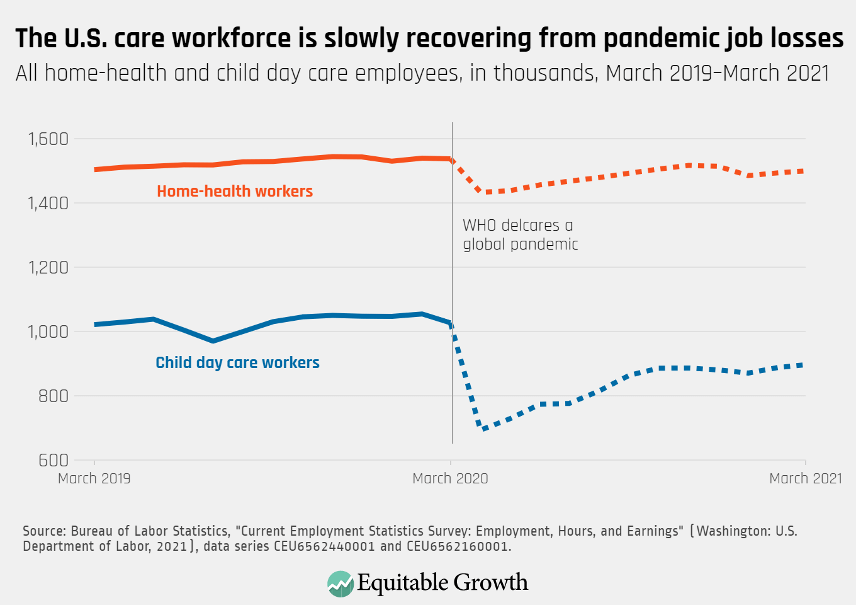
The COVID-19 pandemic and recession exposed preexisting flaws in the nation’s care infrastructure and further weakened an already-fragile system. Employment in the child care and home-health sectors remains depressed, suggesting the care economy could struggle to meet demand as the nation reopens, blunting the economic recovery. (See Figure 1.)
The U.S. care workforce is slowly recovering from pandemic job losses
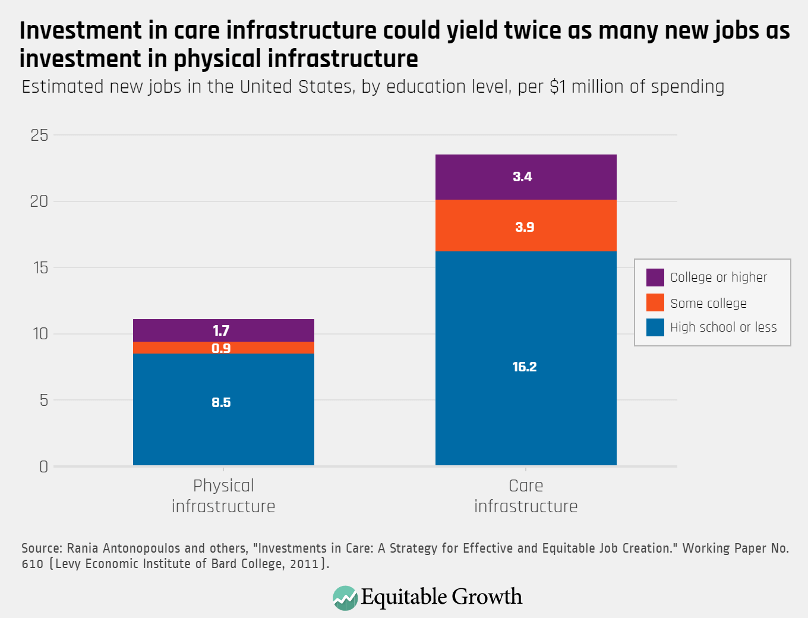
Investment in care infrastructure could yield twice as many new jobs as investment in physical infrastructure
Inefficiencies in the nation’s current care infrastructure—paid family and medical leave, child care, and home-based services and supports—constrain economic growth, and leave families and businesses vulnerable to unexpected health and caregiving shocks. Caregiving work is undervalued, and many U.S. workers across the economy face a financial penalty for engaging in care work, which can lead to high turnover and caregiving instability. When care workers are not available or not affordable, family members take on new caregiving responsibilities, exacerbating work-life challenges. If family caregivers cannot resolve these challenges, then many are forced out of the workforce—costing the economy trillions of dollars in lost productivity and compensation.
Alternatively, research suggests that investments in care infrastructure could create significantly more new jobs than investments in physical infrastructure alone, boosting GDP growth and reducing the gender employment divide. Research on the individual components of the care economy likewise support further investment.
Accessible, affordable, and high-quality child care is associated with employment gains for parents in the short term and human capital improvements for children in the long term. Likewise, a preponderance of the evidence on paid leave indicates positive labor market outcomes for caregivers and health and well-being outcomes for care recipients. Finally, patients who transition out of institution-based long-term care report better quality of life, fewer unmet care needs, and lower healthcare costs.
Altogether, the bulk of the research and evidence suggests investments in care infrastructure are a promising tool to boost U.S. economic growth, productivity, and well-being. Policymakers looking to jumpstart the U.S. economic recovery from the coronavirus recession, ensure broad-based future economic growth, and provide much-needed support to U.S. workers and their families must prioritize investment in both physical and care infrastructure.
1. Child Care Aware of America, “The US and the High Price of Child Care” (2019); Rasheed Malik and others, “The Coronavirus Will Make Child Care Deserts Worse and Exacerbate Inequality” (Washington: Center for American Progress, 2020); Jessica H. Brown and Chris M. Herbst, “Child Care Over the Business Cycle,” IZA Discussion Paper No. 14048 (IZA Institute of Labor Economics, 2021); U.S. Bureau of Labor Statistics, “Child Care Works.” In Occupational Outlook Handbook (Washington: Department of Labor, 2021).
2. Melissa Favreault and Judith Dey, “Long-Term Care Services and Supports For Older Americans: Risks and Financing, 2020” (Washington: U.S. Department of Health and Human Services, Office of the Assistant Secretary for Planning and Evaluation, 2021); Kaiser Family Foundation, “Waiting List Enrollment for Medicaid Section 1915(c) Home and Community-Based Services Waivers” (2018).
3. National Partnership for Women and Families, “State Paid Family and Medical Leave Insurance Laws: January 2021” (2021); U.S. Bureau of Labor Statistics, “National Compensation Survey, Employee Benefits in the United States, March 2020” (Washington: Department of Labor, 2020); Scott Brown and others, “Employee and Worksite Perspectives of the Family and Medical Leave Act: Results from the 2018 Surveys” (Washington: U.S. Department of Labor, 2020).
4. Nancy Folbre and Kristin Smith, “The wages of care: Bargaining power, earnings and inequality.” Working Paper (Washington Center for Equitable Growth, 2017); Robert Holly, “Home Care Industry Turnover Reaches All-Time High of 82%,” Home Health Care News, 2019.
5. Yulya Truskinovsky, Jessica Finlay, and Lindsay Kobayashi, “Caregiving in a Pandemic: COVID-19 and the Well-being of Family Caregivers 55+ in the U.S.” Working Paper (Washington Center for Equitable Growth, 2021).
6. Dan Witters, “Caregiving Costs U.S. Economy $25.2 Billion in Lost Productivity” (Washington: Gallup Inc., 2011); Metlife Mature Market Institute, “The MetLife Study of Caregiving Costs to Working Caregivers” (New York: Metlife Services and Solutions LLC, 2011).
7. Titan Alon and others, “From Mancession to Shecession: Women’s Employment in Regular and Pandemic Recession.” Working Paper 28632(National Bureau of Economic Research, 2021); The National Women’s Law Center, “A Year of Strength & Loss: The Pandemic, The Economy, and The Value of Women’s Work” (2021); U.S. Bureau of Labor Statistics, “Labor Force Participation Rate – Women [LNS11300002]” (n.d.), retrieved from the Federal Reserve Bank of St. Louis; Caitlyn Collins and others, “The Gendered consequences of a Weak Infrastructure of Care: School Reopening Plans and Parents’ Employment During the COVID-19 Pandemic,” Gender and Society (2021); Jérôme Adda, Christian Dustmann, and Katrien Stevens, “The Career Costs of Children,” Journal of Political Economy 125(2) (2017): 293–337.
8. Rania Antonopoulos and others, “Investing in Care: A Strategy for Effective and Equitable Job Creation.” Working Paper No. 60 (Levy Economic Institute of Bard College, 2011).
9. Jérôme De Henau and others, “Investing in the Care Economy: A gendered analysis of employment stimulus in seven OECD countries” (Brussels: International Trade Union Confederation, 2016).
10. Taryn W. Morrissey, “Child care and parent labor force participation: a review of the research literature,” Review of Economics of Households 15 (2016): 1–24; Chris M. Herbst and Burt S. Burnow, “Close to Home: A Simultaneous Equations Model of the Relationship Between Child Care Accessibility and Female Labor Force Participation,” Journal of Family and Economic Issues 29 (2008): 128–151.
11. James Heckman, “Invest in Early Childhood Development: Reduce Deficits, Strengthen the Economy” (The Heckman Equation,2013).
12. Elisabeth Jacobs, “Paid Family and Medical Leave in the United States: A Research Agenda” (Washington: Washington Center for Equitable Growth, 2018); Rui Huang and Muzhe Yang, “Paid maternity leave and breastfeeding practice before and after California’s implementation of the nation’s first paid family leave program,” Economic & Human Biology 16 (2015): 45–59; Joanne Klevens and others, “Paid family leave’s effect on hospital admissions for pediatric abusive head trauma” Injury Prevention 22(6) (2016): 442–445; Shirlee Lichtman-Sadot and Neryvia Pillay Bell, “Child Health in Elementary School Following California’s Paid Family Leave Program,” Journal of Policy Analysis and Management 36 (4) (2017): 790–827; Kanika Arora and Douglas A. Wolf, “Does Paid Leave Reduce Nursing Home Use? The California Experience,” Journal of Policy Analysis and Management 37 (1) (2018): 38–62; Jack Smalligan and Chantel Boyens, “Paid Medical Leave Research” (Washington: Washington Center for Equitable Growth, 2020).
13. Alix Gould-Werth, “New paid leave research demonstrates challenge of balancing work and caregiving” (Washington: Washington Center for Equitable Growth, 2019); Charles L. Baum II and Christopher J. Ruhm, “The Effects of Paid Family Leave in California on Labor Market Outcomes,” Journal of Policy Analysis and Management 35 (2) (2016): 333–356; Kelly Jones and Britni Wilcher, “Reducing maternal labor market detachment: A role for paid family leave.” Working Paper (Washington Center for Equitable Growth, 2020).
14. Carol V. Irvin and others, “Money Follows the Person 2015 Annual Evaluation Report” (Baltimore, MD: U.S. Department of Health and Human Services, Center for Medicare and Medicaid Services, 2017).
15. Naoko Muramatsu and others, “Risk of Nursing Home Admission Among Older Americans: Does States’ Spending on Home- and Community-Based Services Matter?” The Journals of Gerontology Series B: Psychological Sciences and Social Sciences 62 (4) (2007): S169–S178.
Reports NOV 23, 2026
By: Jacob Leibenluft, Gene Sperling
Essays NOV 20, 2026
By: Chris Clayton, Korin Davis
Essays OCT 30, 2026
By: Christopher Bangert-Drowns
Get updates on our latest research, event announcements, and policy insights delivered straight to your inbox. Stay connected with the leading voices on equitable growth.