
Five policy planks to prepare U.S. workers for dislocation caused by artificial intelligence
Reports NOV 23, 2026
By: Jacob Leibenluft, Gene Sperling
OCT 16, 2025
By: Susan Lambert and Julia Henly
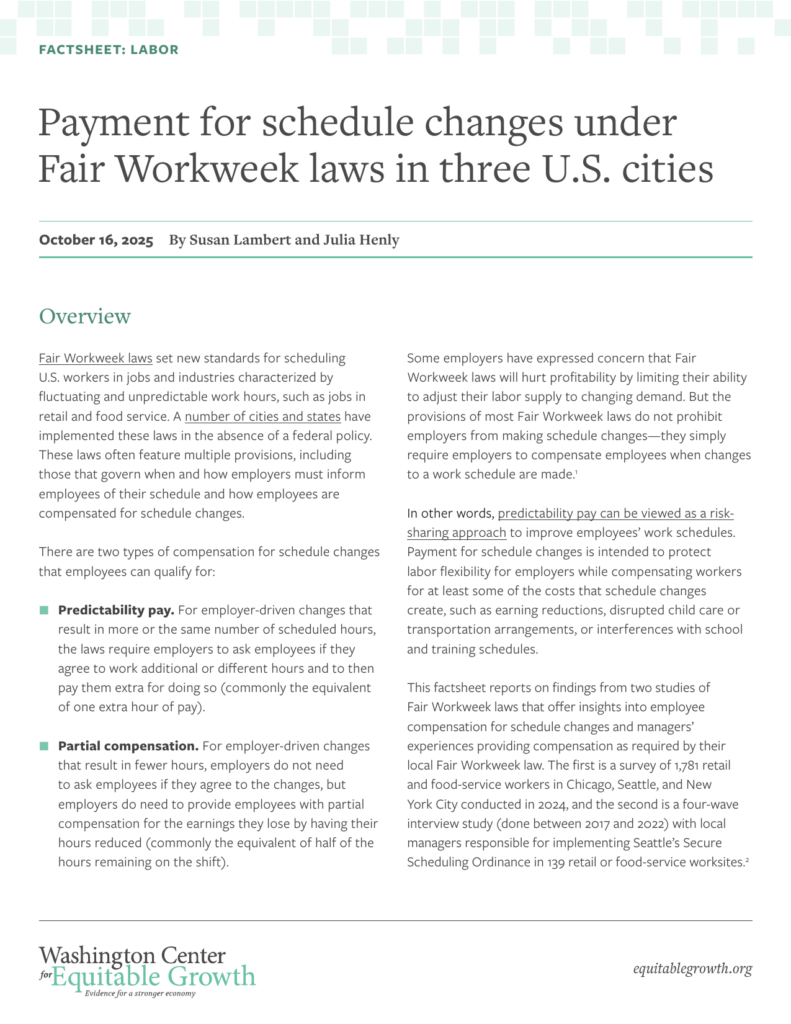
Fair Workweek laws set new standards for scheduling U.S. workers in jobs and industries characterized by fluctuating and unpredictable work hours, such as jobs in retail and food service. A number of cities and states (opens in a new tab) have implemented these laws in the absence of a federal policy. These laws often feature multiple provisions, including those that govern when and how employers must inform employees of their schedule and how employees are compensated for schedule changes.
Payment for schedule changes under Fair Workweek laws in three U.S. cities (PDF)
Download (opens in a new tab)There are two types of compensation for schedule changes that employees can qualify for:
Some employers have expressed concern that Fair Workweek laws will hurt profitability by limiting their ability to adjust their labor supply to changing demand. But the provisions of most Fair Workweek laws do not prohibit employers from making schedule changes—they simply require employers to compensate employees when changes to a work schedule are made.1
In other words, predictability pay can be viewed as a risk-sharing approach to improve employees’ work schedules. Payment for schedule changes is intended to protect labor flexibility for employers while compensating workers for at least some of the costs that schedule changes create, such as earning reductions, disrupted child care or transportation arrangements, or interferences with school and training schedules.
This factsheet reports on findings from two studies of Fair Workweek laws that offer insights into employee compensation for schedule changes and managers’ experiences providing compensation as required by their local Fair Workweek law. The first is a survey of 1,781 retail and food-service workers in Chicago, Seattle, and New York City conducted in 2024, and the second is a four-wave interview study (done between 2017 and 2022) with local managers responsible for implementing Seattle’s Secure Scheduling Ordinancein 139 retail or food-service worksites.2
Not often, unless there’s like, we had a call out that day or we’re super understaffed for some reason [like] sickness … but usually we try to make it work and not try to ask people to extend because we’d still have to pay the predictive pay if you ask people.
—Apparel retail manager, Seattle, June 2022
Yeah [we extend shifts] …. And generally, whenever we are asking someone to extend their shift, that is always just an extra perk that we let them know, like, “Hey, if you do stay, you can get predictability pay,” and that’s almost their, in a way, incentive if they’re willing to stay longer.
—Apparel retail manager, Seattle, June 2022
Manager: “If it’s a slow day and there aren’t a lot of tasks to do … sometimes we do just ask associates if anyone would like to go home early. We don’t ever send anyone home. We just ask them, “Hey, if there’s anyone who would like to go home early today…”
Interviewer: “Would they receive compensation for the hours that they would’ve worked if they completed their full shift?”
Manager: “… from my understanding, if they are sent home, then yes, they do get that compensation. But if it’s something that we present to them as something that’s a voluntary choice and no one’s required to go home … [no].”
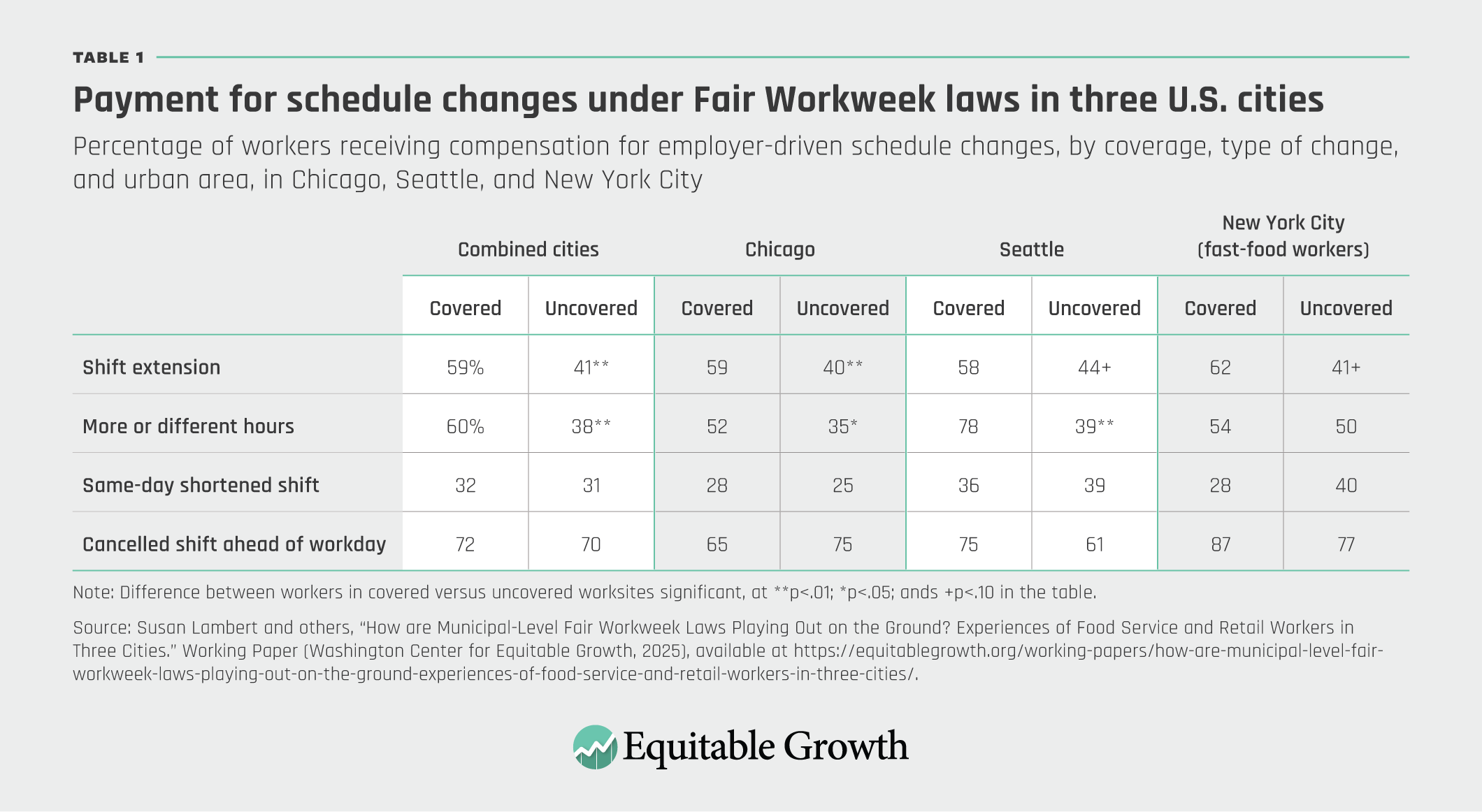
Just as an overtime premium compensates hourly employees for working beyond what is conventionally viewed as a reasonable workweek, predictability pay compensates employees for accommodating employer requests for schedule flexibility. Moreover, predictability pay incentivizes managers to limit schedule changes to those really worth it to their businesses. A federal framework that minimizes exemptions from predictability pay could provide a useful foundation for ensuring consistency across municipalities and states, furthering the goal of establishing universal standards for employers and meaningful improvements for employees. The benefits of such a policy would accrue to both employers and workers across the United States. (See Table 1.)

Payment for schedule changes under Fair Workweek laws in three U.S. cities
1. The Fair Workweek retail law in New York City is an exception. There, hour reductions with less than 72-hours notice are banned, and written agreement is needed to add hours to an employee’s schedule if within 72 hours of the workday in question. Although the employer can be fined by the city for not meeting these requirements, there is no provision for payment directly to employees for employer-driven schedule changes in the New York City Fair Workweek retail law.
2. For this brief, we do not include data from retail workers in the New York City area because the city’s Fair Workweek law for retail workers does not include provisions that compensate workers for schedule changes. New York City’s Fair Workweek law governing fast-food worksites does include predictability pay, and these workers are included in our analyses. For details on methodology and findings for both studies, please see the full research reports. SusanLambert and others,“How Are Municipal-Level Fair Workweek Laws Playing Out on the Ground? Experiences of Food Service and Retail Workers in Three Cities” (Washington: WorkRise, 2025), available at https://www.workrisenetwork.org/publications/fair-scheduling-food-service-and-retail-workers (opens in a new tab); SusanLambert and others, “Seattle’s Secure Scheduling Ordinance 2022 Employer Implementation Report” (Seattle: City of Seattle, Office of the Auditor, 2022), available at https://www.documentcloud.org/documents/23572278-011323-final-secure-scheduling-employer-report (opens in a new tab); Susan Lambert and Anna Haley, “The Evaluation of Seattle’s Secure Scheduling Ordinance: Year 1” (Seattle: West Coast Poverty Center, 2019), available at https://www.seattle.gov/Documents/Departments/CityAuditor/auditreports/SSO_EvaluationYear1Report_122019.pdf (opens in a new tab).
3. See Table A1 in appendix of full report. Susan Lambert and others, “How are Municipal-Level Fair Workweek Laws Playing Out on the Ground? Experiences of Food Service and Retail Workers in Three Cities.” Working Paper (Washington Center for Equitable Growth, 2025), available at https://www.equitablegrowth.org/our-work/resources/how-are-municipal-level-fair-workweek-laws-playing-out-on-the-ground-experiences-of-food-service-and-retail-workers-in-three-cities/.
Reports NOV 23, 2026
By: Jacob Leibenluft, Gene Sperling
Essays NOV 20, 2026
By: Chris Clayton, Korin Davis
Essays OCT 30, 2026
By: Christopher Bangert-Drowns
Get updates on our latest research, event announcements, and policy insights delivered straight to your inbox. Stay connected with the leading voices on equitable growth.