
Five policy planks to prepare U.S. workers for dislocation caused by artificial intelligence
Reports NOV 23, 2026
By: Jacob Leibenluft, Gene Sperling
APR 15, 2022
Seven cities and one state have implemented Fair Workweek laws—legislation that aims to improve the quality of work schedules that employers offer to their workforce.1 If your jurisdiction is considering implementing a Fair Workweek law, you may be thinking about one or more of the frequently asked questions below. Fortunately, rigorous academic research has examined these questions and can provide answers.

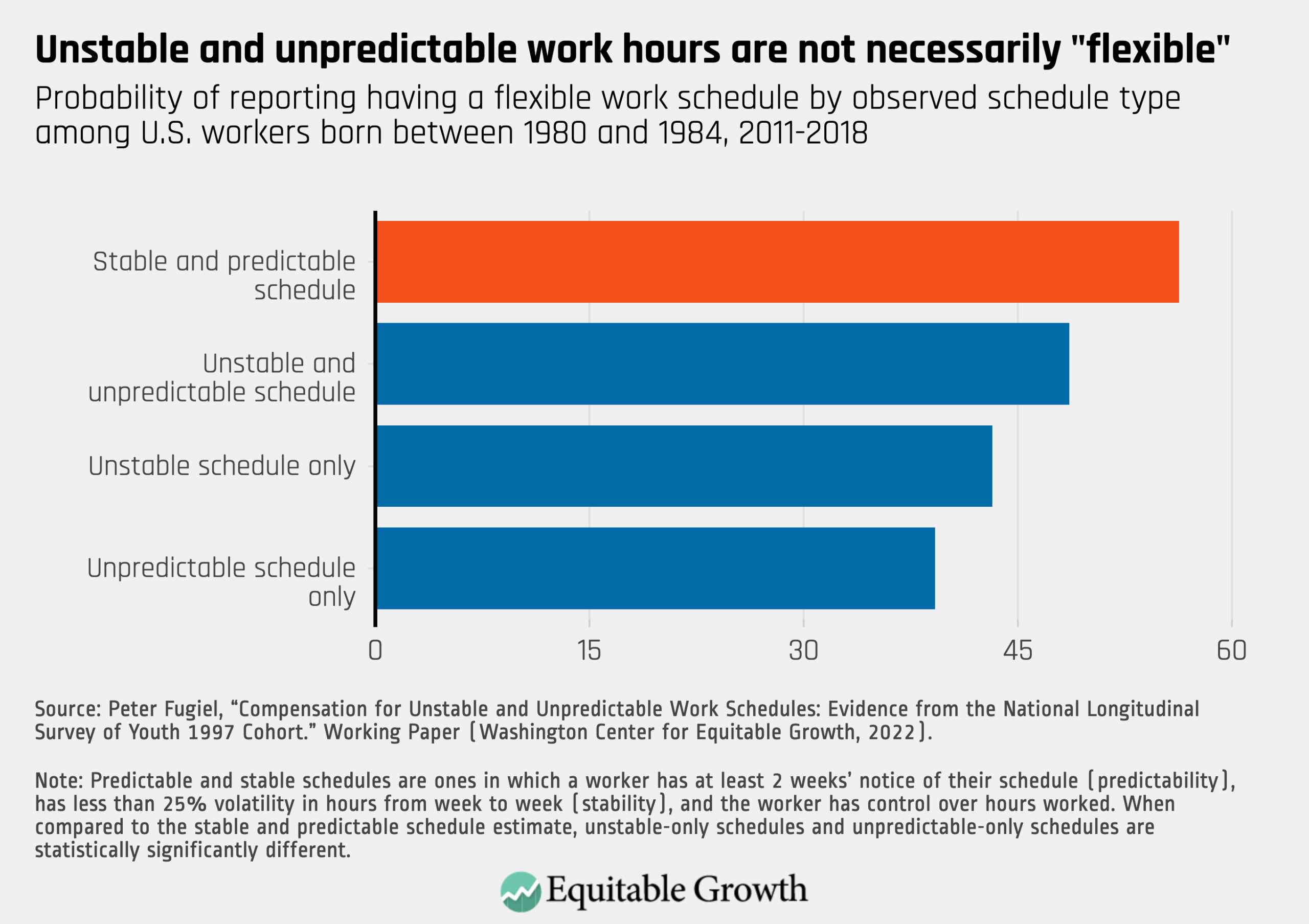
Unstable and unpredictable work hours are not necessarily “flexible”

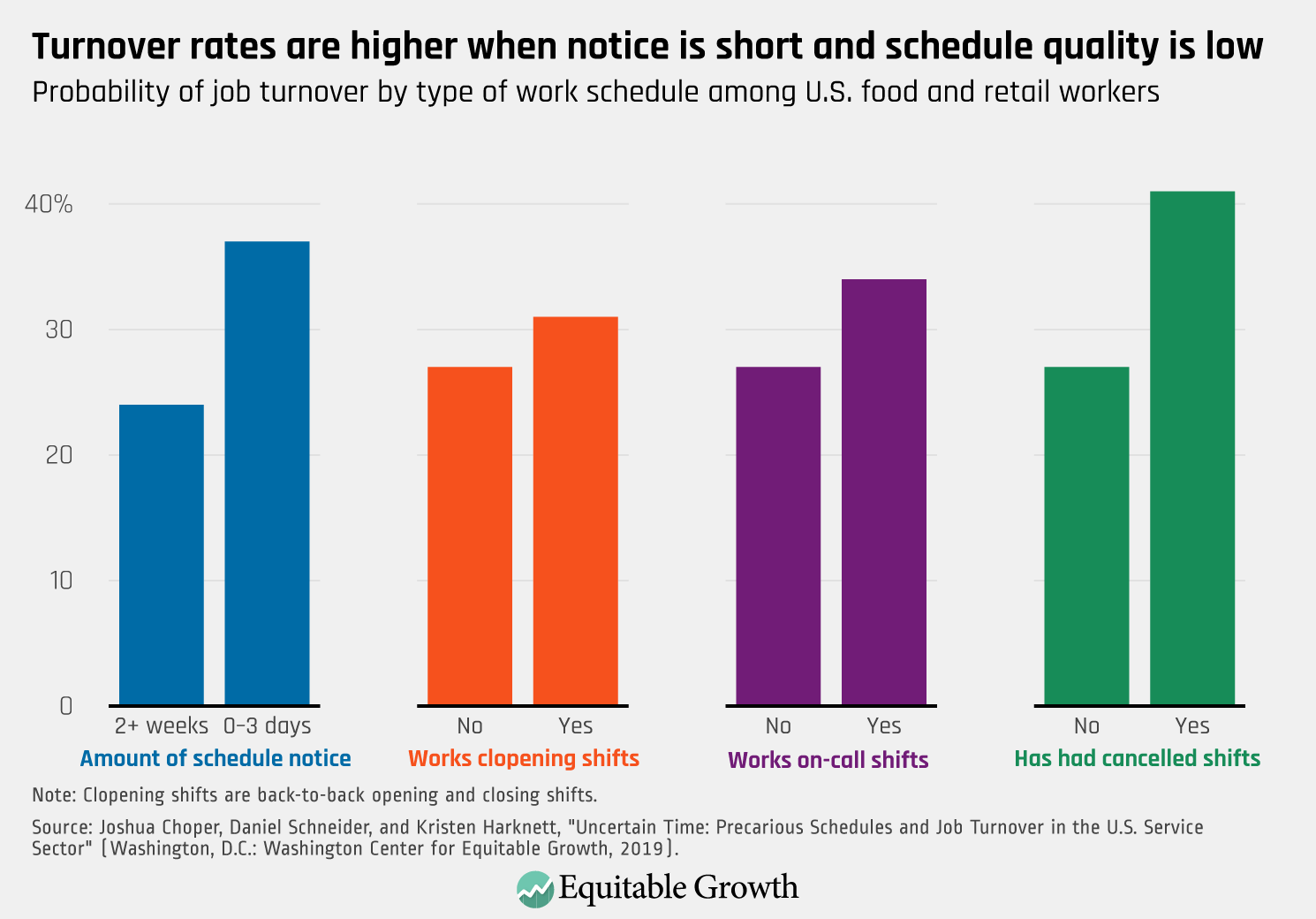
Turnover rates are higher when notice is short and schedule quality is low

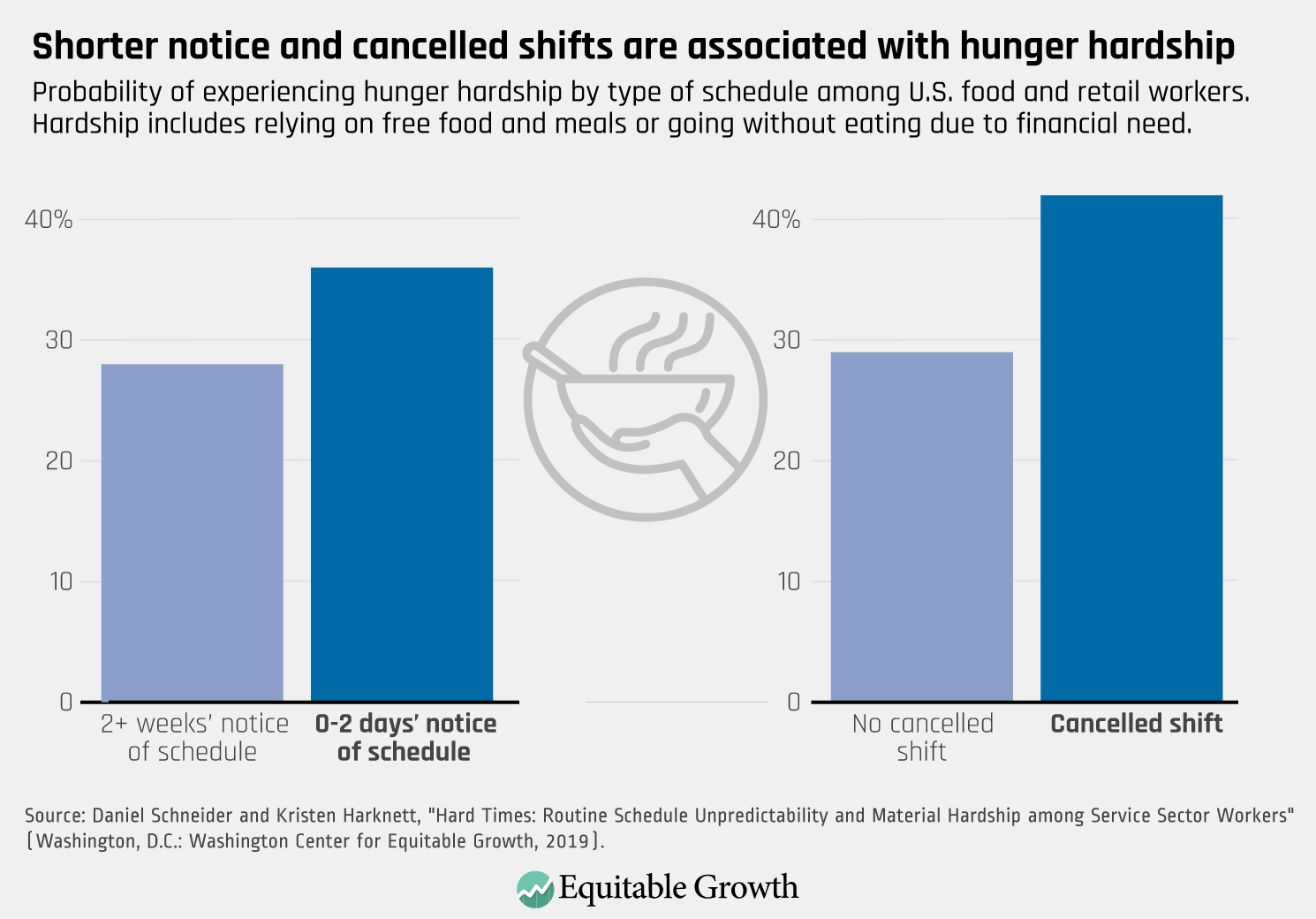
Shorter notice and cancelled shifts are associated with hunger hardship

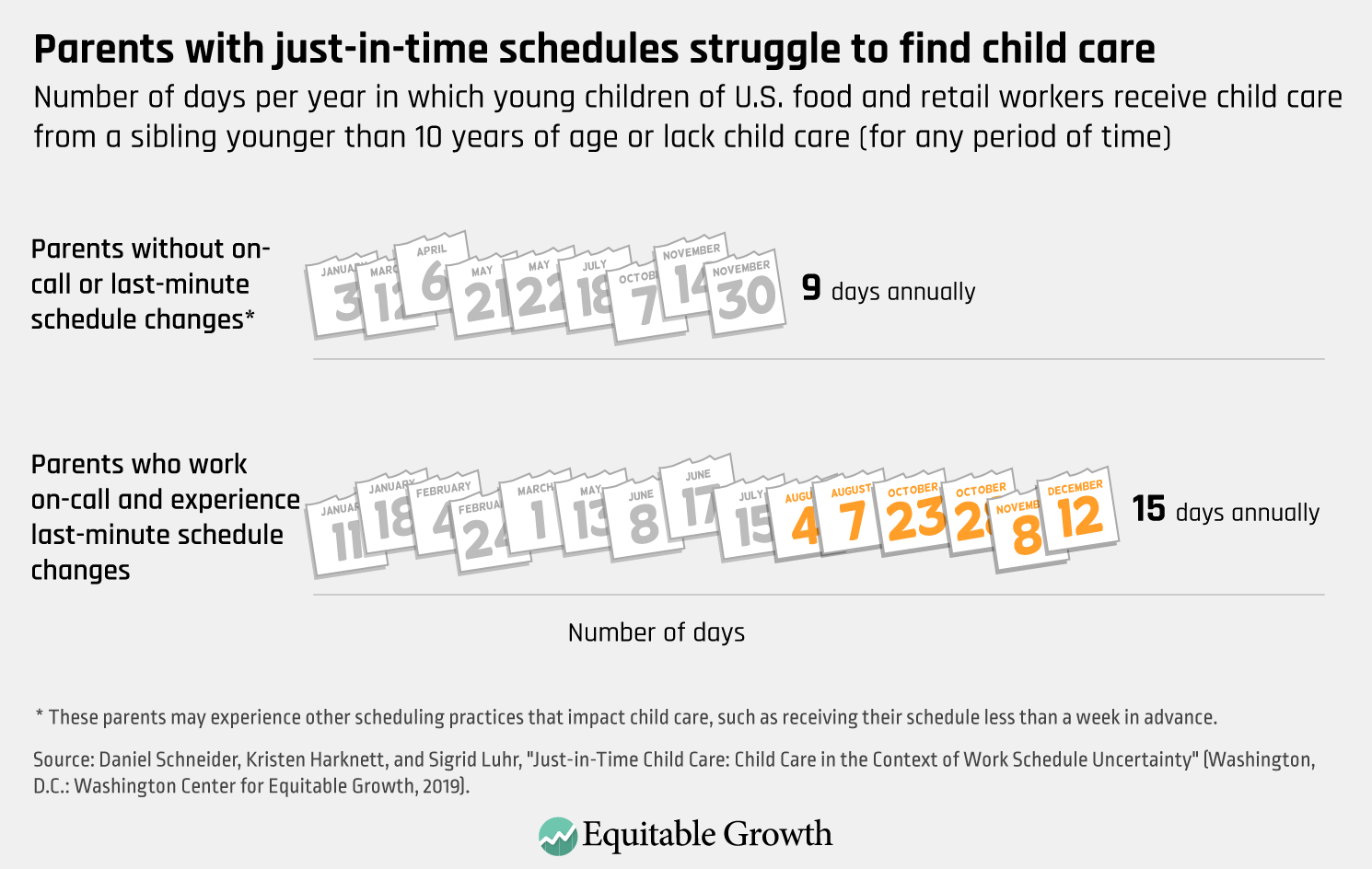
Parents with just in time schedules struggle to find child care
1. National Women’s Law Center, “State and Local Laws Advancing Fair Work Schedules” (2019), available at https://nwlc.org/wp-content/uploads/2019/10/Fair-Schedules-Factsheet-v2.pdf (opens in a new tab).
2. Ibid.
3. Susan Lambert, “Fair work schedules for the U.S. economy and society: What’s reasonable, feasible, and effective” (Washington: Washington Center for Equitable Growth, 2020), available at https://www.equitablegrowth.org/wp-content/uploads/2020/02/Lambert.pdf (opens in a new tab).
4. Peter Fugiel, “Compensation for Unstable and Unpredictable Work Schedules: Evidence from the National Longitudinal Survey of Youth 1997 Cohort.” Working Paper (Washington Center for Equitable Growth, 2022).
5. Ibid.
6. Daniel Schneider and Kristen Harknett, “It’s About Time: How Work Schedule Instability Matters for Workers, Families, and Racial Inequality” (Berkeley, CA: The Shift Project, 2019), available at https://shift.hks.harvard.edu/its-about-time-how-work-schedule-instability-matters-for-workers-families-and-racial-inequality/ (opens in a new tab).
7. Fugiel, “Compensation for Unstable and Unpredictable Work Schedules: Evidence from the National Longitudinal Survey of Youth 1997 Cohort.”
8. Saravanan Kesavan and others, “Doing Well by Doing Good: Improving Retail Store Performance with Responsible Scheduling Practices at the Gap, Inc.,” Management Science (2022).
9. Schneider and Harknett, “It’s About Time: How Work Schedule Instability Matters for Workers, Families, and Racial Inequality.”
10. Elizabeth O. Ananat and Anna Gassman‐Pines, “Work Schedule Unpredictability: Daily Occurrence and Effects on Working Parents’ Well‐Being,” Journal of Marriage and Family 83 (1) (2021): 10–26. [1] Elaine Zundl and others, “Still Unstable: The Persistence of Schedule Uncertainty During the Pandemic” (Cambridge, MA: The Shift Project, 2022), available at https://shift.hks.harvard.edu/still-unstable/ (opens in a new tab).
11. Elaine Zundl and others, “Still Unstable: The Persistence of Schedule Uncertainty During the Pandemic” (Cambridge, MA: The Shift Project, 2022), available at https://shift.hks.harvard.edu/still-unstable/ (opens in a new tab).
12. Elizabeth O. Ananat, Anna Gassman-Pines, and John Fitz-Henley II, “The Effects of the Emeryville Fair Workweek Ordinance on the Daily Lives of Low-Wage Workers and their Families.” Working Paper No. w29792 (National Bureau of Economic Research, 2022), available at https://www.nber.org/papers/w29792 (opens in a new tab).
13. Alix Gould-Werth, Emilie Openchowski, and Raksha Kopparam, “New study in the Proceedings of the National Academy of Sciences shows schedule stability supports U.S. workers and the broader economy” (Washington: Washington Center for Equitable Growth, 2021), available at https://www.equitablegrowth.org/our-work/resources/new-study-in-the-proceedings-of-the-national-academy-of-sciences-shows-schedule-stability-supports-u-s-workers-and-the-broader-economy/.
14. Ibid.
15. Kristen Harknett, Daniel Schneider, and Véronique Irwin, “Improving health and economic security by reducing work schedule uncertainty,” Proceedings of the National Academy of Sciences 118 (42) (2021).
Reports NOV 23, 2026
By: Jacob Leibenluft, Gene Sperling
Essays NOV 20, 2026
By: Chris Clayton, Korin Davis
Essays OCT 30, 2026
By: Christopher Bangert-Drowns
Get updates on our latest research, event announcements, and policy insights delivered straight to your inbox. Stay connected with the leading voices on equitable growth.