




Academic
Request for Proposals: Research grants for early career scholars
Request for Proposals (RFPs) NOV 23, 2026
By: Equitable Growth
Economic Equity & Opportunity
 Browse All Resources
OCT 3, 2017
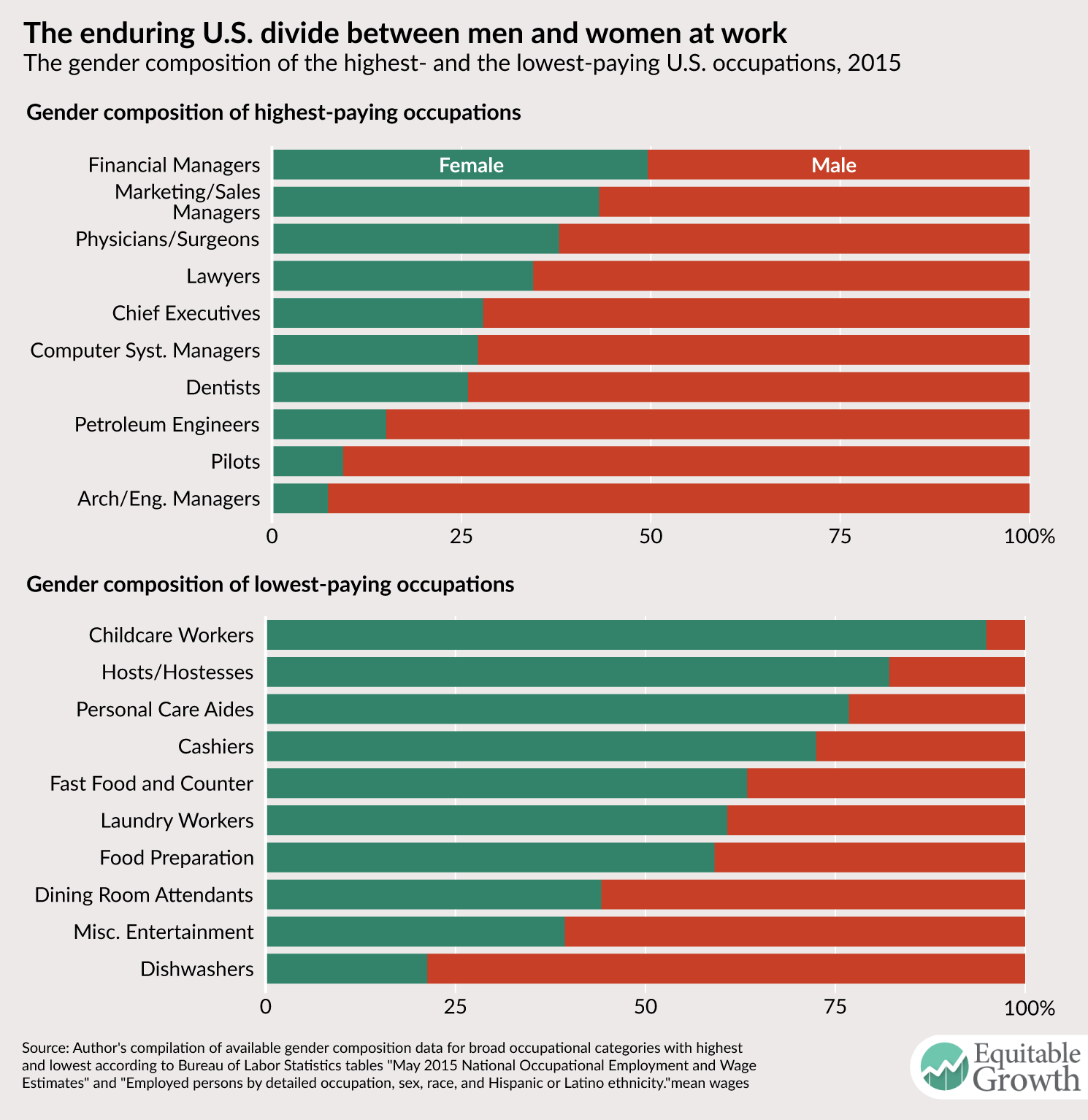
Occupational segregation occurs when one demographic group is overrepresented or underrepresented among different kinds of work or different types of jobs. In 2015, for example, men were 53 percent of the U.S. labor force1, but held less than 30 percent of the jobs in education and more than 98 percent of the jobs in construction.2
Read the full PDF in your browser (opens in a new tab)
The evidence shows that occupational segregation based on gender occurs more because of assumptions about what kinds of work different genders are best suited for than because of an efficient allocation of innate talent. To the extent to which that is true, occupational segregation hurts economic growth because:
Gender segregation at work: ‘separate but equal’ or ‘inefficient and unfair’ (opens in a new tab)
Will McGrew, August 2016
Do U.S. women choose low-paid occupations, or do low-paid occupations choose them? (opens in a new tab)
Bridget Ansel, April 2017
Local economic decline affects marriage and fertility rates, but in a surprising way (opens in a new tab)
Bridget Ansel, February 2017
Many of the fastest growing jobs in the United States are missing men (opens in a new tab)
Bridget Ansel, December 2016
1. U.S. Bureau of Labor Statistics, “Civilian Labor Force Level: Men (LNS11000001) and Civilian Labor Force (CLF16OV)” (2017), available at https://fred.stlouisfed.org/series/LNS11000001 (opens in a new tab).
2. U.S. Census Bureau, “2015 American Community Survey” (2015), available at https://www.census.gov/people/io/ (opens in a new tab).
3. Elyse Shaw and others, “Undervalued and Underpaid in America: Women in Low-Wage, Female-Dominated Jobs” (Washington: Institute for Women’s Policy Research, 2016), available at https://iwpr.org/publications/undervalued-and-underpaid-in-america-women-in-low-wage-female-dominated-jobs/ (opens in a new tab).
4. Asaf Levanon, Paula England, and Paul Allison, “Occupational Feminization and Pay: Assessing Causal Dynamics Using 1950-2000 U.S. Census Data,” Social Forces, 88 (2) (2009): 865–891, available at https://academic.oup.com/sf/article/88/2/865/2235342/Occupational-Feminization-and-Pay-Assessing-Causal (opens in a new tab).
5. Olga Alonso-Villar and Coral del Rio Otero, “The Occupational segregation of Black women in the United States: A look at its evolution from 1940 to 2010” (Verona, Italy: Society for the Study of Economic Inequality, 2013), available at http://econpapers.repec.org/paper/inqinqwps/ecineq2013-304.htm (opens in a new tab).
6. Chang-Tai Hsieh and others, “The Allocation of Talent and U.S. Economic Growth” (2016), available at http://klenow.com/HHJK.pdf (opens in a new tab).
7. Francine D. Blau and Lawrence M. Kahn, “The Gender Wage Gap: Extent, Trends, and Explanations.” Working Paper 21913 (National Bureau of Economic Research, 2016), available at http://www.nber.org/papers/w21913.pdf (opens in a new tab).
8. Chang-Tai Hsieh and others, “The Allocation of Talent and U.S. Economic Growth.”
9. Claudia Goldin, “A Grand Gender Convergence: Its Last Chapter,” American Economic Review 104 (4) (2014): 1091–1119, available at https://scholar.harvard.edu/files/goldin/files/goldin_aeapress_2014_1.pdf (opens in a new tab).
10. Elyse Shaw and others, “Undervalued and Underpaid in America: Women in Low-Wage, Female-Dominated Jobs.”
11. David Autor, David Dorn, and Gordon Hanson, “When Work Disappears: Manufacturing Decline and the Falling Marriage-Market Value of Men,” (2017), available at http://www.ddorn.net/papers/Autor-Dorn-Hanson-MarriageMarket.pdf (opens in a new tab).
Request for Proposals (RFPs) NOV 23, 2026
By: Equitable Growth

Reports NOV 23, 2026
By: Jacob Leibenluft, Gene Sperling

Essays NOV 20, 2026
By: Chris Clayton, Korin Davis
Get updates on our latest research, event announcements, and policy insights delivered straight to your inbox. Stay connected with the leading voices on equitable growth.


