
Skip to content
Browse All Resources
Factsheets

OCT 26, 2020

Factsheet: New study shows that emergency paid sick leave reduced COVID-19 infections in the United States

Abstract

The United States is one of three high-income nations (opens in a new tab) that does not guarantee paid sick leave for workers.1 As of March 2020, 25 percent of private-sector workers had no access to paid sick leave (opens in a new tab). This number is higher for part-time workers (55 percent) and low-income workers (69 percent).2

Without access to paid sick leave, employees who are financially constrained may show up to work sick. When that happens, they risk passing their illness to others and impose costs on employers through lost productivity.3 Several studies demonstrate how paid sick leave guarantees at the state and local level can benefit public health and improve worker productivity, with one recent study (opens in a new tab) finding an 11 percent decline in flu-like illnesses in the first year after such a guarantee was enacted into law.4

When the coronavirus pandemic hit the United States, the U.S. Congress recognized that paid sick leave supports public health and economic well-being, and passed the Families First Coronavirus Response Act on March 18, 2020. The new law, part of several measures to support the economy and health of the nation against the coronavirus and COVID-19, the disease caused by the virus, allows qualified workers across the country who are affected by COVID-19 to take up to 2 weeks of sick leave at full pay (opens in a new tab).5

Now, a new study published in Health Affairs (opens in a new tab) shows that the law was successful in “flattening the curve” of COVID-19 transmissions and was associated with approximately 400 fewer cases of COVID-19 per day in states where the law gave workers new access to guaranteed sick leave.6 While no one study is definitive, it offers some of the first evidence of the law’s efficacy in supporting public health.

Key takeaways

  • Paid sick leave is an important public health tool in the fight against COVID-19, reducing infections by 400 cases per day in states that previously had no paid sick leave guarantee.
  • Extending paid sick leave benefits beyond December 2020, when the current emergency benefits expire, would ensure that the United States has this necessary public health tool for the duration of the pandemic.
  • If more people are eligible for paid sick leave, including people employed by larger firms who are currently ineligible for emergency paid leave under the new law, then it is likely even more cases would be prevented.

About this new study in Health Affairs

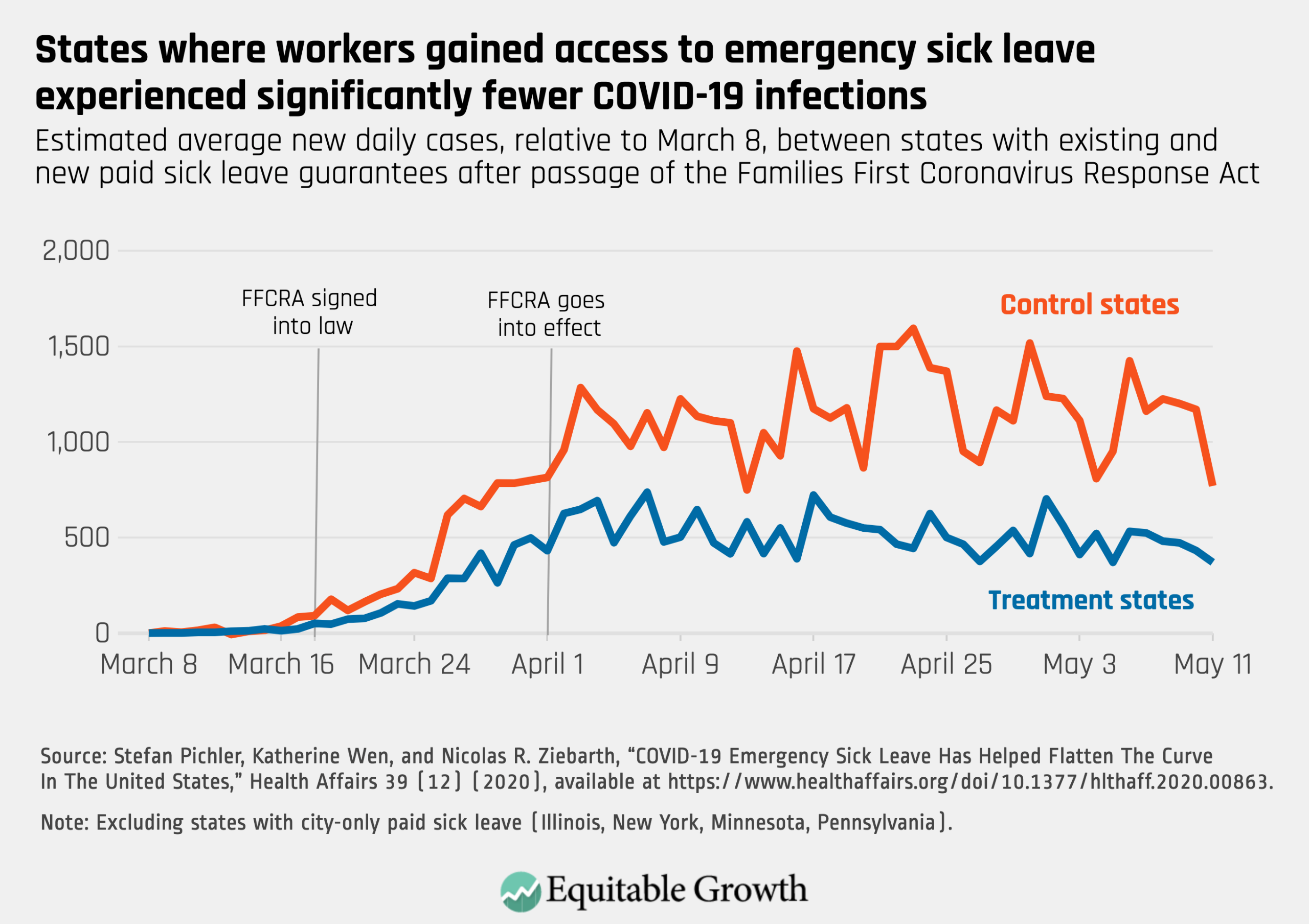
  • Looking at the period of March 6, 2020–May 11, 2020, the researchers find (opens in a new tab) that states where workers gained new access to guaranteed paid sick leave through the Families First Coronavirus Response Act saw a statistically significant 400 fewer confirmed COVID-19 cases per day.7 This translates to a 56 percent decrease in infections in these states.
  • To arrive at these findings, the authors compared infection rates before and after the passage of the new law in states with existing paid sick leave guarantees (the control group) and states without such a guarantee (the treatment group). The authors also controlled for state populations, testing capacities, state and local policies such as stay-at-home orders, and other geographic and temporal factors. (See Figure 1.)
Estimated average new daily cases, relative to March 8m between states with existing and new paid sick leave guarantees after passage of the Families First Coronavirus Response Act

States where workers gained access to emergency sick leave experienced significantly fewer COVID-19 infections

Policy implications

  • Expanding access to emergency paid sick leave could yield even greater public health benefits than those identified in this latest study. Closing the coverage gap for workers at large firms would likely yield even greater public health benefits. The HEROES Act (opens in a new tab), passed by the U.S. House of Representatives on May 15, 2020, would eliminate this carve out for large businesses.13

Conclusion

Building on prior research on the public health and economic benefits of paid leave, this new study demonstrates that sick leave through the Families First Coronavirus Response Act played an important role in flattening the curve of COVID-19 transmissions in the early months of the coronavirus pandemic.14 Expanding and extending access to these benefits could have critical public health implications in 2021 and beyond.

The Health Affairs study presents early insight into how paid leave is supporting public health in the COVID-19 pandemic, and new data-driven evidence of the importance of paid leave, with support from the Washington Center for Equitable Growth, will enable researchers to continue studying how paid sick leave and paid family and medical leave can support workers, public health, and the economy in years to come.15

End Notes

1. “For how long are workers guaranteed paid sick leave?,” available at https://www.worldpolicycenter.org/policies/for-how-long-are-workers-guaranteed-paid-sick-leave (opens in a new tab) (last accessed October 26, 2020).

2. U.S. Bureau of Labor Statistics, “National Compensation Survey: Employee Benefits in the United States, March 2020” (2020), available at https://www.bls.gov/ncs/ebs/benefits/2020/employee-benefits-in-the-united-states-march-2020.pdf (opens in a new tab).

3. Jack Smalligan and Chantel Boyens, “Paid medical leave research: What we know and what we need to know to improve health and economic well-being in the United States” (Washington: Washington Center for Equitable Growth, 2020), available at https://www.equitablegrowth.org/our-work/resources/paid-medical-leave-research/.

4. Stefan Pichler, Katherine Wen, and Nicolas R. Ziebarth, “Positive Health Externalities of Mandating Paid Sick Leave.” Discussion Paper Series(IZA Institute of Labor Economics, 2020), available at http://ftp.iza.org/dp13530.pdf (opens in a new tab).

5. The Families First Coronavirus Response Act, Public Law 116-127, 116th Cong. (March 18, 2020), available at https://www.congress.gov/116/plaws/publ127/PLAW-116publ127.pdf (opens in a new tab).

6. Stefan Pichler, Katherine Wen, and Nicolas R. Ziebarth, “COVID-19 Emergency Sick Leave Has Helped Flatten The Curve In The United States,” Health Affairs 39 (12) (2020), available at https://www.healthaffairs.org/doi/10.1377/hlthaff.2020.00863 (opens in a new tab).

7. Ibid.

8. Pichler, Wen, and Ziebarth, “Positive Health Externalities of Mandating Paid Sick Leave”; Stefan Pickler and Nicolas R. Ziebarth, “The pros and cons of sick pay schemes: Testing for contagious presenteeism and non-contagious absenteeism behavior,” The Journal of Public Economics 156 (2017), available at https://doi.org/10.1016/j.jpubeco.2017.07.003 (opens in a new tab).

9. Sarah Jane Glynn, “Coronavirus Paid Leave Exemptions Exclude Millions of Workers From Coverage” (Washington: Center for American Progress, 2020), available at https://www.americanprogress.org/issues/economy/news/2020/04/17/483287/coronavirus-paid-leave-exemptions-exclude-millions-workers-coverage/ (opens in a new tab).

10. In the first quarter of 2019, the most recent publicly available data, the Bureau of Labor Statistics estimates 59,074,000 private-sector employees work at firms with 500 or more employees, a class of firms excluded from FFCRA. In that same period, BLS estimates 89 percent of private-sector workers at firms with 500 or more employees have access to paid sick leave benefits, while 11 percent do not. Eleven percent of these 59,074,000 workers amounts to 6,498,140 private-sector workers at large firms with no paid sick leave benefits. Estimates of paid sick leave benefits are from U.S. Bureau of Labor Statistics, “National Compensation Survey: Employee Benefits in the United States, March 2019” (2019), available at https://www.bls.gov/ncs/ebs/benefits/2019/ownership/private/table31a.pdf (opens in a new tab). Estimates of the private-sector workforce by firm size are from U.S. Bureau of Labor Statistics, “Business Employment Dynamics: National Business Employment Dynamics by Firm Size Class” (2020), available at https://www.bls.gov/bdm/bdmfirmsize.htm (opens in a new tab).

11. The Families First Coronavirus Response Act; Megan Scudellari, “How the pandemic might play out in 2021 and beyond,” Nature, August 5, 2020, available at https://www.nature.com/articles/d41586-020-02278-5 (opens in a new tab).

12. The National Partnership for Women and Families, “The Health Families Act: Fact Sheet” (2020), available at https://www.nationalpartnership.org/our-work/resources/economic-justice/paid-sick-days/the-healthy-families-act-fact-sheet.pdf (opens in a new tab).

13. House Appropriations Committee, “House Democrats Updated Version of The Heroes Act: Title-By-Title Summary” (Washington: United States House of Representatives, 2020), available at https://appropriations.house.gov/sites/democrats.appropriations.house.gov/files/Updated%20Heroes%20Act%20Summary.pdf (opens in a new tab).

14. For examples of research on how paid sick leave and paid medical leave can support the well-being of workers and the economy, see Smalligan and Boyens, “Paid medical leave research: What we know and what we need to know to improve health and economic well-being in the United States.”

15. Alix Gould-Werth and Sam Abbott, “Equitable Growth invests more than $250,000 to advance research on paid family and medical leave in the United States” (Washington: Washington Center for Equitable Growth, 2020), available at https://www.equitablegrowth.org/our-work/resources/equitable-growth-invests-more-than-250000-to-advance-research-on-paid-family-and-medical-leave-in-the-united-states/.

Related

Your Direct Line to Cutting-Edge Research

Get updates on our latest research, event announcements, and policy insights delivered straight to your inbox. Stay connected with the leading voices on equitable growth.

