




Academic
Request for Proposals: Research grants for early career scholars
Request for Proposals (RFPs) NOV 23, 2026
By: Equitable Growth
Economic Equity & Opportunity
 Browse All Resources
AUG 28, 2018
By: Will McGrew
Earlier this month, Equitable Growth released a working paper (opens in a new tab) on the wage gap faced by African American women to coincide with Black Women’s Equal Pay Day, the date in 2018 when black women in the United States must work, on average, to make as much as white men made in 2017 alone.1 The paper, authored by economists Mark Paul of the New College of Florida, Darrick Hamilton of the New School, and William Darity Jr. and Khaing Zaw of Duke University, calculates the wage gap for black women compared to white men and breaks down the different factors contributing to this persistent gap.
Using a wage decomposition strategy, the authors quantify a wage gap for black women of 36 percent (36 cents for every dollar earned by a white man), and they also determine that 55.5 percent of this 36-cent gap (20 cents for every dollar earned by a white man) is not explained by human capital variables, including age, education, family structure, occupation, or industry. This unexplained wage gap is often interpreted by economists as the closest approximation of genuine discrimination. Of the observed variables, however, racial and gender differences in industry and occupation—collectively referred to as workplace segregation—explain by far the largest portion of the gap (28 percent, or 10 cents for every dollar earned by a white man). The authors emphasize that these differences “themselves may result from discriminatory practices.”2
Consistent with this finding, trends in workplace segregation in recent decades and numerous empirical studies investigating its causes and effects provide strong evidence for the discriminatory nature of the workplace segregation faced by African American women. In fact, workplace segregation is not efficient, but instead profoundly distortionary—dampening black women’s wages and weakening aggregate growth. This issue brief details the trends in workplace segregation over the past eight decades, the channels through which segregation contributes to workplace discrimination, and the continuing causes of this persistent discrimination.
Olga Alonso-Villar and Coral del Río, two professors of economics at the University of Vigo in Galicia, Spain, have conducted extensive quantitative research on occupational segregation of black women (opens in a new tab), along with other (opens in a new tab) racial and ethnic groups by gender, in the United States.3 Using the segregation index data generated by Alonso-Villar and del Río, changes in segregation levels for black women since 1940 in the aggregate, as well as by region and education, can be detailed. The index they construct represents the fraction of black women who would need to change jobs in order for their occupational distribution to be consistent with the average occupational distribution of all workers in the U.S. economy. (See Figure 1.)
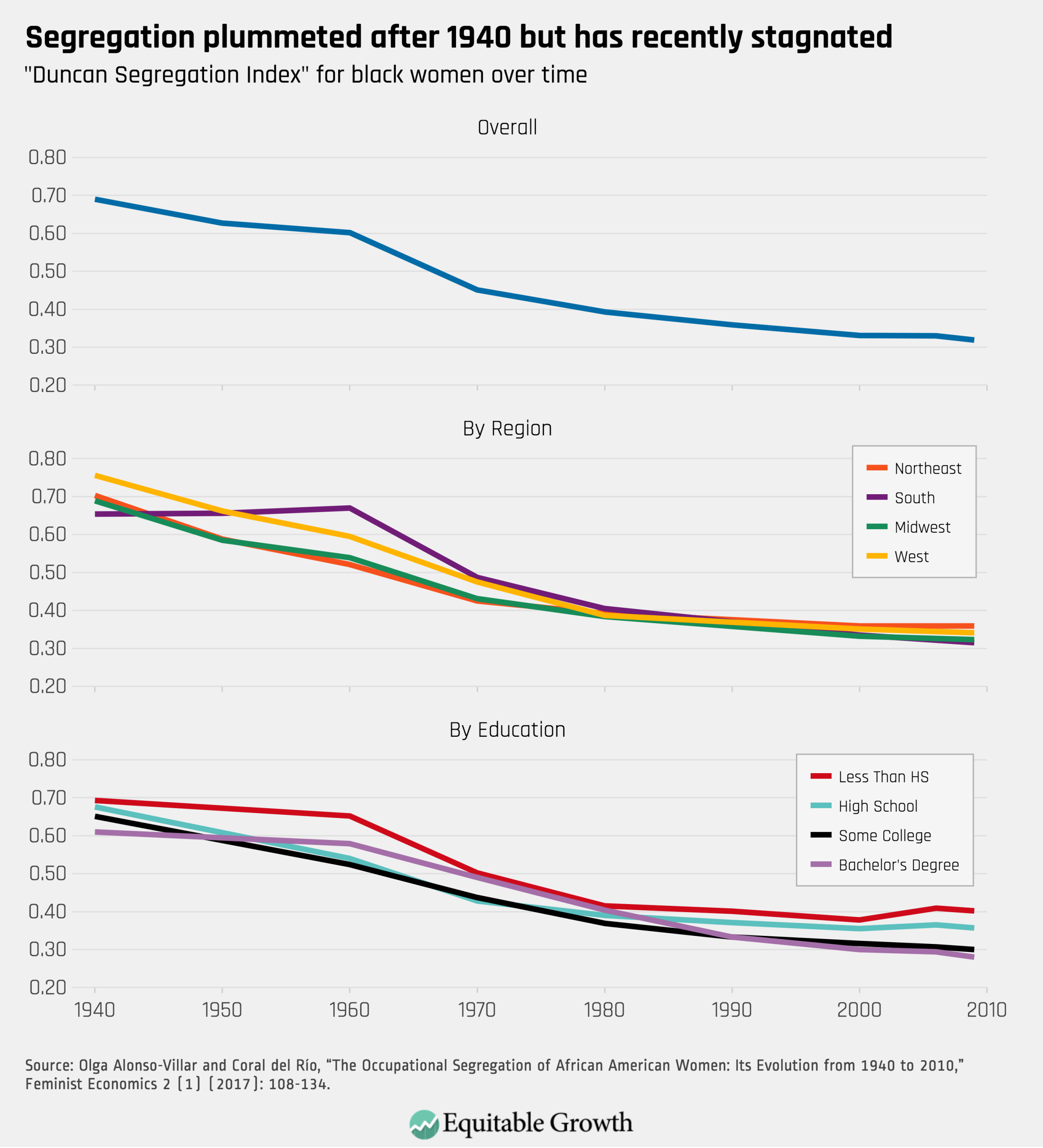
Over the course of this period, the aggregate occupational segregation of black women was reduced by more than half—from an index of 69 percent in 1942 to 32 percent in 2008–2010. Currently, 32 percent of African American women would thus have to change jobs in order to reflect the general distribution of workers among jobs in the economy. In a separate paper (opens in a new tab), Alonso-Villar and del Río calculate that this level of occupational segregation faced by black women is 38 percent greater than the segregation affecting black men and 43 percent greater than the segregation affecting white women.4
As explained in more detail below, Alonso-Villar and del Río break down segregation trends for three 20-year intervals and disaggregate the respective effects of social movements and technological change in the multidecade decline in workplace segregation for black women. The authors define these social-movement effects as changes in the specific distribution of black women across occupations, likely as a result of changes in social norms. Technology effects are changes in the distribution of all workers across occupations due to structural changes in the economy as a whole such as the rapid mechanization of the agricultural sector in the post-World War II era.
Between 1940 and 1960, technological changes and the ongoing Great Migration of African Americans into the Northern and Western regions of the country helped facilitate black women’s moves from jobs often as farm laborers and domestic workers to growing and higher-paying white-female-dominated occupations in health care, clerical work, and other service sectors outside the South. The subsequent passing of civil rights protections (opens in a new tab) and federal enforcement of affirmative action (opens in a new tab) between 1960 and 1980 brought about an even sharper national decline in segregation—this time including the South—as black women further increased their representation in clerical occupations and also gained growing access to various management, professional, and technical occupations, which had formerly been dominated by white men.5
Beginning in the 1980s through 2000, the pace of desegregation slowed dramatically as a result of declining civil rights enforcement and a judiciary increasingly (opens in a new tab) hostile (opens in a new tab) to discrimination claims.6 While African American women dramatically boosted (opens in a new tab) their average levels of education and increased their numbers in managerial and professional occupations, many administrative support and service occupations came to be characterized by an overrepresentation of black women.7 For many black women with limited resources and professional connections, these administrative and service occupations thus became “the highest rungs in the [job] ladder (opens in a new tab),” explain Alonso-Villar and del Río.8 Since 2000, workplace segregation for black women at all levels of education has essentially stagnated, as was recently pointed out (opens in a new tab) by economist Valerie Wilson and her co-author Madison Matthews at the Economic Policy Institute.9
While black women remain underrepresented in entry- and middle-level positions across occupations and at all levels of education, disparities at the top are the most striking. A recent report (opens in a new tab) by Lean In and McKinsey & Co., based on a survey of 222 companies employing more than 12 million people, documents that women of color as a group (including black, Latina, Asian American, Native American, and mixed race women) constitute only 3 percent of so-called C-suite executives, 6 percent of vice presidents, and 11 percent of managers.10 Likewise, using U.S. Census Bureau data, Ph.D. candidate in sociology William Scarborough of the University of Illinois at Chicago calculates (opens in a new tab) that black women hold only 4 percent of all manager positions in the United States. As explained in more detail below, these discrepancies reflect the cumulative effect of discriminatory norms, policies, and behaviors throughout the corporate managerial pipeline.11
Workplace segregation is seriously damaging for black women’s wages because it concentrates (opens in a new tab) them in lower-paying occupations (opens in a new tab), on average, compared to white men and other groups.12 As discussed above, the authors of Equitable Growth’s recent working paper—Paul, Hamilton, Darity, and Zaw—separate out the effects of various observable variables (including occupation and industry) on the wage gap faced by black women vis-à-vis white men, enabling them to calculate the relative size of the explained and unexplained gaps, as well as the respective contributions of relevant human capital and demographic variables to the former. (See Figure 2.)
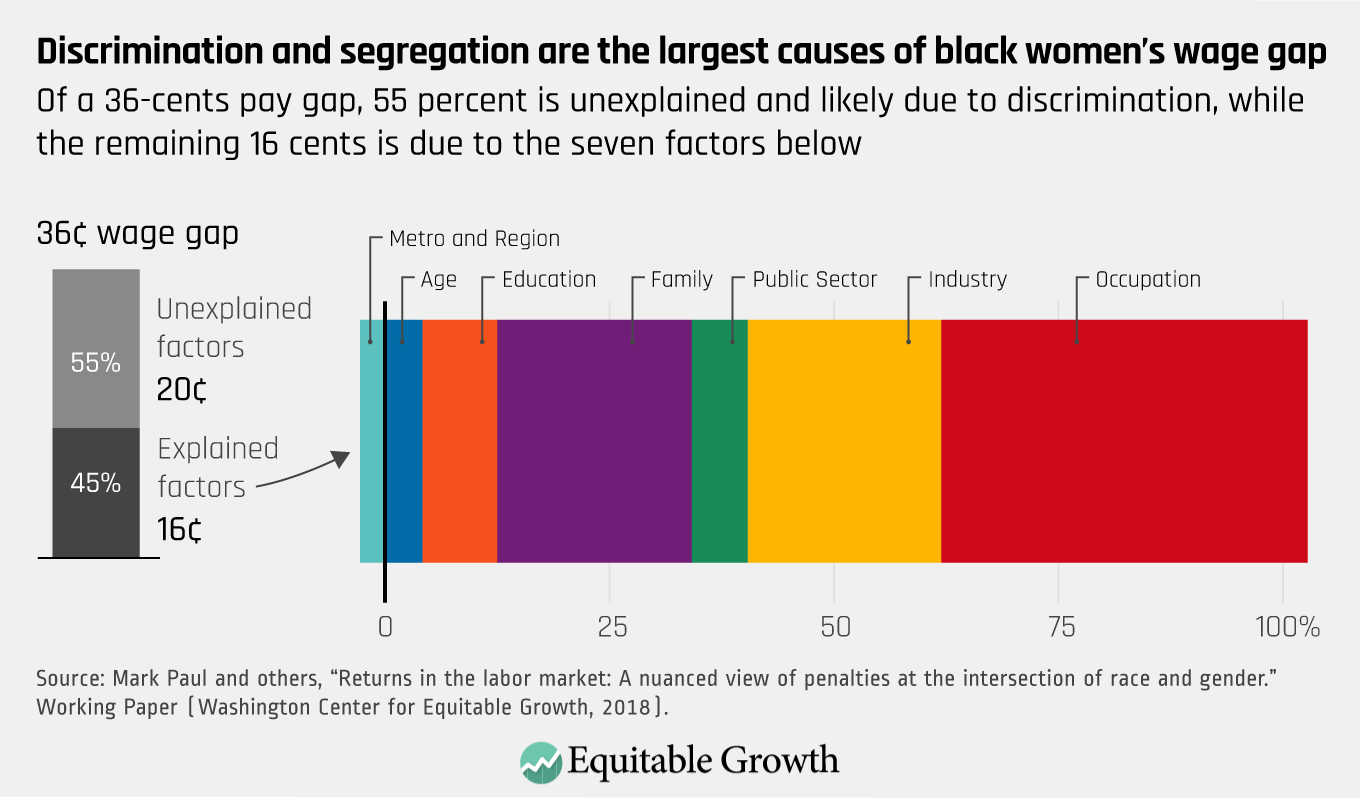
Discrimination and segregation are the largest causes of black women’s wage gap
Quantitative research demonstrates that pervasive wage penalties based on occupational racial and gender compositions are not rooted in productivity differences, but rather in social norms and stereotypes. Controlling for a large number of variables in local labor markets, sociologists Matt Huffman of the University of California, Irvine and Philip N. Cohen of the University of Maryland find that race- (opens in a new tab) and gender- (opens in a new tab)based devaluation of jobs associated with particular demographic groups are widespread—with occupational wage penalties largest in the most segregated labor markets.13 This reality has led many economists, including the former president of Bennett College, Julianne Malveaux, to advocate for a comparable-worth approach (opens in a new tab) to pay equity, mandating that African American women receive equal pay for jobs of equal value.14
Wage penalties depress black women’s wages across occupations and at all skill levels. While Alonso-Villar and del Río demonstrate that segregation levels for black women decrease to some extent with education, they find relatively comparable wage penalties for them no matter their educational backgrounds.15 As organizer and writer Alicia Garza has interrogated (opens in a new tab) and sociologists Paula England of New York University and Michelle Budig of the University of Massachusetts Amherst, along with economist Nancy Folbre of UMass Amherst, have reported (opens in a new tab), African American women are particularly disadvantaged by the wage penalty for care work given their overrepresentation in the field and the substantial wage devaluation (opens in a new tab) affecting care workers.16 Beyond their concentration in the lowest-paying occupations, black women also are overrepresented in many middle-income jobs (opens in a new tab) that pay less than male-dominated jobs with similar skill requirements.17
In addition to these clear effects on the “explained” wage gap, there is evidence from behavioral economics and social psychology that workplace segregation may also worsen the “unexplained” gap by fostering environments where harassment and discrimination are widespread. Indeed, there is a large body (opens in a new tab) of evidence in the social sciences substantiating that minority groups are at the highest risk of discrimination and harassment (opens in a new tab) in work environments where they are heavily underrepresented.18
A highly segregated workplace culture has been empirically demonstrated to substantially lower the wages of black women—along with those of black men, LGBTQ (opens in a new tab) workers (opens in a new tab), women of all races and ethnicities, and other underrepresented groups—in a variety of ways.19 It can lead to pay discrimination (opens in a new tab) against black women due to the prevalence (opens in a new tab) of discriminatory stereotypes and norms.20 It can result in work (opens in a new tab) sabotage (opens in a new tab) whereby black women are undermined in their efforts to fulfill their job responsibilities and lose out on the chance to take on the most highly remunerated tasks (opens in a new tab).21 It can cut them off from social networks (opens in a new tab) that provide access to information necessary to maximize earnings potential.22 And it can push them to take jobs in lower-paying firms (opens in a new tab) even if they remain in the same occupation.23
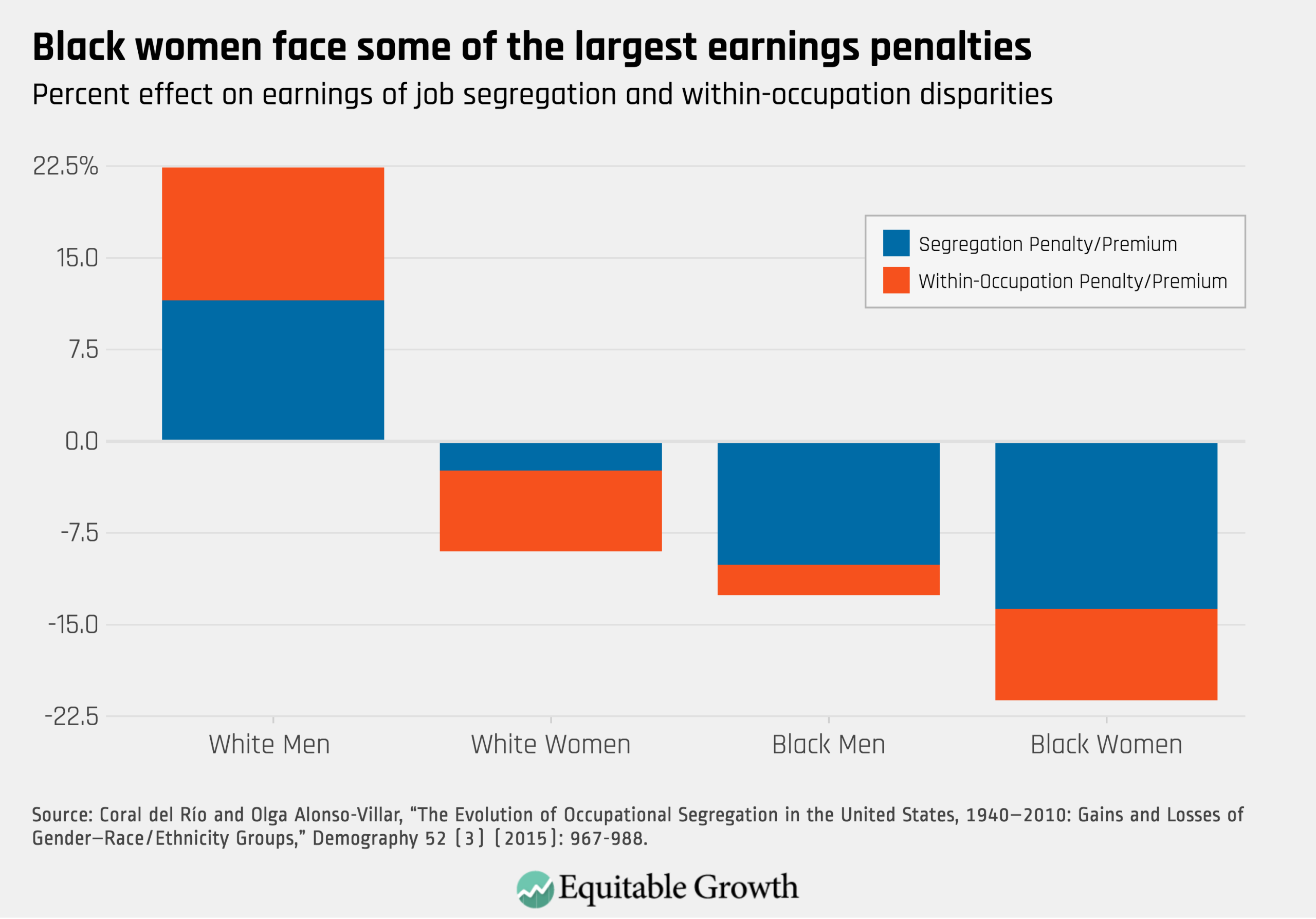
Comparing average earnings levels by demographic group vis-à-vis the average level for all workers in the economy, Alonso-Villar and del Río calculate the size of the penalty/premium for various gender groups by ethnicity and race, as well as the relative contributions of the groups’ occupational segregation to the wage gap. They find that black women face larger earnings penalties than white women and black men—both in terms of segregation and in terms of within-occupation inequalities, although the combined effects on earnings relative to the economy’s average are negative and substantial for all three groups. (See Figure 3.)
This evidence makes clear that black women face significant wage discrimination even when working (opens in a new tab) in the same jobs as white men.24 On the other hand, the research below explains how the jobs in which black women end up are often determined by discrimination as well.
Workplace segregation is traditionally understood to be the result of the sorting of workers in the labor market on the basis of skills, preferences, and ambitions, yet recent empirical research demonstrates that differences in workers’ skills and interests are too small to explain the high levels of race- and gender-based segregation in the contemporary workforce. Indeed, while there are some average differences in certain measures of academic performance among adolescents and young adults, the performance distributions by gender and race are (opens in a new tab) heavily (opens in a new tab) overlapping (opens in a new tab) and insufficient (opens in a new tab) to explain (opens in a new tab) the large extent of persistent segregation—as neuroscientist Lise Eliot of Rosalind Franklin University of Medicine has detailed (opens in a new tab) extensively.25 On top of various studies questioning the reliability (opens in a new tab) of test scores in measuring academic (opens in a new tab) and earnings (opens in a new tab) potential, there also is evidence indicating that documented academic disparities probably reflect the cumulative effects of discrimination and inequality.26 Rigorous empirical studies substantiate this claim, finding nonexistent or negligible racial (opens in a new tab) and gender (opens in a new tab) gaps in cognitive skills among the youngest children.27
Instead of adhering to the traditional human capital explanation of sorting based on skills and interests, contemporary economic and legal (opens in a new tab) scholars argue that labor market preferences—both among groups that face discrimination and among those that perpetrate it—are largely determined by education, workplace, and other institutions that exist in the status quo.28 As I explained (opens in a new tab) in a previous issue brief for Equitable Growth on the efficiency case for workplace integration, economists propose several theories to explain why such institutions continue to limit black women’s labor market opportunities.29 In the stratification economics model (opens in a new tab) proposed by Professor Darity or in the identity economics model (opens in a new tab) developed by economists George Akerlof of Georgetown University and Rachel Kranton of Duke University, economically advantaged groups such as white men in the United States support institutions that perpetuate segregation in order to maximize their own socioeconomic power or sense of identity.30
Another explanation is offered by Harvard economist Claudia Goldin. Pointing instead to the informational distortions created by occupational segregation in the status quo, she posits (opens in a new tab) that members of society may discriminate based on stereotypes they erroneously infer about the skills of black women and other disadvantaged groups from their current underrepresentation in the highest-paying occupations.31
Consistent with all of these frameworks, one major driver of occupational segregation is the racial and ethnic disparity in access to resources, which hurts children’s educational outcomes and thus their long-term labor market opportunities. In their study (opens in a new tab) on intergenerational mobility for different racial/gender groups in the United States, economists Raj Chetty and Nathaniel Hendren of Harvard University and Maggie Jones and Sonya Porter of the U.S. Census Bureau illustrate that much of the occupational segregation faced by black women can be explained by controlling for parents’ income.32 These results prove that for many black women, it is access to resources as children rather than differences in preferences or abilities that determines their limited occupational options as adults. Importantly, however, Chetty and his co-authors find persistent race- and gender-based segregation among the children of parents in the eighth income decile—those making between approximately $90,000 and $115,000 as a household—pointing to the important role of discrimination even among children in upper-income families.33
Together with resource disparities, recent empirical studies chronicle several ways in which family members, schools, and society at large (opens in a new tab) can impose limits on black women’s labor market opportunities.34 To start, children’s career aspirations are fundamentally influenced (opens in a new tab) by their parents’ occupations, as well as widespread social views on the appropriate occupational choices for various groups (opens in a new tab).35 In elementary and high school, students’ interests are also determined based on the occupations of the role models (opens in a new tab) and social networks (opens in a new tab) to which they are exposed.36 Later on, in college, research (opens in a new tab) by psychologist Colleen Ganley of Florida State University and her co-authors finds that perceived levels of discrimination—as opposed to interests in particular fields—are the primary determinant explaining women’s underrepresentation in STEM, or science, technology, engineering, and math, and certain non-STEM majors such as economics, philosophy, and, to a lesser extent, business.37
Educational institutions can also foster discriminatory norms and beliefs about black girls and women among economically advantaged groups. Despite progress since the mid-20th century, stereotypes (opens in a new tab) about and biased (opens in a new tab) attitudes (opens in a new tab) toward black women remain widespread in contemporary media messages.38 Counteracting these harmful tropes requires conscious efforts to expose children to a diverse array of classmates and counter-stereotypical role models. Unfortunately, the contemporary reality of widespread race- and income-based school segregation does the exact opposite—keeping African American girls out of (opens in a new tab) many of the highest performing white-dominated schools and thus allowing pernicious (opens in a new tab) stereotypes (opens in a new tab) and prejudices (opens in a new tab) to thrive (opens in a new tab) in these largely homogenous student bodies.39 Recent efforts to improve outcomes for black boys by creating all-male schools have likewise been criticized (opens in a new tab) by black feminist scholars (opens in a new tab) for excluding black girls from these enrichment opportunities, particularly given the dearth (opens in a new tab) of evidence (opens in a new tab) justifying segregated educational programs.40
In addition to the role of institutions in shaping labor market preferences at a young age, research demonstrates that workplace structures—and the experiences they generate—also have a profound impact on occupational segregation. In a recent article (opens in a new tab), legal scholar Vicki Schultz of Yale Law School leverages legal and social science evidence to argue that sex segregation and unchecked “subjective authority” (i.e., mangers’ substantial power to determine their employees’ career outcomes with limited standards and accountability) work in concert to create climates of discrimination and harassment, keeping women, especially queer women and women of color, out of white-male-dominated fields.41 In many historically white male workplaces, including financial, management, and STEM professions, negative experiences of discrimination have been empirically documented (opens in a new tab) to begin early on (opens in a new tab) in a worker’s tenure, and they accumulate as black women and members of other minority groups move through (opens in a new tab) their careers.42 Indeed, the experiences of harassment, work sabotage, and network closure discussed above do not only result in wage discrimination in highly segregated occupations; they also push (opens in a new tab) black women (opens in a new tab) out of (opens in a new tab) white-male-dominated fields into lower-paying occupations.43
As legal scholar Kimberlé Crenshaw (opens in a new tab) of Columbia University and the University of California, Los Angeles and sociologist Enobong Branch (opens in a new tab) of the University of Massachusetts Amherst (among other researchers) have theorized and empirically documented, black women are uniquely disadvantaged as they face the discriminatory stereotypes, resource disparities, and other inequalities affecting African Americans and women in general—as well as those affecting black women in particular.44 This reality means that economic penalties imposed on black women are not necessarily additive and are instead often greater than the mere aggregation of race- and gender-based effects.45
Economist Cecilia Conrad, who currently serves as the managing director of the MacArthur Fellows Program of the MacArthur Foundation, has argued (opens in a new tab) that the unique complex of stereotypes and inequalities faced by black women is a central explanation for the lack of effective public policy targeted at increasing their incomes and economic security.46 Along with sociologist Rose M. Brewer of the University of Minnesota and economist Mary C. King of Portland State University, Conrad calls for (opens in a new tab) a more nuanced and intersectional analysis of the interplay between race, gender, and class in economics, as well as greater empirical focus on the specific challenges faced by black women.47
While the persistence of U.S. workplace segregation in the 21st century is discouraging, particularly given its large negative effects on black women’s wages, the good news is that historical and contemporary research shows that segregation can be deeply malleable. After all, the trends over the past eight decades described by Alonso-Villar and del Río did not take place in a vacuum but were instead the result of massive social movements and subsequent policy and legal reforms that pressured firms to hire more black women (opens in a new tab) along with members of other economically disenfranchised groups. Empirical evidence also demonstrates that occupational integration can both dramatically increase black women’s wages—accounting for 56 percent (opens in a new tab) of black women’s earnings growth from 1960 to 2010—and decrease the prevalence (opens in a new tab) of the discriminatory stereotypes and norms that are both causes and effects of workplace segregation.48
Beyond these encouraging implications for the wages of black women and the economic security of their families, there is growing evidence that desegregating the workplace also would boost human capital skills, productivity, innovation, and growth. In terms of human capital, Chetty and his co-authors find (opens in a new tab) that controlling for parents’ income, black women have higher rates of college attendance compared to white men, demonstrating the large benefits of removing barriers to their economic advancement.49 Furthermore, there is burgeoning evidence that increasing racial and gender diversity at all levels strengthens productivity (opens in a new tab), innovation (opens in a new tab), and financial performance (opens in a new tab) in firms across industries.50
Combined, these microeconomic improvements can have massive aggregate effects. Economists Chang-Tai Hsieh and Erik Hurst of the University of Chicago and Charles I. Jones and Peter J. Klenow of Stanford University estimate (opens in a new tab) that occupational integration by race and gender was responsible for one-quarter of the growth in aggregate output per worker since 1960.51 These results make clear that workplace segregation of black women does not just restrict their opportunities; it also holds back the broader U.S. economy.
1. Mark Paul and others, “Returns in the labor market: A nuanced view of penalties at the intersection of race and gender.” Working Paper (Washington Center for Equitable Growth, 2018).
2. Ibid, p. 23.
3. Olga Alonso-Villar and Coral del Río, “The Occupational Segregation of African American Women: Its Evolution from 1940 to 2010,” Feminist Economics 2 (1) (2017): 108–134; Coral del Río and Olga Alonso-Villar, “The Evolution of Occupational Segregation in the United States, 1940–2010: Gains and Losses of Gender–Race/Ethnicity Groups,” Demography 52 (3) (2015): 967–988.
4. Del Río and Alonso-Villar, “The Evolution of Occupational Segregation in the United States, 1940–2010: Gains and Losses of Gender–Race/Ethnicity Groups.”
5. Fidan Ana Kurtulus, “Affirmative Action and the Occupational Advancement of Minorities and Women During 1973–2003,” Industrial Relations 51 (2) (2012): 213–246; Donald Tomaskovic-Devey and Kevin Stainback, “Discrimination and Desegregation: Equal Opportunity Progress in U.S. Private Sector Workplaces since the Civil Rights Act,” ANNALs of the American Academy of Political and Social Science 609 (1) (2007).
6. Vicki Schultz and Stephen Petterson, “Race, Gender, Work, and Choice: An Empirical Study of the Lack of Interest Defense in Title VII Cases Challenging Job Segregation,” University of Chicago Law Review 59 (3) (1992): 1073–1181; Michael Selmni, “Why are Employment Discrimination Cases So Hard to Win?” Louisiana Law Review 61 (2001); Michael J. Graetz and Linda Greenhouse, The Burger Court and the Rise of the Judicial Right (New York: Simon and Schuster, 2017); Ronald Dworkin, The Supreme Court Phalanx: The Court’s New Right-Wing Bloc (New York: New York Review of Books, 2008).
7. Anne McDaniel and others, “The Black Gender Gap in Educational Attainment: Historical Trends and Racial Comparisons,” Demography 48 (3) (2011): 889–914.
8. Alonso-Villar and del Río, “The Occupational Segregation of African American Women: Its Evolution from 1940 to 2010.”
9. Madison Matthews and Valerie Wilson, “Separate is still unequal: How patterns of occupational segregation impact pay for Black women” (Washington: Economic Policy Institute, 2018).
10. Lean In and McKinsey & Co., “Women in the Workplace 2017” (2018).
11. William Scarborough, “What the Data Says About Women in Management Between 1980 and 2010,” Harvard Business Review, February 23, 2018.
12. Ariane Hegewisch and Heidi Hartmann, “Occupational Segregation and the Gender Wage Gap: A Job Half Done” (Washington: Institute for Women’s Policy Research Report, 2014); David A. Cotter, Joan M. Hermsen, and Reeve Vanneman, “The Effects of Occupational Gender Segregation across Race,” The Sociological Quarterly 44 (1) (2003): 17–36.
13. Matt L. Huffman and Philip N. Cohen, “Racial Wage Inequality: Job Segregation and Devaluation across U.S. Labor Markets,” American Journal of Sociology 109 (4) (2004): 902–36; Philip N. Cohen and Matt L. Huffman, “Occupational Segregation and the Devaluation of Women’s Work across U.S. Labor Markets,” Social Forces 81 (3) (2003): 881–908.
14. Julianne Malveaux, “Comparable Worth and Its Impact on Black Women,” The Review of Black Political Economy 14 (2–3) (1985): 47–62.
15. Alonso-Villar and del Río, “The Occupational Segregation of African American Women: Its Evolution from 1940 to 2010.”
16. Alicia Garza, “Do We Care For The Black Women Who Care For Us?,” Huffington Post, February 24, 2016; Paula England, Michelle Budig, and Nancy Folbre, “Wages of Virtue: The Relative Pay of Care Work,” Social Problems 49 (4) (2002): 455–73; Institute for Women’s Policy Research, “Undervalued and Underpaid in America: Women in Low-Wage, Female-Dominated Jobs” (2016).
17. Ariane Hegewisch and others, “Pathways to Equity: Narrowing the Wage Gap by Improving Women’s Access to Good Middle-Skill Jobs” (Washington: Institute for Women’s Policy Research, 2016).
18. Iris Bohnet, What Works: Gender Equality by Design (Cambridge, Massachusetts: Belknap Press, 2016), pp. 211–12, 230–33, 349; Heather McLaughlin, Christopher Uggen, and Amy Blackstone, “Sexual Harassment, Workplace Authority, and the Paradox of Power,” American Sociological Review 77 (4) (2012): 625–47.
19. Del Río and Alonso-Villar, “The Evolution of Occupational Segregation in the United States, 1940–2010: Gains and Losses of Gender–Race/Ethnicity Groups”; M. V. Lee Badgett and Mary C. King, “Lesbian and Gay Occupational Strategies.” In Amy Gluckman and Betsy Reed, eds., Homo Economics (New York: Routledge, 2012); M. V. Lee Badgett, “The Wage Effects of Sexual Orientation Discrimination,” ILR Review 48 (4) (1995): 726–39; András Tilcsik, Michel Anteby, and Carly R. Knight, “Concealable Stigma and Occupational Segregation: Toward a Theory of Gay and Lesbian Occupations,” Administrative Science Quarterly 60 (3) (2015): 446–81.
20. Huffman and Cohen, “Racial Wage Inequality: Job Segregation and Devaluation across U.S. Labor Markets”; Cohen and Huffman, “Occupational Segregation and the Devaluation of Women’s Work across U.S. Labor Markets”; Barbara R. Bergmann, “Occupational Segregation, Wages and Profits When Employers Discriminate by Race or Sex,” Eastern Economic Journal 1 (2) (1974): 103–110.
21. Marion Crain, “Women, Labor Unions, and Hostile Work Environment Sexual Harassment: The Untold Story,” Texas Journal of Women and the Law 4 (1995); Carrie N. Baker, “Race, Class, and Sexual Harassment in the 1970s,” Feminist Studies 30 (1) (2004): 7–27; Ramit Mizrahi, “‘Hostility to the Presence of Women’: Why Women Undermine Each Other in the Workplace and the Consequences for Title VII,” The Yale Law Journal 113 (7) (2004): 1579–1621; Todd R Stinebrickner, Ralph Stinebrickner, and Paul J Sullivan, “Job Tasks and the Gender Wage Gap among College Graduates.” Working Paper (National Bureau of Economic Research, 2018).
22. Mary Blair-Loy, “It’s Not Just What You Know, It’s Who You Know: Technical Knowledge, Rainmaking, and Gender among Finance Executives.” In Steven Vallas, ed., The Transformation of Work (Research in the Sociology of Work), vol. 10 (Somerville, MA: Emerald Insight, 2001).
23. Ana Rute Cardoso, Paulo Guimarães, and Pedro Portugal, “What Drives the Gender Wage Gap? A Look at the Role of Firm and Job-Title Heterogeneity,” Oxford Economic Papers 68 (2) (2016): 506–24.
24. Matthews and Wilson, “Separate is still unequal: How patterns of occupational segregation impact pay for Black women.”
25. Lise Eliot, Pink Brain, Blue Brain (Oxford, UK: Oneworld Publications, 2010); Rod Plotnik and Haig Kouyoumdjian, Introduction to Psychology (Boston: Cengage Learning, 2013), p. 294; Iris Vander Pluym, “On Gender Essentialism in Public Schools, Bell Curves and CPD.,” Perry Street Palace blog, September 6, 2012, https://perrystreetpalace.com/2012/09/06/on-gender-essentialism-in-public-schools-bell-curves-and-cpd/; Mat Leonard, “Abusing Science to Disguise Sexism,” Age of Awareness blog, August 16, 2017, available at https://medium.com/age-of-awareness/abusing-science-to-disguise-sexism-4b6f8ef8715d; S. Dekhtyar and others, “Sex Differences in Academic Strengths Contribute to Gender Segregation in Education and Occupation: A Longitudinal Examination of 167,776 Individuals,” Intelligence 67 (2018): 84–92; Naomi Friedman-Sokuler and Moshe Justman, “Gender Streaming and Prior Achievement in High School Science and Mathematics,” Economics of Education Review 53 (2016): 230–53.
26. Nalini Ambady and others, “Stereotype Susceptibility in Children: Effects of Identity Activation on Quantitative Performance,” Psychological Science 12 (5) (2001): 385–90; Brian Jacob and Jesse Rothstein, “The Measurement of Student Ability in Modern Assessment Systems,” Journal of Economic Perspectives 30 (3) (2016): 85–108; Raj Chetty and others, “Race and Economic Opportunity in the United States: An Intergenerational Perspective” (Cambridge, MA: National Bureau of Economic Research, 2018), p. 5.
27. Alyssa J. Kersey and others, “No Intrinsic Gender Differences in Children’s Earliest Numerical Abilities,” Npj Science of Learning 3 (1) (2018): 1–10; Roland G. Fryer Jr. and Steven D. Levitt, “Testing for Racial Differences in the Mental Ability of Young Children,” American Economic Review 103 (2) (2013): 981–1005.
28. Cass R. Sunstein, “Social Norms and Social Roles,” Columbia Law Review 96 (4) (1996): 903–68.
29. Will McGrew, “Gender segregation at work: ‘separate but equal’ or ‘inefficient and unfair’” (Washington: Washington Center for Equitable Growth, 2018).
30. William Darity, “Stratification Economics: The Role of Intergroup Inequality,” Journal of Economics and Finance 29 (2) (2005): 144–53; George A. Akerlof and Rachel E. Kranton, “Economics and Identity,” The Quarterly Journal of Economics 115 (3) (2000): 715–53.
31. Claudia Goldin, “A Pollution Theory of Discrimination: Male and Female Differences in Occupations and Earnings,” Human Capital in History: The American Record (2014): 313–48.
32. Chetty and others, “Race and Economic Opportunity in the United States: An Intergenerational Perspective,” p. 22 & Online Appendix Figure III.
33. CNN Money, “How close are you to the top 1%?” available at https://money.cnn.com/calculator/pf/income-rank/index.html (opens in a new tab) (last accessed August 22, 2018).
34. Maria Charles and Karen Bradley, “Indulging Our Gendered Selves? Sex Segregation by Field of Study in 44 Countries,” American Journal of Sociology 114 (4) (2009): 924–76.
35. Maaike van der Vleuten and others, “Intergenerational Transmission of Gender Segregation: How Parents’ Occupational Field Affects Gender Differences in Field of Study Choices,” British Educational Research Journal 44 (2) (2018): 294–318; Andreas Kuhn and Stefan C. Wolter, “The Strength of Gender Norms and Gender-Stereotypical Occupational Aspirations Among Adolescents.” Economics of Education Working Paper Series (University of Zurich, Department of Business Administration (IBW), 2018); Grace Kao, “Group Images and Possible Selves Among Adolescents: Linking Stereotypes to Expectations by Race and Ethnicity,” Sociological Forum 15 (3) (2000): 407–30.
36. Thomas Breda and others, “Can Female Role Models Reduce the Gender Gap in Science? Evidence from Classroom Interventions in French High Schools.” Working Paper (Paris School of Economics, 2018); James R. Elliott, “Social Isolation and Labor Market Insulation: Network and Neighborhood Effects on Less-Educated Urban Workers,” The Sociological Quarterly 40 (2) (1999): 199–216.
37. Colleen M. Ganley and others, “Gender Equity in College Majors: Looking Beyond the STEM/Non-STEM Dichotomy for Answers Regarding Female Participation,” American Educational Research Journal 55 (3) (2018): 453–87.
38. Marquita Marie Gammage, Representations of Black Women in the Media: The Damnation of Black Womanhood (New York: Routledge, 2015); Joanna Schug and others, “Gendered Race in Mass Media: Invisibility of Asian Men and Black Women in Popular Magazines,” Psychology of Popular Media Culture 6 (3) (2017): 222–36; Wendy Ashley, “The Angry Black Woman: The Impact of Pejorative Stereotypes on Psychotherapy with Black Women,” Social Work in Public Health 29 (1) (2014): 27–34.
39. Nikole Hannah-Jones, “Choosing a School for My Daughter in a Segregated City,” New York Times, June 9, 2016; Diane F. Halpern and others, “The Pseudoscience of Single-Sex Schooling,” Science 333 (6050) (2011): 1706–7; Jeffrey C. Dixon and Michael S. Rosenbaum, “Nice to Know You? Testing Contact, Cultural, and Group Threat Theories of Anti-Black and Anti-Hispanic Stereotypes*,” Social Science Quarterly 85 (2) (2004): 257–80; Thomas F. Pettigrew and Linda R. Tropp, “How Does Intergroup Contact Reduce Prejudice? Meta-Analytic Tests of Three Mediators,” European Journal of Social Psychology 38 (6) (2008): 922–34; Thomas F. Pettigrew and Linda R. Tropp, “A Meta-Analytic Test of Intergroup Contact Theory,” Journal of Personality and Social Psychology 90 (5) (2006): 751–83.
40. Letter from Mary Frances Berry and others to President Barack Obama, “Why We Can’t Wait: Women of Color Urge Inclusion in ‘My Brother’s Keeper’” (2014); Kimberlé W. Crenshaw, Diane F. Halpern, and Juliet A. Williams, “Single-Sex Schools are a Civil Rights Assault,” Education Week, May 21, 2017; Kimberlé W. Crenshaw, “The Girls Obama Forgot,” New York Times, July 30, 2014; Heidi Hartmann, Chandra Childers, and Elyse Shaw, “Toward Our Children’s Keeper: A Data-Driven Analysis of the Interim Report of the My Brother’s Keeper Initiative Shows the Shared Fate of Boys and Girls of Color” (Washington: Institute for Women’s Policy Research, 2015); Heidi Hartmann, “My Brother’s Keeper Skating on Thin Evidence?” Huffington Post, July 22, 2014; Halpern and others, “The Pseudoscience of Single-Sex Schooling.”
41. Vicki Schultz, “Reconceptualizing Sexual Harassment, Again,” Yale Law Journal Forum 128 (2018): 22–66.
42. McGrew, “Gender segregation at work: ‘separate but equal’ or ‘inefficient and unfair’”; Carroll Seron and others, “Persistence Is Cultural: Professional Socialization and the Reproduction of Sex Segregation,” Work and Occupations 43 (2) (2016): 178–214; Ella L. J. Edmondson Bell and Stella M. Nkomo, Our Separate Ways (Boston; Maidenhead: Harvard Business Review Press, 2003).
43. Ellen Ernst Kossek, Rong Su, and Lusi Wu, “‘Opting Out’ or ‘Pushed Out’? Integrating Perspectives on Women’s Career Equality for Gender Inclusion and Interventions,” Journal of Management 43 (1) (2017): 228–54; LORI L. REID, “Occupational Segregation, Human Capital, and Motherhood: Black Women’s Higher Exit Rates from Full-Time Employment,” Gender & Society 16 (5) (2002): 728–47; Jerry A. Jacobs, Revolving Doors: Sex Segregation and Women’s Careers (Palo Alto, CA: Stanford University Press, 1989).
44. Kimberlé Crenshaw, “Demarginalizing the Intersection of Race and Sex: A Black Feminist Critique of Antidiscrimination Doctrine, Feminist Theory and Antiracist Politics,” University of Chicago Legal Forum (1989): 139–167; Kimberlé Williams Crenshaw, “Beyond Racism and Misogyny: Black Feminism and 2 Live Crew.” In Mari J. Matsuda, ed., Words That Wound (New York: Routledge, 1993); Enobong Hannah Branch, “The Creation of Restricted Opportunity Due to the Intersection of Race & Sex: Black Women in the Bottom Class,” Race, Gender & Class 14 (3/4) (2007): 247–64.
45. Paul and others, “Returns in the labor market: A nuanced view of penalties at the intersection of race and gender.”
46. Cecilia Conrad, “Black Women: The Unfinished Agenda,” The American Prospect, September 20, 2008.
47. Rose M. Brewer, Cecilia A. Conrad, and Mary C. King, “The Complexities and Potential of Theorizing Gender, Caste, Race, and Class,” Feminist Economics 8 (2) (2002): 3–17.
48. Alexandra Kalev, Frank Dobbin, and Erin Kelly, “Best Practices or Best Guesses? Assessing the Efficacy of Corporate Affirmative Action and Diversity Policies,” American Sociological Review 71 (4) (2006): 589–617; Chang-Tai Hsieh and others, “The Allocation of Talent and U.S. Economic Growth” (Cambridge, MA: National Bureau of Economic Research, 2018); Gordon Dahl, Andreas Kotsadam, and Dan-Olof Rooth, “Does Integration Change Gender Attitudes? The Effect of Randomly Assigning Women to Traditionally Male Teams.” Working Paper (National Bureau of Economic Research, 2018).
49. Chetty and others, “Race and Economic Opportunity in the United States: An Intergenerational Perspective,” p.4.
50. Chad Sparber, “Racial Diversity and Macroeconomic Productivity across US States and Cities,” Regional Studies 44 (1) (2010): 71–85; Marina Töpfer, “The Effect of Women Directors on Innovation Activity and Performance of Corporate Firms: Evidence from China,” Hohenheim Discussion Papers in Business, Economics and Social Sciences (University of Hohenheim, Faculty of Business, Economics and Social Sciences, 2018); Corinne Post and Kris Byron, “Women on Boards and Firm Financial Performance: A Meta-Analysis,” Academy of Management Journal 58 (5) (2014): 1546–71.
51. Hsieh and others, “The Allocation of Talent and U.S. Economic Growth.”
Request for Proposals (RFPs) NOV 23, 2026
By: Equitable Growth

Reports NOV 23, 2026
By: Jacob Leibenluft, Gene Sperling

Essays NOV 20, 2026
By: Chris Clayton, Korin Davis
Get updates on our latest research, event announcements, and policy insights delivered straight to your inbox. Stay connected with the leading voices on equitable growth.


