

Five policy planks to prepare U.S. workers for dislocation caused by artificial intelligence
Reports NOV 23, 2026
By: Jacob Leibenluft, Gene Sperling
JAN 14, 2021
By: Sandra Black and Jesse Rothstein
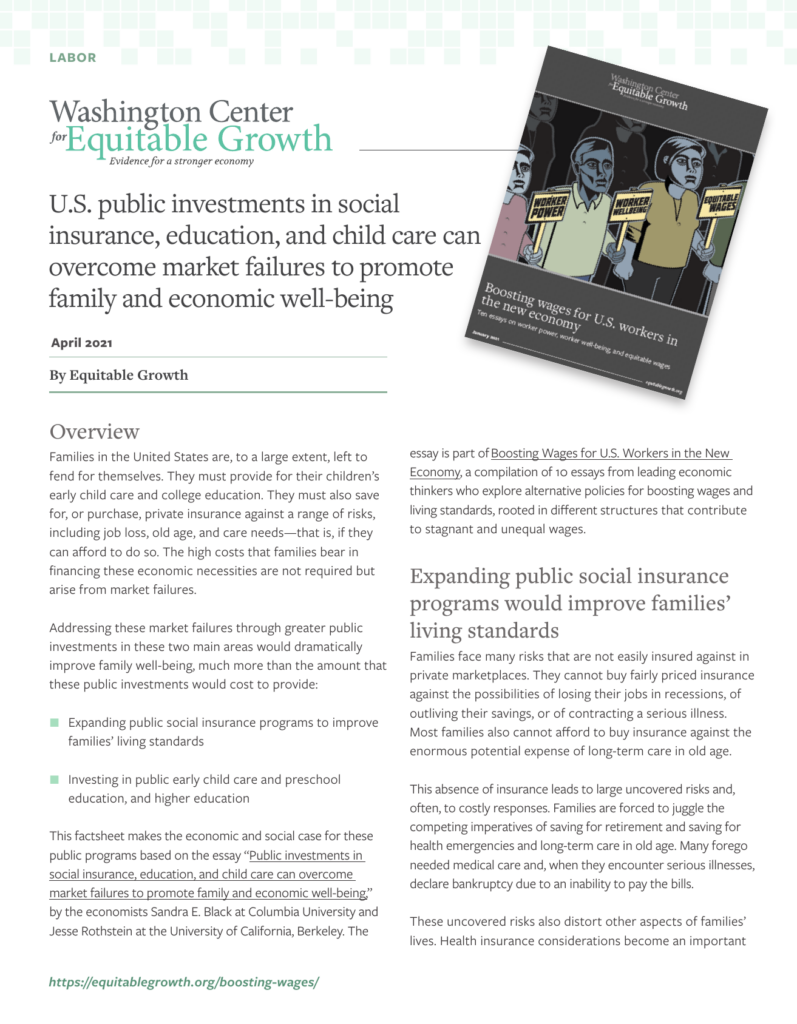
This essay is part of Boosting Wages for U.S. Workers in the New Economy, a compilation of 10 essays from leading economic thinkers who explore alternative policies for boosting wages and living standards, rooted in different structures that contribute to stagnant and unequal wages. The authors in the new book demonstrate that efforts to improve workers’ access to good jobs do not need to be limited to traditional labor policy. Policies relating to macroeconomics, to social services, and to market concentration also have direct relevance to wage levels and inequality, and can be useful tools for addressing them.
To read more about Boosting Wages for U.S. Workers in the New Economy 20 and download the full collection of essays, click here.
Families in the United States are, to a large extent, left to fend for themselves. They must provide for their children’s early child care and college education. They must also save for, or purchase, private insurance against a range of risks, including job loss, old age, and care needs—that is, if they can afford to do so. Economic theory, plenty of evidence, and the long experiences of many families all show that the lack of protection against these risks burdens families, which greatly need social insurance protection in these areas. This is combined with rising costs of healthcare, child care, higher education, and long-term care, and the rise of fissured work that has eroded workplace benefits, leaving families’ economic positions even more precarious. A greater public role would enhance both economic efficiency and family well-being.
U.S. public investments in social insurance, education, and child care can overcome market failures to promote family and economic well-being (PDF)
Download (opens in a new tab)We argue for a larger public role in protecting families through the public provision of care and social insurance. Government needs to play a larger role in insuring against certain types of risks that individuals and families face, including greater Unemployment Insurance protections alongside old age insurance, health insurance, and long-term care insurance. Government also needs to do more to support families in the raising and educating of children during their early childhood years and when they go to college.
The high costs that families bear in financing these economic necessities are not necessary but arise from market failures. Addressing these market failures through greater public investments would be cost effective and boost family well-being. The federal government can provide social insurance protections at a much lower overall cost, and by removing major risks from families’ own balance sheets, enable families to stretch their market earnings further, enhancing their economic security. In effect, the government provision of these social protections would increase the real value of wages, allowing for better and more secure living standards at any given market wage.
In this essay, we first present the evidence for why expanded public social insurance programs would improve families’ living standards and the broader U.S. economy, and then turn to the reasons why increased public support for early childhood care and college education would deliver greater family well-being. While disparate, all of the policy proposals presented in this essay share a unifying feature: They all would dramatically improve family well-being, much more than the amount that these public investments would cost to provide.
The social insurance programs detailed above would remove major risks from families. Other important, fast-growing expenses that families face are child care and education. Substantial new public investments in these areas would not only prepare the next generation of workers and their future families to be more productive members of the U.S. economy and society, but also would reduce the drag on families’ budgets, enabling families to contribute more to our economy and to enjoy higher standards of living. In this section of the essay, we’ll look first at early child care and education, and then at higher education.
Children are very expensive, particularly in their early years. Families must provide round-the-clock care, either purchasing it at high cost on the private market or relying on a family member, who is then unable to work in the market. Moreover, while research has shown large benefits from high-quality early childhood education, this is very expensive, too. Parents must bear these costs, though most of the benefits accrue to the children, and must do so at a time in their lifecycle when they have few resources to draw upon.
The decision whether to purchase early child care and early childhood education, along with the burden of paying for it all, rests on parents today, while it is the children’s futures that are at stake. In theoretical models, families should collateralize their children’s future earnings as security for loans to finance these investments. In these models, parents may invest less in children’s education than the children themselves would, as they may not value the benefits as much.
More importantly, however, the loans needed to support this arrangement do not exist in the real world.15 Even when the government can create a market for them, as it has done for college student loans, borrowers face substantial risks and the loans can be quite burdensome to pay. More direct public financing for early childhood care and education will lead to more investment in childrens’ development and thus more productive workers when the children are grown, while substantially easing families’ budgets in their early years of formation. A better-educated child also benefits the rest of society through reduced reliance on public support, productivity spillovers, and reduced criminal activity.
There is substantial precedent for extensive public involvement in this area. Most obviously, we provide free public education from age 5 onward. But those public investments are heavily tilted toward older children. President Barack Obama’s Council of Economic Advisers estimated (opens in a new tab) that, in 2015, combined annual local, state, and federal expenditure per child was 63 percent higher for those kids between the ages of 6 and 11 than for those between 3 and 5.16 This is despite the fact that evidence increasingly shows that high-quality early child care and childhood education, prior to entering Kindergarten, is a key investment with important implications for children’s long-run outcomes.17
There are a range of existing programs to help parents when children are very young. The Head Start preschool program is one example.18 But these programs are relatively small and tightly targeted to the very poor. The high expenses of early childhood are a burden not just for poor families but also for middle-class families, which are at similar risk of underinvesting in their young children. Another consequence of the high cost of early childhood care and education in private markets is that many families do not use it. This keeps parents, mostly mothers, out of the workforce, reducing family earnings and mothers’ career progression. Other families rely upon low-quality programs that do not adequately prepare children for school.
It is time to recognize that early child care and education is a public good and will be underprovided until it is treated as a public responsibility. We need greatly expanded public provision of child care and early childhood education, with public funding and careful, thoughtful regulation to ensure quality.19
Higher education presents its own set of challenges. Extensive evidence demonstrates that high-quality higher education leads to enormous earnings increases and also delivers spillovers for more than just the students involved: Each young adult who is sent to college makes his or her neighbors and co-workers more productive as well.20 This type of externality, along with the same types of credit market failures discussed above that make it hard for children to borrow against their future earnings, leads to underinvestment by too many young adults and their families.
The United States currently supports higher education in three ways. We directly support public institutions of higher education through direct federal and state allocations; we provide grants to very low-income students; and we support public student loans. Yet all three of these policies are increasingly failing to keep up with changes in our economy.
There are not enough public colleges and universities to accommodate growing demand, even as higher education has become a near requirement for decent adult earnings. Scholarships for low-income students also are not keeping up with rising tuition and offer essentially no help with nontuition costs of higher education. And student loans are subject to abuse by low-quality institutions that take loans on students’ behalf without providing education of commensurate quality.21 This, of course, is risky for students who do not know if their education will pay off in terms of career success. Indeed, much of the growing student loan crisis (opens in a new tab) is concentrated among students who never finished their degrees.22
This is why policymakers need to take public action to reduce the private cost of higher education. This could take many forms, including increased spending on tuition subsidies, such as by expanding the existing Pell Grant program, and investing in a growing public higher education sector, with restrained or eliminated tuition made up through additional investment of tax revenue. The essential goal is to ensure that more affordable, high-quality spots are available for students wanting to pursue higher education, and that the cost burden on families of this pursuit is reduced.
Each of the above proposals—the social insurance programs we discussed first, as well as the early childhood care, preschool, and higher education recommendations we presented second—would remove large costs and risks from families’ budgets. Together, they would allow earnings to go much further.
With these programs in place, families would not need to set aside substantial savings against the possibility of job losses, unexpected medical costs, an unanticipated long retirement, or a child who needs day care or college tuition. They could instead spend their earnings on meeting current consumption needs. Moreover, by removing social insurance benefits from employment relationships, these programs would free up constraints on the U.S. labor market, enabling better worker-job matching, higher female labor force participation, and thus higher productivity and wages.
We recognize that our proposals would require substantial additional federal budgetary commitments. It is important to recognize, however, that these are not new costs. They are merely transfers from families’ budgets to the government’s accounts. Because these types of public social insurance programs are much more efficiently provided at scale than at the individual level, the cost in increased taxes needed to finance them would be less than families are currently paying, allowing for increased consumption even after the higher tax bills are paid.
Moreover, the use of tax financing would enable more progressive funding structures that take account of the enormous increase in economic inequality that U.S. society and the economy have experienced in recent decades. This growing inequality means that even middle-class families increasingly need support to afford their obligations, and it makes sense for policymakers to draw on the extremely wealthy for disproportionate shares of the costs.
—Sandra E. Black is a professor of economic and international and public affairs at Columbia University. Jesse Rothstein is a professor of public policy and economics at the University of California, Berkeley.
1. M.N. Baily, “Some aspects of optimal unemployment insurance,” Journal of Public Economics 10 (3) (1978): 379–402; Raj Chetty, “Moral hazard versus liquidity and optimal unemployment insurance,” Journal of Political Economy 116 (2) (2008): 173–234; Johannes F. Schmieder and Till von Wachter, “The effects of unemployment insurance benefits: New evidence and interpretation,” Annual Review of Economics 8 (2016): 547–581.
2. Camille Landais, Pascal Michaillat, and Emmanuel Saez, “A macroeconomic approach to optimal unemployment insurance: Theory,” American Economic Journal: Economic Policy 10 (2) (2018).
3. Another possible form of insurance against job loss would be through wage insurance. Evidence suggests that individuals who lose their jobs often suffer wage losses in their next jobs. See Steven J. Davis & Till Von Wachter, 2011. “Recessions and the Costs of Job Loss,” Brookings Papers on Economic Activity, Economic Studies Program, The Brookings Institution, vol. 43(2 (Fall)), available at https://www.brookings.edu/bpea-articles/recessions-and-the-costs-of-job-loss/ (opens in a new tab). Wage insurance would offset some of these losses. Wage insurance was included in President Barack Obama’s 2017 Budget Proposal; see Suzanne Simonetta, “UI Reform Proposals in the Fiscal Year 2017 Obama Budget Request,” in Unemployment Insurance Reform: Fixing a Broken System, Stephen A. Wandner, editor. Kalamazoo, MI: W.E. Upjohn Institute for Employment Research, 2018. Available at https://research.upjohn.org/cgi/viewcontent.cgi?filename=1&article=1268&context=up_press&type=additional (opens in a new tab).
4. Adriana Kugler, “Strengthening Reemployment in the Unemployment Insurance System.” Discussion Paper (The Hamilton Project, 2015), available at https://www.hamiltonproject.org/assets/legacy/files/downloads_and_links/strengthening_reemployment_in_unemployment_insurance_syste_kugler.pdf (opens in a new tab).
5. Annamaria Lusardi, “On the importance of the precautionary saving motive,” The American Economic Review 88 (2) (1998): 449–453; Andrew B. Abel, “Precautionary saving and accidental bequests,” The American Economic Review 75 (4) (1985): 777–791; R. Glenn Hubbard and Kenneth L. Judd, “Social security and individual welfare: Precautionary saving, borrowing constraints, and the payroll tax,” The American Economic Review (1987): 630–646; Laurence J. Kotlikoff, John Shoven, and Avia Spivak. “The effect of annuity insurance on savings and inequality,” Journal of Labor Economics 4 (3) (1986): S183–S207; Olivia S. Mitchell and others, “New evidence on the money’s worth of individual annuities,” American Economic Review 89 (5) (1999): 1299–1318.
6. Jeffrey R. Brown and others, “Why don’t people insure late-life consumption? A framing explanation of the under-annuitization puzzle,” American Economic Review 98 (2) (2008): 304–09; Amy Finkelstein and James Poterba, “Adverse selection in insurance markets: Policyholder evidence from the UK annuity market,” Journal of Political Economy 112 (1) (2004): 183–208.
7. Lee M. Lockwood, “Bequest motives and the annuity puzzle,” Review of Economic Dynamics 15 (2) (2012): 226–243; Mitchell and others, “New evidence on the money’s worth of individual annuities.”
8. Monique Morrissey and Natalie Sbadish, “Retirement Inequality Chartbook: How the 401(k) revolution created a few big winners and many losers” (Washington: Economic Policy Institute, 2013), available at http://www.epi.org/files/2013/epi-retirement-inequality-chartbook.pdf (opens in a new tab).
9. Katherine Swartz, “Reinsuring risk to increase access to health insurance,” American Economic Review 93 (2) (2003): 283–287; David U. Himmelstein and others, “Illness And Injury As Contributors To Bankruptcy: Even universal coverage could leave many Americans vulnerable to bankruptcy unless such coverage was more comprehensive than many current policies,” Health Affairs 24 (Suppl1) (2005): W5–63; David U. Himmelstein and others, “Medical bankruptcy in the United States, 2007: Results of a national study,” The American Journal of Medicine 122 (8) (2009): 741–746; Elizabeth Warren, Teresa A. Sullivan, and Melissa B. Jacoby, “Medical problems and bankruptcy filings,” Norton’s Bankruptcy Adviser (2000).
10. Amy Finkelstein, Neale Mahoney, and Matthew J. Notowidigdo, “What does (formal) health insurance do, and for whom?” Annual Review of Economics 10 (2018): 261–286; David W. Brown, Amanda E. Kowalski, and Ithai Z. Lurie, “Medicaid as an investment in children: What is the long-term impact on tax receipts?” Working Paper No. w20835 (National Bureau of Economic Research, 2015).
11. Brigitte C. Madrian, “Employment-Based Health Insurance and Job Mobility: Is There Evidence of Job-Lock?” The Quarterly Journal of Economics 109 (1) (1994): 27–54, available at www.jstor.org/stable/2118427 (opens in a new tab).
12. Jeffrey R. Brown and Amy Finkelstein, “Why is the market for long-term care insurance so small?” Journal of Public Economics 91 (10) (2007): 1967–1991; Jeffrey R. Brown and Amy Finkelstein, “The private market for long‐term care insurance in the United States: a review of the evidence,” Journal of Risk and Insurance 76 (1) (2009): 5–29; Brown and others, “Why don’t people insure late-life consumption? A framing explanation of the under-annuitization puzzle.”
13. Jeffrey R. Brown and Amy Finkelstein. “The interaction of public and private insurance: Medicaid and the long-term care insurance market,” American Economic Review 98 (3) (2008): 1083–1102; Jeffrey R. Brown and Amy Finkelstein, “Insuring long-term care in the United States,” Journal of Economic Perspectives 25 (4) (2011): 119–42.
14. Marc Cohen, Judith Feder, and Melissa Favreault, “A new public-private partnership: Catastrophic public and front-end private LTC insurance” (Boston and Washington: LeadingAge LTSS Center at UMass Boston and The Urban Institute, 2018), available at https://bipartisanpolicy.org/wp-content/uploads/2018/01/Public-Catastrophic-Insurance-Paper-for-Bipartisan-Policy-Center-1-25-2018.pdf (opens in a new tab). There was an attempt to do this via the Affordable Care Act, but the program was underresourced and was eventually abandoned. The problem has not gone away, and welfare would be improved if we did this right.
15. Elizabeth M. Caucutt and Lance Lochner, “Early and late human capital investments, borrowing constraints, and the family,” Journal of Political Economy 128 (3) (2020): 1065–1147; Meta Brown, John Karl Scholz, and Ananth Seshadri, “A new test of borrowing constraints for education,” The Review of Economic Studies 79 (2) (2012): 511–538.
16. Council of Economic Advisers, “The disconnect between resources and needs when investing in children” (2016), available at https://obamawhitehouse.archives.gov/sites/default/files/page/files/201612_issue_brief_cea_resources_needs_investing_in_children.pdf (opens in a new tab).
17. Sneha Elango and others, “Early childhood education.” In Robert A. Moffitt, ed., Economics of Means-Tested Transfer Programs in the United States, volume 2 (Chicago: University of Chicago Press, 2015) pp. 235–297; David Deming, “Early childhood intervention and life-cycle skill development: Evidence from Head Start,” American Economic Journal: Applied Economics 1 (3) (2009): 111–34.
18. Deming, “Early childhood intervention and life-cycle skill development: Evidence from Head Start.”
19. Council of Economic Advisers, “Economic Report of the President” (2016), chapter 4.
20. Enrico Moretti, “Estimating the social return to higher education: evidence from longitudinal and repeated cross-sectional data,” Journal of Econometrics 121 (1-2) (2004): 175–212.
21. David J. Deming, Claudia Goldin, and Lawrence F. Katz, “The for-profit postsecondary school sector: Nimble critters or agile predators?” Journal of Economic Perspectives 26 (1) (2012): 139–64.
22. Council of Economic Advisers, “Investing in Higher Education: Benefits, Challenges, and the State of Student Debt” (2016), available at https://obamawhitehouse.archives.gov/sites/default/files/page/files/20160718_cea_student_debt.pdf (opens in a new tab).
Reports NOV 23, 2026
By: Jacob Leibenluft, Gene Sperling
Essays NOV 20, 2026
By: Chris Clayton, Korin Davis
Essays OCT 30, 2026
By: Christopher Bangert-Drowns
Get updates on our latest research, event announcements, and policy insights delivered straight to your inbox. Stay connected with the leading voices on equitable growth.

