

Five policy planks to prepare U.S. workers for dislocation caused by artificial intelligence
Reports NOV 23, 2026
By: Jacob Leibenluft, Gene Sperling
OCT 2, 2025
By: Susan Lambert and Julia Henly
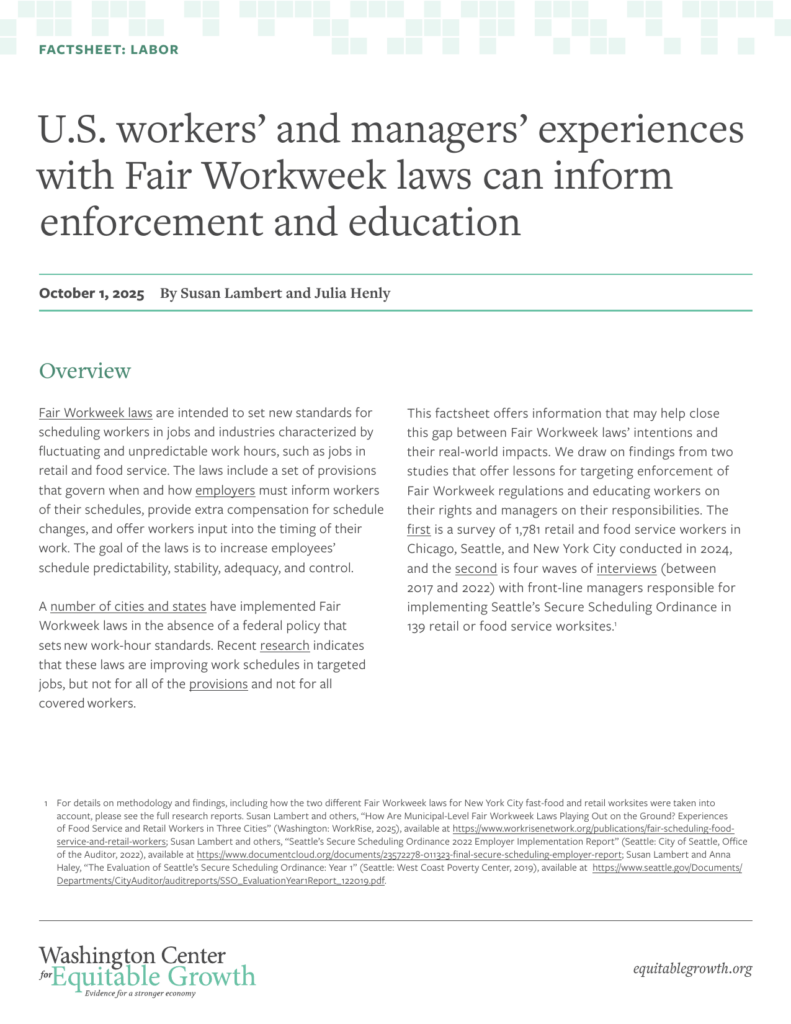
Fair Workweek laws are intended to set new standards for scheduling workers in jobs and industries characterized by fluctuating and unpredictable work hours, such as jobs in retail and food service. The laws include a set of provisions that govern when and how employers must inform workers of their schedules, provide extra compensation for schedule changes, and offer workers input into the timing of their work. The goal of the laws is to increase employees’ schedule predictability, stability, adequacy, and control.
A number of cities and states (opens in a new tab) have implemented Fair Workweek laws in the absence of a federal policy that sets new work-hour standards. Recent research (opens in a new tab) indicates that these laws are improving work schedules in targeted jobs, but not for all of the provisions (opens in a new tab) and not for all covered workers.
U.S. workers and managers experiences with Fair Workweek laws can inform enforcement and education (PDF)
Download (opens in a new tab)This factsheet offers information that may help close this gap between Fair Workweek laws’ intentions and their real-world impacts. We draw on findings from two studies that offer lessons for targeting enforcement of Fair Workweek regulations and educating workers on their rights and managers on their responsibilities. The first (opens in a new tab) is a survey of 1,781 retail and food service workers in Chicago, Seattle, and New York City conducted in 2024, and the second (opens in a new tab) is four waves of interviews (opens in a new tab) (between 2017 and 2022) with front-line managers responsible for implementing Seattle’s Secure Scheduling Ordinance in 139 retail or food service worksites.1
1. For details on methodology and findings, including how the two different Fair Workweek laws for New York City fast-food and retail worksites were taken into account, please see the full research reports. SusanLambert and others,“How Are Municipal-Level Fair Workweek Laws Playing Out on the Ground? Experiences of Food Service and Retail Workers in Three Cities” (Washington: WorkRise, 2025), available at https://www.workrisenetwork.org/publications/fair-scheduling-food-service-and-retail-workers (opens in a new tab); SusanLambert and others, “Seattle’s Secure Scheduling Ordinance 2022 Employer Implementation Report” (Seattle: City of Seattle, Office of the Auditor, 2022), available at https://www.documentcloud.org/documents/23572278-011323-final-secure-scheduling-employer-report (opens in a new tab); Susan Lambert and Anna Haley, “The Evaluation of Seattle’s Secure Scheduling Ordinance: Year 1” (Seattle: West Coast Poverty Center, 2019), available at https://www.seattle.gov/Documents/Departments/CityAuditor/auditreports/SSO_EvaluationYear1Report_122019.pdf (opens in a new tab).
Reports NOV 23, 2026
By: Jacob Leibenluft, Gene Sperling
Essays NOV 20, 2026
By: Chris Clayton, Korin Davis
Essays OCT 30, 2026
By: Christopher Bangert-Drowns
Get updates on our latest research, event announcements, and policy insights delivered straight to your inbox. Stay connected with the leading voices on equitable growth.

